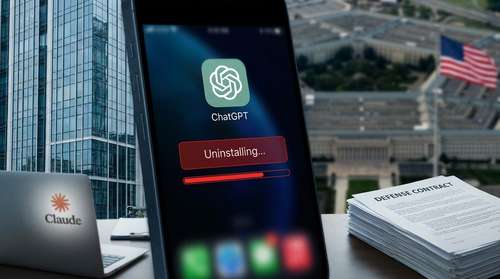
New app analytics data released late Sunday paints a grim picture for the world's most recognizable artificial intelligence platform. A massive ChatGPT user exodus is officially underway, with domestic uninstalls skyrocketing by 295% over the weekend. This unprecedented flight of everyday consumers comes directly on the heels of the finalized OpenAI military deal, a highly controversial agreement that grants the U.S. Department of War (formerly the Department of Defense) full access to deploy the company's frontier models across classified military networks.
The sudden shift in corporate policy has fundamentally fractured public trust. Millions of privacy-conscious users, enterprise clients, and tech professionals are abandoning the platform. They are actively seeking refuge with competitors who refuse to cross ethical red lines regarding domestic surveillance and autonomous warfare.
The Sam Altman Defense Controversy Reaches a Boiling Point
The corporate crisis escalating over the last 48 hours is rooted in a profound shift in how the leading AI lab operates. The Sam Altman defense controversy centers on the CEO's decision to aggressively pursue military partnerships immediately after the Pentagon sidelined Anthropic, a primary competitor.
Internal communications that surfaced recently reveal Altman acknowledging the partnership rollout was "rushed" and appeared "opportunistic and sloppy" to the public. Despite desperate efforts at damage control—including revised contract language published to assure users that the AI system will not intentionally target U.S. persons for domestic surveillance—the damage to the brand's reputation appears deeply entrenched.
Users are particularly alarmed by the removal of legacy safety guardrails. Previous iterations of OpenAI's usage policies strictly prohibited military and warfare applications. The newly revised terms now allow for broad deployment within the military-industrial complex, sparking a widespread AI ethics user revolt among both consumers and internal employees.
Fears of Militarized Artificial Intelligence
Public anxiety isn't merely theoretical paranoia. Reports indicate that AI-enabled systems are already being actively utilized in operational planning and targeting decisions by U.S. military forces, including highly publicized operations involving Iran and Venezuela. For everyday consumers, the idea that the exact same neural network drafting their corporate emails or helping kids with homework is simultaneously processing classified combat logistics represents a bridge too far. The ethical implications of an AI system learning from both civilian inputs and classified military operations have triggered widespread alarm among privacy advocates.
Anthropic vs OpenAI Military Showdown
The starkest contrast driving this weekend's massive wave of uninstalls is the ongoing Anthropic vs OpenAI military philosophical divide. While OpenAI embraced the Pentagon's controversial requirements, rival firm Anthropic firmly rejected them, opting to protect user privacy over government contracts.
Secretary of War Pete Hegseth recently issued a strict mandate requiring contracted AI firms to permit "any lawful use" of their models, effectively demanding the removal of hardcoded restrictions against mass surveillance and autonomous weapons development. Anthropic, the developer behind the highly capable Claude chatbot, flatly refused these terms. Consequently, the government designated Anthropic a "Supply-Chain Risk to National Security," ordering all federal agencies to immediately cease using their technology.
Rather than stand in solidarity with industry peers over ethical boundaries, OpenAI stepped in to fill the vacuum. This opportunistic maneuver secured a highly lucrative position as the premier AI supplier to the military-industrial complex, but it severely alienated a massive segment of their core consumer base. The dichotomy between a company willing to walk away from millions to protect civil liberties versus one rushing to sign the contract has become the central narrative of the tech industry.
The Record-Breaking ChatGPT Uninstall Spike
The consumer response has been swift, brutal, and measurable. Analytics firm Sensor Tower confirmed the massive ChatGPT uninstall spike, mapping a jaw-dropping 295% increase in domestic app removals over recent weeks. Social media platforms and tech forums like Reddit are flooded with tutorials on how to permanently delete OpenAI accounts, citing a severe decline in model quality and an absolute loss of trust.
While OpenAI bleeds active mobile users, Anthropic is experiencing an unprecedented renaissance. Following the news of Anthropic's principled stand against the Department of War, the Claude application saw an explosive influx of new accounts. Daily installs surged by 37% initially, followed by a 51% jump the next day, rapidly propelling the app to the absolute number one spot on the Apple App Store charts.
This massive user migration underscores a fundamental shift in consumer priorities. Raw performance benchmarks and feature sets are no longer the sole drivers of AI adoption. Ethical governance, data privacy, and corporate transparency have become paramount deciding factors for both enterprise clients and individual users.
Redefining AI Defense Contracts 2026
The fallout from this weekend's finalized data release sets a chaotic and highly scrutinized precedent for the landscape of AI defense contracts 2026 and beyond. The technology sector is watching closely as the massive financial rewards of military partnerships clash violently with consumer market share and public perception.
OpenAI currently maintains its defensive posture, arguing that the U.S. military absolutely needs strong AI models to counter growing threats from potential global adversaries. The company insists their multi-layered approach to safety, which allegedly keeps engineers "in the loop," will prevent catastrophic misuse. However, as the 295% surge in uninstalls clearly demonstrates, the broader public remains unconvinced by these corporate assurances.
As regulatory scrutiny intensifies and the public debate over mass surveillance reignites, artificial intelligence companies face a permanent fork in the road. They can either serve the Pentagon's classified networks or maintain the implicit trust of the global consumer market. Based on the unprecedented exodus unfolding this week, it appears increasingly impossible to successfully do both.