
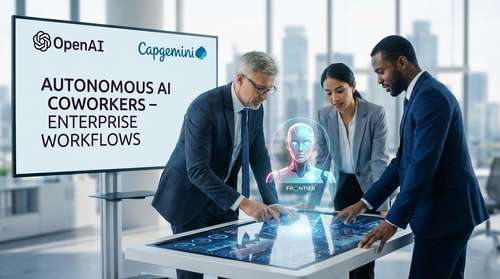
OpenAI has officially launched Frontier, a groundbreaking enterprise platform designed to deploy and manage autonomous "AI coworkers" capable of executing complex business workflows independently. In a major strategic move announced on February 23, 2026, the AI giant revealed the "Frontier Alliance," a founding partnership with consulting powerhouse Capgemini and other industry leaders. This initiative signals a definitive shift from the era of passive generative chatbots to a new age of agentic AI, where digital agents possess the reasoning capabilities to plan, act, and collaborate alongside human employees to drive enterprise transformation.
The Dawn of the AI Coworker: Inside the Frontier Platform
The Frontier platform represents a significant architectural leap for OpenAI, moving beyond simple text generation to create what the company calls "shared business context." Unlike previous models that operated in isolation, Frontier is engineered to serve as a unified "semantic layer" that sits on top of an enterprise's existing infrastructure.
This semantic layer connects disparate data silos—from CRM systems like Salesforce to ERP solutions like SAP—allowing AI agents to understand the full context of a business operation. For the first time, these AI agents are given "employee-like identities" with specific, role-based permissions. This means an AI agent in the finance department can autonomously draft invoices, verify them against contract terms in a separate database, and email them to clients, all while adhering to strict governance protocols.
Key features of the Frontier platform include:
- Autonomous Execution: Agents can reason through multi-step problems, plan a course of action, and use software tools to complete tasks without constant human prompting.
- Persistent Memory: Unlike chatbots that reset after every session, Frontier agents build "institutional memory," learning from past interactions to improve efficiency over time.
- Enterprise-Grade Governance: A robust observability system provides a full audit log of every action taken by an agent, ensuring compliance and security—a critical requirement for Fortune 500 adoption.
Capgemini and the 'Frontier Alliance': Bridging the Implementation Gap
While OpenAI provides the engine, the "Frontier Alliance" is designed to build the car. The partnership with Capgemini, along with Accenture, BCG, and McKinsey, addresses the single biggest hurdle in enterprise AI: implementation. OpenAI Chief Revenue Officer Denise Dresser emphasized that enterprises "don't just need caution; they actually need a path."
As a founding partner, Capgemini is deploying its deep technical expertise to help clients integrate Frontier into their legacy systems. Fernando Alvarez, Capgemini's Chief Strategy and Development Officer, was candid about the necessity of this ecosystem approach in a statement following the launch.
"If it was a walk in the park, OpenAI would have done it by themselves," Alvarez noted, highlighting the complexity of enterprise integration. "It's recognition that it takes a village."
Capgemini has already begun rolling out its "Agentic Gallery," a portfolio of over 100 bespoke AI agent solutions tailored for specific industries. These range from supply chain agents that can autonomously re-route shipments during weather disruptions to customer service agents that can resolve complex claims end-to-end.
Strategy Meets Execution
The partnership plays to Capgemini's strengths in both strategy and technical execution. While firms like BCG and McKinsey will focus on the organizational change management required to welcome AI coworkers, Capgemini and Accenture are tasked with the heavy lifting of wiring these agents into the messy reality of corporate IT stacks.
The Future of Work: Agentic AI in 2026
The launch of Frontier aligns with broader market trends predicting 2026 as the "Year of Agentic AI." Businesses are increasingly looking for ROI that goes beyond drafting emails. They want technology that does the work. OpenAI COO Brad Lightcap stated that the partnership aims to "close the gap between what frontier AI can do and what businesses can actually deploy."
However, this shift also brings new challenges regarding trust and control. Capgemini CEO Aiman Ezzat recently warned business leaders against "racing too far ahead" without proper governance, advocating for a balance he calls "human-AI chemistry." Ezzat stresses that successful adoption isn't just about the technology, but about defining clear roles where humans retain oversight of their autonomous digital counterparts.
As companies begin to onboard these new AI coworkers, the workplace of 2026 is set to undergo a radical transformation. The question is no longer if AI can be useful, but how quickly organizations can restructure themselves to manage a hybrid workforce of humans and machines working in tandem.