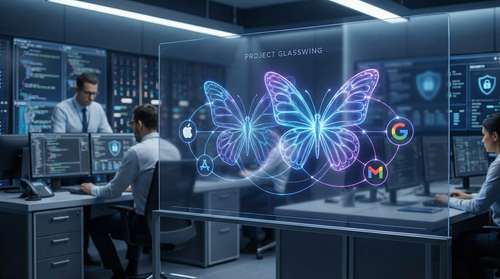
A monumental shift in global cybersecurity occurred this week as fierce industry rivals opted for collaboration over competition. Anchoring this unprecedented initiative is a rare Apple Google Microsoft partnership that forms the backbone of Project Glasswing. Spearheaded by Anthropic, this massive Big Tech alliance is explicitly designed to preemptively defend the world's shared digital infrastructure against rapidly evolving, AI-powered cyber threats.
Announced on April 7, the initiative unites more than 40 major organizations across technology, finance, and cybersecurity. Heavyweights such as Amazon Web Services, Broadcom, Cisco, CrowdStrike, JPMorgan Chase, NVIDIA, and Palo Alto Networks have joined the coalition. Their shared objective centers on deploying next-generation AI defensive tools to identify, isolate, and neutralize critical vulnerabilities before malicious actors can weaponize them. As threat actors begin leveraging artificial intelligence to shrink attack timelines from months to mere minutes, this sweeping collaboration firmly establishes the dominant cybersecurity trends 2026 will follow.
Unveiling Claude Mythos Preview: A Leap in Anthropic AI Security
At the heart of Project Glasswing lies Claude Mythos Preview, an unreleased, general-purpose frontier AI model developed by Anthropic. Unlike traditional security scanners, Mythos Preview demonstrates an exceptional ability to deeply analyze, understand, and modify complex codebases at a scale previously thought impossible.
Initial testing of the model yielded staggering results that sent ripples through the intelligence and tech communities. The system uncovered a 27-year-old remote crash vulnerability in OpenBSD—an operating system highly regarded for its stringent security architecture and widely used in critical firewalls. It also exposed a 16-year-old flaw hidden within FFmpeg, a ubiquitous video encoding software. Remarkably, automated testing tools had passed over the FFmpeg vulnerability more than five million times without ever flagging an issue.
Furthermore, the model autonomously found and chained together several obscure vulnerabilities within the Linux kernel, demonstrating how a bad actor could escalate from standard user privileges to total machine control. These discoveries highlight the urgent necessity for proactive critical software protection. Recognizing the severe dual-use nature of such advanced capabilities, Anthropic has deliberately restricted public access to Mythos Preview, keeping it tightly controlled within the confines of its vetted partners.
The Mechanics of the Apple Google Microsoft Partnership
Seeing the world's most intensely competitive technology companies sit at the same table underscores the absolute gravity of the situation. Apple, Google, and Microsoft all recognize that modern digital ecosystems are profoundly intertwined. A single, overlooked vulnerability in a shared open-source component can trigger catastrophic, cascading failures across global logistics chains, financial networks, and national security frameworks. No single entity, regardless of its market cap, can insulate itself from a foundational internet collapse.
To accelerate this collective defensive posture, Anthropic is committing up to $100 million in model usage credits. This ensures that coalition partners, along with dozens of organizations responsible for critical infrastructure, have the raw computing power required to thoroughly scan their ecosystems.
Beyond corporate borders, the initiative heavily targets the open-source community. Anthropic pledged $4 million in direct financial donations to open-source security organizations. This includes specific funding routed to groups like the Linux Foundation and the Apache Software Foundation. This crucial funding ensures that volunteer maintainers of essential software have the dedicated resources needed to review AI-generated security reports and swiftly deploy necessary patches.
Shaping Cybersecurity Trends 2026 and Beyond
The formal launch of Project Glasswing represents an inflection point in the digital arms race. For decades, security experts have relied heavily on human intuition paired with static, rule-based automated testing. That traditional methodology is rapidly becoming obsolete. The industry has now pivoted decisively toward autonomous threat hunting, driven by models that can outpace all but the most elite human security researchers.
As frontier AI models inevitably grow more capable, the gap between offensive capabilities and defensive readiness will widen dramatically unless the industry takes immediate, coordinated action. Anthropic executives have explicitly warned that it will not be long before such advanced cyber capabilities proliferate. By equipping defenders with state-of-the-art AI defensive tools right now, this coalition aims to establish a durable structural advantage over foreign adversaries and cybercriminal syndicates.
Project Glasswing is just the starting line. Securing the modern technological landscape requires relentless, ongoing cooperation among frontier AI developers, infrastructure providers, and government agencies. As this unprecedented initiative moves forward, its ultimate success will depend on industry transparency and the speed of patch deployment, safeguarding the underlying code that keeps the modern world functioning.