
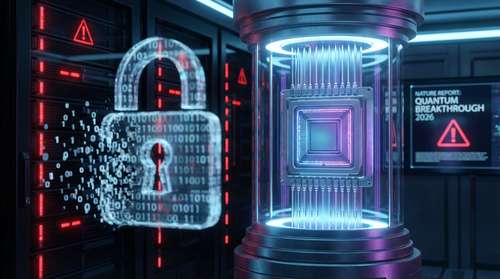
For decades, the threat of a machine powerful enough to crack the mathematical codes underpinning the internet was treated as a distant, theoretical problem. Not anymore. A landmark Nature quantum report published this week has sent a shockwave through the tech industry, revealing that the timeline for an encryption-busting machine has drastically accelerated. Two independent research teams have proved that quantum hardware requires a fraction of the processing power previously assumed to break current cryptographic standards. This quantum computing breakthrough 2026 creates a massive, immediate cybersecurity risk for financial institutions, governments, and everyday internet users.
The 10,000-Qubit Reality
The prevailing consensus in the scientific community was that cracking RSA-2048—the industry standard protecting digital certificates, banking systems, and secure communications—would require millions of physical qubits. Because these microscopic processing units are notoriously unstable and prone to environmental noise, experts assumed we had decades to build machines large enough to handle necessary error correction. The recent findings fundamentally dismantle that timeline.
Independent studies released in early April, including a white paper from Google and a preprint from Caltech-affiliated startup Oratomic, demonstrated that a neutral-atom system needs as few as 10,000 to 26,000 qubits to execute Shor's algorithm. Peter Shor's 1994 mathematical breakthrough proved that a quantum machine could factor large prime numbers exponentially faster than a classical supercomputer—the exact mathematical hurdle that keeps RSA encryption secure.
With a system of 26,000 qubits, a machine could dismantle standard RSA encryption in a mere seven months. This devastating encryption vulnerability means the theoretical timeline for a fault-tolerant quantum machine has moved from the 2040s to potentially before the end of this decade.
The "Harvest Now, Decrypt Later" Threat
Why does a machine that might exist in 2029 matter today? The answer lies in an adversarial strategy known as "harvest now, decrypt later". Nation-state actors and sophisticated cyber-syndicates are actively intercepting and storing vast troves of encrypted data traversing global networks. While they cannot read the files today, they are hoarding foreign exchange records, intelligence communications, and corporate intellectual property.
As soon as an attacker gains access to a functional quantum computer, every gigabyte of that stolen data becomes an open book. The cybersecurity risk is retroactive. If your organization relies heavily on conventional public-key cryptography to secure data with a long shelf life, your sensitive information is already fundamentally compromised. The dangerous lag between these rapid hardware advancements and the widespread deployment of new defense mechanisms is creating a critical window of vulnerability.
Accelerating Post-Quantum Cryptography
The only viable defense against this looming computational threat is a total migration to post-quantum cryptography. These advanced algorithms are specifically designed to withstand the mathematical onslaught of both classical and quantum attacks. While global guidelines originally targeted 2035 for a full transition, this new reality demands an immediate, aggressive shift across all sectors.
Bridging the Defense Gap
Organizations can no longer treat quantum-resistant security as a future roadmap item. It must be treated as an active deployment priority. The National Institute of Standards and Technology (NIST) has worked extensively to finalize primary standards, giving developers the tools they need to begin integrating these resilient algorithms into existing network infrastructures. However, cryptographic agility—the ability to swap out vulnerable algorithms for secure ones without tearing down entire IT systems—remains a massive engineering hurdle for older institutional networks.
Navigating the Future of Cybersecurity 2026
We are standing at a pivotal crossroads in digital history. The future of cybersecurity 2026 will be entirely defined by how quickly governments and private sectors can adopt post-quantum frameworks. Enterprises must immediately audit their cryptographic footprints, identifying exactly where legacy algorithms like RSA and Elliptic Curve Cryptography are utilized in their technology stacks.
The era of classical encryption is entering its twilight. Waiting for hardware developers to officially announce a fully realized, encryption-breaking machine is a recipe for catastrophic data loss. The blueprint for tomorrow's digital defense is clear, and the transition must begin today to secure the foundation of our global digital economy.