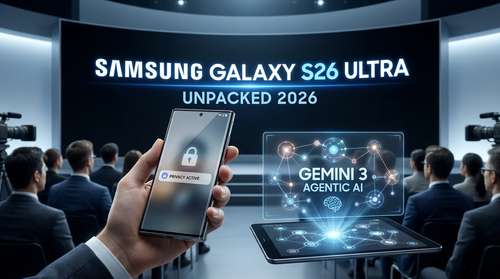
In a defining moment for the post-smartphone era, Samsung has officially unveiled the Galaxy S26 series at its Unpacked 2026 event in San Francisco, introducing a lineup that fundamentally changes how we interact with mobile technology. Leading the charge is the Samsung Galaxy S26 Ultra, a device that doesn't just iterate on specs but introduces two industry-first technologies: a hardware-based Mobile Privacy Display and the fully autonomous Gemini 3 agentic AI. With the global release set for March 11 and pre-orders opening today, Samsung has thrown down a massive gauntlet to Apple's iPhone 17, positioning the S26 not merely as a phone, but as a secure, intelligent command center for daily life.
The World's First 'Privacy Display': Security Woven Into Pixels
The most talked-about feature of the Galaxy S26 Ultra is undoubtedly its revolutionary Mobile Privacy Display. Unlike the clumsy, adhesive screen protectors of the past, this technology is engineered directly into the OLED panel itself. By manipulating light dispersal at a pixel level using a new controllable 'black matrix' layer, the S26 Ultra can physically restrict viewing angles on demand.
During the keynote demonstration, executives showed how a simple double-press of the side button instantly engages 'Private Mode.' To the user looking head-on, the 6.9-inch QHD+ screen remains crystal clear and vibrant. However, to anyone sitting next to you on a flight or standing behind you in a coffee shop, the screen appears completely black. This hardware-level solution addresses a growing concern in our always-connected world: visual hacking. Whether you are reviewing sensitive work documents or checking banking details in public, the S26 Ultra ensures your data remains for your eyes only.
Snapdragon 8 Elite Gen 5: The Engine of Agentic AI
Powering this new privacy-centric experience is the Snapdragon 8 Elite Gen 5 chipset. Qualcomm's latest 3nm marvel is a beast, boasting a 19% jump in CPU speed and a staggering 39% increase in NPU performance compared to last year's Gen 4. This neural processing power is critical because the Galaxy S26 isn't just running apps; it's running agents.
Gaming and Efficiency
Beyond AI, the Snapdragon 8 Elite Gen 5 delivers what Samsung calls "console-level" ray tracing, claiming a 17% improvement in lighting physics for mobile gaming. Despite this raw power, efficiency has been improved, with the 5,000mAh battery now optimized to last roughly 2 hours longer than the S25 Ultra under heavy mixed use. For power users, this means the S26 Ultra can finally handle a full day of heavy AI processing and 5G multitasking without reaching for a charger by 6 PM.
Gemini 3 and the Era of 'Agentic' Action
If the display protects your privacy, Gemini 3 agentic AI liberates your time. This isn't just a chatbot; it's an agent capable of multi-step reasoning and autonomous action. The integration runs deep into One UI 8.5, transforming the familiar 'Circle to Search' into 'Circle to Do.'
For example, in a live demo, a presenter circled a concert poster in a YouTube video. Instead of just showing search results, the Gemini 3 agent recognized the context, checked the user's calendar for availability, found tickets on a partner site, and presented a "Book Now" confirmation overlay—all without the user ever leaving the video app. This shift from information retrieval to autonomous task execution is what Google calls the "Intelligence System" era.
Thought Signatures & Reliability
To address reliability concerns, Samsung introduced "Thought Signatures"—a transparency feature where you can tap to see the exact logic chain the AI used to reach its conclusion. If the agent books a flight, you can verify why it chose that specific itinerary (e.g., "Cheapest direct option avoiding layovers < 1 hour"). This level of transparency is crucial as we hand over more complex tasks to our devices.
Cameras, Pricing, and Outlook
While AI and privacy stole the show, the camera system received significant refinements. The S26 Ultra retains the 200MP main sensor but pairs it with a new 50MP 5x telephoto lens that uses the Snapdragon chip's ISP to deliver lossless optical-quality zoom at 10x. Nightography has also been overhauled, with AI denoising now happening in real-time on the viewfinder rather than just in post-processing.
Pricing for the Galaxy S26 series sees a slight bump, reflecting the new display technology. The Galaxy S26 starts at $899, the S26 Plus at $1,099, and the Galaxy S26 Ultra at $1,299.
With the Galaxy S26 Ultra, Samsung has successfully pivoted the conversation from "specs" to "utility." By solving a real-world problem with the Privacy Display and delivering the first truly useful implementation of agentic AI, they have set a high bar for the rest of 2026. As the best AI smartphone of 2026 so far, the S26 Ultra isn't just a challenge to the iPhone 17—it's a glimpse into a future where our phones act less like screens and more like secure, intelligent partners.