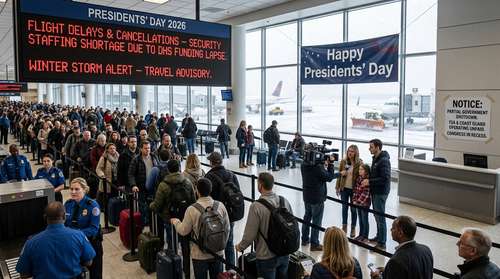
WASHINGTON, D.C. – The United States Department of Homeland Security (DHS) entered its third day of a partial shutdown on Monday, coinciding with one of the busiest travel days of the year. As millions of Americans navigate Presidents Day travel disruptions, the political impasse in Washington has left approximately 60,000 Transportation Security Administration (TSA) officers and thousands of Coast Guard personnel working without pay. The funding lapse, which officially began at 12:01 a.m. on Valentine's Day, was triggered after Congress failed to reach an agreement on the DHS fiscal year budget, resulting in a stalemate that shows no signs of immediate resolution.
TSA and Coast Guard unpaid as 'One Big Beautiful Bill' Protects ICE
Unlike previous government shutdowns that brought all agency operations to a halt, this DHS shutdown 2026 is unique in its selective impact. While TSA screeners, Federal Emergency Management Agency (FEMA) staff, and U.S. Coast Guard members face missed paychecks, agents within Immigration and Customs Enforcement (ICE) and Customs and Border Protection (CBP) remain fully funded. This anomaly is due to the controversial "One Big Beautiful Bill" passed in late 2025, which secured multi-year appropriations for border enforcement agencies.
"It creates a morale crisis we haven't seen before," said a union representative for TSA workers at O'Hare International Airport, who spoke on condition of anonymity. "Our officers are screening passengers for the holiday rush while knowing their counterparts at the border are getting paid. It’s a recipe for disaster."
The Minneapolis Flashpoint: Why Congress Stalled
The Congress budget standoff is rooted in a fierce debate over federal law enforcement tactics. Senate Democrats, led by Minority Leader Chuck Schumer, blocked the funding measure late Friday, demanding new statutory restrictions on ICE and CBP operations. The demands follow the fatal shootings of two U.S. citizens, Alex Pretti and Renee Good, by federal agents in Minneapolis last month—an event that has sparked nationwide protests and calls for reform.
Democrats are insisting on provisions that would ban agents from wearing face masks during domestic operations and require judicial warrants for home entries. "We cannot sign a blank check for an agency that operates in the shadows," Schumer stated before the Senate adjourned. Conversely, the Trump administration and House Speaker Mike Johnson have refused to accept what they term "poison pill" policy riders, arguing that the restrictions would hamstring national security efforts.
Presidents Day Travel Nightmares: Storms and Sickouts
The timing could not be worse for travelers. The Presidents Day travel disruptions are being compounded by a perfect storm of operational failures. As TSA lines lengthened at major hubs like JFK and Atlanta due to early reports of "sickouts"—where unpaid officers call in sick—a massive winter storm system is tracking across the Northeast, grounding hundreds of flights.
Spirit Airlines Meltdown Adds to Chaos
Adding to the misery, low-cost carrier Spirit Airlines is in the midst of an operational collapse, with over 150 flight cancellations reported on Monday morning alone. Combined with the TSA staffing shortages, airport terminals have become holding cells for frustrated passengers. "I've been in line for security for two hours," tweeted a traveler from Miami International Airport. "The agents look exhausted, and the line isn't moving."
Congress Leaves Town as Funding Lapses
Perhaps the most contentious aspect of the current government funding status is the absence of lawmakers. Despite the active shutdown, both the House and Senate have departed Washington for a scheduled 10-day recess. Leadership has indicated that members could be recalled on 24 hours' notice if a deal is struck, but sources close to the negotiations suggest the parties remain far apart.
"Leaving town while the Coast Guard protects our shores without pay is a dereliction of duty," said House Minority Leader Hakeem Jeffries in a press conference Sunday. Meanwhile, Republican leadership has placed the blame squarely on the Senate filibuster, with Speaker Johnson noting that the House had already passed a clean funding bill earlier this month.
What’s Next? Outlook for Federal Employee Pay
For the affected federal employees, the immediate concern is the next pay period. If the shutdown extends past February 24—when Congress is scheduled to return—workers will officially miss a paycheck. While the Government Employee Fair Treatment Act guarantees back pay once funding is restored, that offers little solace to families living paycheck to paycheck.
With the White House standing firm on its refusal to limit ICE authority and Democrats equally committed to the Minneapolis reforms, Washington insiders predict this partial shutdown could drag into early March. Until then, travelers should expect longer waits, and federal workers should prepare for lean times.