As Americans finalize their tax returns today, the mounting political and financial costs of overseas conflict have taken center stage in Washington. The Senate is preparing for a pivotal War Powers Resolution vote aimed at reining in the White House's military expansion. This high-stakes legislative showdown follows the abrupt collapse of peace negotiations in Pakistan over the weekend, which immediately prompted a highly contentious Trump Iran naval blockade. With global energy markets reeling and questions mounting over the limits of executive power, lawmakers are racing to prevent further escalation in the Middle East.
The Pakistan Peace Talks Collapse and Unilateral Naval Blockade
Over the weekend, intensive diplomatic efforts to secure a lasting ceasefire unraveled completely in Islamabad. The US delegation, led by Vice President JD Vance, failed to reach an agreement with Iranian officials after Tehran adamantly refused to surrender its stockpile of highly enriched uranium. The regime had reportedly demanded immediate sanctions relief to rebuild infrastructure degraded by weeks of intensive American bombing, a concession the administration flatly rejected. The talks were initially viewed as the most promising diplomatic window since the conflict began. Pakistani Prime Minister Shehbaz Sharif, acting as a regional mediator, warned that the immediate pivot to a blockade could permanently shatter the fragile trust required to sustain negotiations.
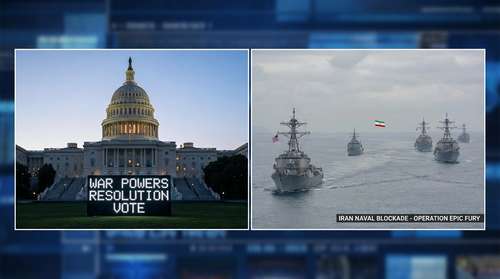
In immediate retaliation for the diplomatic breakdown, President Donald Trump ordered US Central Command to halt maritime traffic entering or exiting Iranian ports. The Trump Iran naval blockade, which officially commenced Monday morning, marks a dramatic escalation. Trump initially took to Truth Social to declare a sweeping embargo on all vessels transiting the Strait of Hormuz, though military officials later clarified that CENTCOM is executing a targeted interdiction of ships specifically calling at Iranian ports. Critically, this massive operation was launched without a United Nations mandate, a formal international coalition, or even a public request from allied Gulf states, leaving US naval forces to enforce the embargo entirely unilaterally.
Senate Vote Today: Reining in Presidential War Authority
The sudden imposition of a maritime embargo has ignited a constitutional crisis on Capitol Hill, culminating in the critical Senate vote today. Senate Minority Leader Chuck Schumer and a coalition of Democrats are utilizing the War Powers Act to force a mandatory floor vote, demanding an immediate halt to hostilities unless Congress explicitly declares war or passes a specific military authorization.
Lawmakers forcefully argue that unilaterally enforcing a naval blockade and executing sustained preemptive strikes far exceeds standard presidential war authority. Previous attempts to check the administration's military directives under Operation Epic Fury fell short in tight 47-53 votes earlier this year, with Senator Rand Paul standing as the lone Republican breaking ranks. However, the sheer scale of this new blockade—and the lack of allied support—has left several moderate Republicans uneasy about the unchecked expansion of executive power.
The 25th Amendment Trump Bill
The extreme unpredictability of the administration's foreign policy pivots has driven a deeply polarized response in Congress. Frustration recently reached a boiling point among the President's sharpest critics, culminating in the drafting of a symbolic 25th Amendment Trump bill by a handful of progressive lawmakers. Critics point to the administration's erratic whipsawing—shifting rapidly from threatening total annihilation to praising peace talks, and then instantly pivoting to a blockade—as evidence of operational instability. While the measure has virtually no viable path to passing both chambers, its introduction strongly underscores the severe constitutional anxieties echoing through Washington as the executive branch operates without traditional oversight.
Tax Day 2026 Military Spending Ignites Public Anger
Domestic pressure is rapidly compounding the legislative revolt. Because the pivotal vote coincides with the April 15 federal tax deadline, anti-war advocates and fiscal conservatives alike are heavily highlighting Tax Day 2026 military spending. The Pentagon is reportedly preparing to ask Congress for a staggering $200 billion supplemental funding package to sustain the war effort, compounding the $11 billion already expended since the conflict formally began in late February.
The proposed $200 billion expenditure has drawn fierce criticism from both progressive Democrats and conservative deficit hawks. Critics point out that this massive sum eclipses numerous domestic priorities, making the timing of the vote on Tax Day particularly symbolic. Senate leadership intends to use this supplemental request as leverage to compel public testimony from key administration officials regarding the war's ultimate endgame.
For everyday citizens, these astronomical geopolitical costs are already materializing at the gas pump. Crude oil futures surged past $103 a barrel immediately following the blockade's implementation. Lawmakers backing today's resolution argue that these soaring energy prices are effectively functioning as a hidden tax on working-class consumers right as they settle their obligations with the IRS.
US-Iran Conflict Update: A Fragile Future
In the latest US-Iran conflict update, military analysts are warning that the regional situation remains extraordinarily volatile. The current two-week ceasefire window is set to expire shortly, and without a diplomatic breakthrough in Pakistan, defensive postures on both sides are heightening. White House advisors have firmly signaled that limited military strikes against Iranian infrastructure could resume at any moment to break the current diplomatic stalemate.
As the Senate casts its votes this afternoon, the outcome will test the structural boundaries of American constitutional government. Whether Congress can successfully claw back its constitutional war making powers remains uncertain, but today's historic decision will undoubtedly shape the trajectory of a conflict that has already upended the Middle East and threatened the global economy.