
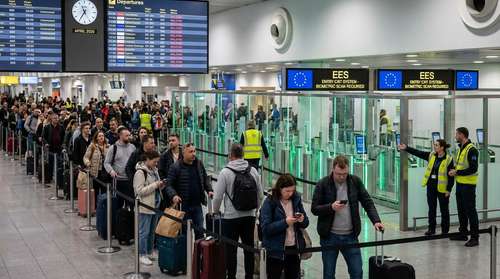
The countdown has officially begun for millions of transatlantic travelers. With exactly one week remaining until the highly anticipated Europe EES launch date 2026 on April 10, the European Union is bracing for a monumental shift at its external checkpoints. After a six-month progressive rollout, manual passport stamping will be permanently abolished across 29 nations, replaced by a strict, highly advanced security network. But as this historic border overhaul collides head-on with spring break travel records 2026, international aviation authorities are sounding the alarm over potential mass disruptions at the continent’s busiest transit hubs.
The April 10 Deadline: Exploring the Schengen Area Digital Border
The transition to the Schengen area digital border has technically been in motion since October 2025, but April 10 marks the absolute point of no return. On this date, the progressive grace period concludes, making the Entry/Exit System (EES) fully operational and inescapable for non-EU visitors traveling for short stays.
Travelers touching down in Paris, Rome, or Madrid will be met with strict new passport rules for Europe 2026. Instead of waiting for a border guard’s ink stamp to authorize their vacation, tourists will now interface with automated self-service kiosks. These high-tech terminals are designed to electronically log your name, passport details, and exact entry and exit times. The primary goal is to close security loopholes and automatically calculate the strict 90-day limit for short-stay visitors within any 180-day period.
Facial Scans and Fingerprints: EU Biometric Entry Requirements
At the core of this vast technological leap are the mandatory EU biometric entry requirements. If you are entering the bloc from a visa-exempt country like the United States or the United Kingdom, you must provide four fingerprints and submit to a facial image scan upon arrival. The only notable exception applies to children under 12 years old, who are exempt from the fingerprinting process.
These biometric markers will be stored securely in a central database for three years. This means frequent flyers will benefit from a slightly faster process on subsequent trips, as their physical data will already be on file. However, refusal to provide these biometric identifiers is not an option—doing so will result in an immediate denial of entry. While EU agencies insist the automated network will eventually streamline border crossings, the initial data-capture process takes significantly longer than a traditional passport check.
Preparing for European Airport Delays April 2026
The timing of the full EES mandate could not be more challenging for the travel industry. U.S. carriers are reporting unprecedented booking volumes this month, setting up a perfect storm as the rollout crashes into peak vacation season. Industry bodies, including the Airports Council International (ACI Europe), have already issued dire warnings regarding extreme wait times.
Travelers should prepare for severe European airport delays April 2026. Gateways like Paris-Charles de Gaulle, Frankfurt, and Amsterdam Schiphol are bracing for biometric bottlenecks. Pilot programs over the winter already saw queue times increase by up to 70 percent in some locations, with isolated incidents of lines stretching for three to four hours. To mitigate total gridlock, the European Commission has included a legal flexibility clause: member states can temporarily suspend biometric checks for up to 90 days if border congestion reaches critical, unmanageable levels. Nonetheless, the April 10 launch date remains firmly legally binding.
The Entry Exit System EES for Americans: What You Need to Know
So, how can U.S. tourists avoid the worst of the chaos over the coming weeks? Navigating the Entry Exit System EES for Americans requires no pre-travel registration or fees right now, meaning the real hurdle is entirely at the physical border. However, savvy travelers can optimize their arrival strategy.
1. Utilize the Travel to Europe App Where Available
Frontex, the EU border agency, has quietly rolled out a mobile application currently operational in select arrival countries like Sweden and Portugal. If you are flying into a participating nation, you can pre-register your passport data and complete entry questionnaires up to 72 hours before your flight to save critical time upon arrival.
2. Buffer Your Connecting Flights
If your itinerary involves connecting through a major Schengen hub before reaching your final destination, ensure you have a layover of at least three hours. Because EES checks occur at your first point of entry into the Schengen zone, short connections are highly vulnerable to the new processing times. Note that countries like the Republic of Ireland and Cyprus are outside the Schengen area, meaning the EES does not apply there.
3. Beware the Automated Overstay Calculator
The days of slipping past border control with an expired visa are over. The new system features an automated overstay calculator that instantly flags anyone who exceeds 90 days in the zone. Penalties for overstaying now carry swift consequences, including heavy fines and potential bans from future entry into all 29 participating nations.
As the sun sets on the era of ink-stained passport pages, the dawn of Europe’s high-tech perimeter is here. Those flying across the Atlantic next week must pack an extra dose of patience alongside their luggage, ensuring their biometric debut goes as smoothly as possible.