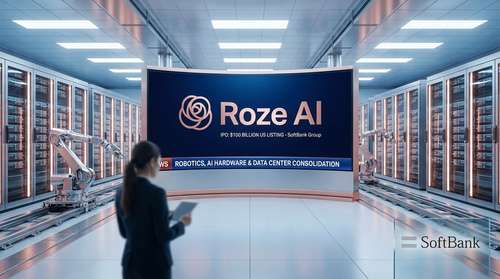
The global race to build artificial intelligence infrastructure has just entered an unprecedented phase. SoftBank Group is reportedly preparing a massive U.S. public listing for Roze AI, a newly formed entity that merges the Japanese conglomerate's sprawling investments across robotics, semiconductor design, and data center development. With an eye-watering $100 billion target valuation, the highly anticipated SoftBank Roze AI IPO is already shaping up to be the defining financial event of the year, signaling a major shift from software-centric AI to massive industrial automation.
The Birth of a 'Physical AI' Juggernaut
For years, equity markets have primarily focused on the large language models and software algorithms driving the artificial intelligence boom. However, this ambitious Masayoshi Son robotics venture aims to dominate the tangible, heavy-duty side of the equation. By integrating its recent multi-billion dollar acquisitions, SoftBank is building what industry analysts are calling a vertically integrated physical AI hardware stack.
To create the foundation for Roze AI, SoftBank is consolidating several massive technological assets. The crown jewels of this new portfolio include the $5.4 billion acquisition of ABB's highly respected robotics division and the $6.5 billion purchase of U.S. chip designer Ampere Computing. Furthermore, the new company will fold in DigitalBridge—acquired for $3 billion—alongside various energy and land infrastructure holdings.
This combination is far more than a financial reshuffling. By owning both Ampere's Arm-based computing architectures optimized for inference workloads and ABB's mechanical systems, SoftBank is forging a seamless "chips-to-robots" pipeline. This tight hardware-software co-design dramatically lowers latency and energy consumption, which is absolutely critical when autonomous machines are executing split-second decisions on active construction sites.
Automating the Data Center Boom
The core commercial thesis behind this robotics and data center consolidation is both simple and incredibly ambitious: utilizing autonomous robots to physically build the next generation of server farms. As tech giants scramble to deploy compute power to train ever-larger neural networks, traditional construction timelines of two to three years have become a severe bottleneck. Building these hyperscale facilities is currently too slow, too expensive, and heavily reliant on specialized manual labor.
Roze AI plans to tackle these project delays and chronic industry labor shortages head-on. The company will deploy fleets of autonomous and semi-autonomous robots to handle strenuous heavy lifting, precision welding, and complex server rack assembly. Operating around the clock without fatigue, this automated workforce could slash construction times by more than half while simultaneously improving site safety. For developers banking on massive facilities, this robotic efficiency could fundamentally alter the cost structure of deploying computational hardware.
The addressable market for such automation is massive. Major cloud service providers—including Amazon Web Services, Microsoft Azure, and Google Cloud—are racing to secure localized power and infrastructure for their models. By stepping in as an integrated builder and hardware provider, Roze AI aims to become the indispensable middleman in the deployment of next-generation AI investment globally. SoftBank's existing relationships across the tech sector give the new venture an immediate strategic advantage in securing early enterprise contracts.
Wall Street Weighs the $100 Billion Question
Despite the undeniable technological synergy, the sheer scale of the proposed listing has generated intense debate among analysts covering AI infrastructure stocks. Roze AI's foundational assets currently sit at roughly $20 billion in total value—comprising an estimated $12 billion in robotics investments and $8 billion in data center and energy holdings. Stretching that baseline to a $100 billion public valuation is testing the limits of market optimism.
Internal sources at SoftBank have reportedly expressed skepticism regarding the aggressive valuation and the compressed IPO timeline, citing broader macroeconomic and geopolitical uncertainties. To counter this hesitation, the parent company plans to host an exclusive analyst day in Texas this July. This event is expected to serve as a high-profile platform to drum up institutional enthusiasm, demonstrate working prototypes, and clarify the standalone entity's long-term revenue model.
Strategic Capital for Next-Generation AI Investment
Behind the headline-grabbing valuation lies a distinct financial necessity. SoftBank's commitment to artificial intelligence has been notoriously capital-intensive. This is highlighted by an extraordinary pledge of over $30 billion to support OpenAI, as well as a massive partnership with Oracle and Abu Dhabi's MGX for the $500 billion Stargate data center initiative.
Pushing Roze AI to public markets allows the new venture to raise its own capital. This strategic separation simultaneously eases the severe balance sheet pressure on its parent company and generates vital liquidity to fund further expansion. If successful, a late 2026 or early 2027 market debut will cement Roze AI's position at the absolute center of global tech infrastructure.
As the most highly anticipated entry in 2026 tech IPO news, Roze AI represents a high-stakes gamble by one of the tech sector's most aggressive investors. It puts billions on the line to prove a single, profound concept: the physical infrastructure powering the future of computing will soon be built not by human hands, but by the very artificial intelligence systems those facilities are designed to host.