
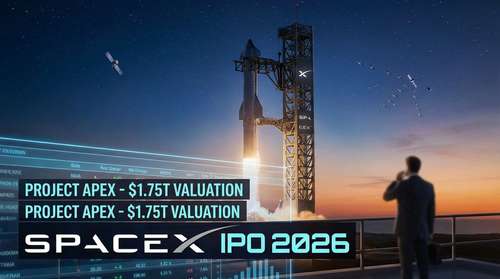
In a move that has instantly rewritten the trajectory of global financial markets, Elon Musk’s aerospace giant has submitted a confidential draft registration to the Securities and Exchange Commission. Slated for a June 2026 debut under the tightly guarded internal codename "Project Apex," the highly anticipated SpaceX IPO 2026 is actively seeking to raise a staggering $75 billion. If the offering prices as expected, it will shatter the previous record set by Saudi Aramco's $29 billion listing in 2019, cementing its place as the largest IPO in history. At the core of this monumental capital raise is a targeted SpaceX valuation of $1.75 trillion,. Such an astronomical figure would immediately elevate the rocket manufacturer into the ultra-exclusive club of the world's most valuable corporations, rivaling entrenched tech titans like Apple, Microsoft, and Nvidia,.
Inside Project Apex SpaceX: The Massive 21-Bank Syndicate
To execute a public debut of this sheer magnitude, the company has assembled an unprecedented financial syndicate consisting of 21 major global banks,. Five heavyweight institutions are serving as the active lead bookrunners: Morgan Stanley, Goldman Sachs, JPMorgan Chase, Bank of America, and Citigroup,. These primary managers will be responsible for drumming up institutional interest, pricing the shares, and ensuring the complex listing executes flawlessly.
Sixteen additional banks—including Barclays, UBS, Deutsche Bank, and Wells Fargo—have signed on to support the offering in smaller roles,. Their inclusion ensures the stock reaches investors across varied geographic regions and diverse capital segments,. The massive scale of this underwriting team underscores the vast logistical complexity of bringing a trillion-dollar aerospace entity to the public market. Market experts note that such massive syndicates have become the gold standard for mega-deals, mirroring the broad underwriting strategies previously utilized by legacy listings like ARM Holdings and Alibaba Group.
How the $1.75 Trillion Valuation Was Reached
A multi-trillion-dollar price tag demands exceptional underlying financials. While traditional Falcon 9 rocket launches and NASA contracts provide steady, predictable cash flow, the true drivers behind the company's stratospheric worth are its satellite internet monopoly and a recent, transformative artificial intelligence acquisition.
The Imminent Starlink Public Offering Boom
Much of the current Wall Street excitement centers on what is effectively a highly lucrative Starlink public offering built right into the broader corporate umbrella. The satellite internet constellation has evolved from an experimental project into an absolute cash juggernaut. Starlink closed out 2025 with 9.2 million active subscribers, generating over $10 billion in revenue for the fiscal year.
By early 2026, that user base is rapidly approaching the 10 million milestone. Wall Street analysts project that Starlink alone could deliver up to $24 billion in revenue by the end of 2026, commanding gross margins nearing 25% and accounting for roughly 80% of the firm's overall income,. The network has successfully monopolized the low-earth orbit (LEO) broadband market, establishing an impenetrable competitive moat that traditional telecom providers simply cannot match.
The X-Factor: The 2026 xAI Merger
The secondary market had already pushed the company's private valuation to around $800 billion by late 2025, but a major corporate consolidation earlier this year completely altered the math. In February 2026, SpaceX executed a massive all-stock merger with Elon Musk’s artificial intelligence startup, xAI. This strategic integration instantly reset the combined company's value to $1.25 trillion.
Within just six weeks, the IPO target climbed to the current $1.75 trillion mark as institutional investors began to grasp the long-term vision: "Orbital Intelligence",. By combining Starlink's low-latency global communication network with xAI's advanced large language models (LLMs), the firm is laying the literal groundwork to operate autonomous AI data centers directly in space,. This synergy bypasses terrestrial energy constraints and establishes an entirely new paradigm for global data processing.
What Elon Musk SpaceX Stock Means for Everyday Investors
Retail investors usually find themselves boxed out of mega-cap technology listings, forced to wait until shares hit the secondary market at a significant premium. However, early reports indicate a radically different approach for the Elon Musk SpaceX stock debut. The eccentric billionaire is reportedly planning to allocate an unprecedented 30% of the initial offering shares directly to retail investors.
This strategy dwarfs the standard 5% to 10% retail allocation typical for traditional Wall Street debuts. By democratizing access to what is shaping up to be the most critical space technology news event of the decade, Musk is ensuring that his loyal consumer base can participate in the financial upside. Investor briefings are scheduled throughout April, giving the public a deeper look into the valuation methodology before the official June listing,.
Redefining the Future of Capital Markets
As the June listing approaches, the global financial world will be watching closely as the "Project Apex" roadshow officially kicks off. Whether institutional markets will easily digest a nearly two-trillion-dollar valuation resting largely on future space infrastructure remains the ultimate test.
Yet, with unparalleled vertical integration, a near-monopoly on commercial heavy-lift launches, and the integration of orbital artificial intelligence, the company is attempting something entirely without precedent in corporate history,. The upcoming debut isn't just a conventional corporate milestone. It signals a fundamental shift in capital markets, proving that the global economy's next massive growth frontier lies firmly among the stars.