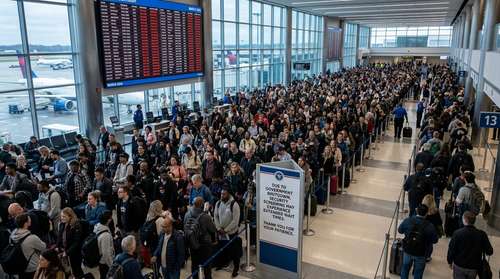
The Great American Getaway has collided with a staggering federal roadblock. As millions of vacationers pack their bags for the highly anticipated Spring Break travel 2026 season, U.S. aviation infrastructure is straining under the weight of an unprecedented 171 million projected passengers. This massive surge, occurring between early March and late April, represents a record 4% jump from last year. However, travelers arriving at terminals this week are encountering severe bottlenecks. A prolonged Department of Homeland Security (DHS) shutdown has left roughly 50,000 Transportation Security Administration screeners working without pay since mid-February, creating a perfect storm of staffing shortages and sprawling security lines.
Record TSA Passenger Volume Collides With Staffing Shortages
Industry forecasts from Airlines for America estimated that domestic carriers would operate 26,000 daily flights to accommodate the rush. At the checkpoint level, this translates to a record TSA passenger volume regularly cresting at 2.8 million travelers a day. Unfortunately, the workforce tasked with securing these skies is buckling under the financial strain of the 44-day funding lapse. Call-out rates among unpaid screeners have spiked, reaching upwards of 11.8% nationwide, with a staggering 40% to 55% absentee rate reported at specific regional hubs over the past weekend.
Despite President Trump signing an emergency executive order on Friday, March 27, aimed at immediately resuming pay for TSA personnel, the ripple effects of the past six weeks are difficult to reverse overnight. Nearly 500 officers have already resigned, forcing airport authorities to consolidate lanes and scramble for backup security solutions.
Government Shutdown Travel Impact: Unpaid Screeners and ICE Deployments
The government shutdown travel impact has quickly become the defining story of the aviation sector this spring. Because the funding lapse localized entirely on DHS—sparing other federal departments—aviation security bore the exclusive brunt of the political stalemate. As passenger lines swelled over the weekend, the administration deployed Immigration and Customs Enforcement (ICE) agents to several commercial hubs to assist with the overwhelming volume.
While ICE personnel are stepping in for crowd management, they are not trained to operate specialized X-ray and screening equipment. Sunday morning broadcasts confirmed that these auxiliary officers will remain stationed at checkpoints indefinitely until normal operations resume and returning TSA staff stabilizes. For the traveling public, this means the visual of hybrid security forces will remain a standard part of the departure process well into April.
The Busiest Spring Break Airports Hit Hardest
Not all regions are experiencing the same level of friction, as the busiest spring break airports are absorbing the most severe operational shocks. Over the weekend of March 28-29, officials at George Bush Intercontinental Airport in Houston warned travelers of security waits stretching up to four hours. Similar chaotic scenes unfolded at Hartsfield-Jackson Atlanta International, where passengers were instructed to arrive a minimum of four hours prior to both domestic and international departures.
New York's LaGuardia and JFK airports, alongside Louis Armstrong New Orleans International, also issued urgent advisories following sudden spikes in screening times. Third-party mobile tracking apps have proven completely unreliable during this period, as rapidly fluctuating staffing levels render predictive wait-time algorithms obsolete.
Navigating US Airport Delays Today: What Flyers Need to Know
If you have a boarding pass for this week, proactive preparation is your greatest asset. US airport delays today are incredibly dynamic; a terminal that is relatively clear at 6:00 a.m. can become entirely gridlocked by 8:00 a.m. if a single shift of screeners is heavily understaffed. Aviation authorities uniformly advise arriving at least three to four hours before your scheduled departure time, even for short-haul domestic flights.
It is absolutely crucial to monitor flight status alerts directly through your airline's official application rather than relying on third-party aggregators. Pack plenty of patience, limit your carry-on bags to expedite the physical screening process, and verify that your trusted traveler status is active. While TSA PreCheck lanes generally remain operational, the processing for Global Entry has been suspended at various points during the closure.
Looking Ahead: 2026 Airline Travel Trends
The friction points defining this month are fundamentally reshaping broader 2026 airline travel trends. Consumers are beginning to alter their booking behaviors, actively pivoting toward off-peak travel days and prioritizing direct routes to minimize the risk of missing a connection due to an initial delay. Furthermore, airlines are being forced to preemptively adjust capacity; some major carriers are already scaling back summer frequency schedules by up to 5% to account for rising operational costs and persistent infrastructure vulnerabilities.
Until a permanent legislative resolution fully secures DHS funding and stabilizes the TSA workforce, the domestic aviation network will remain highly sensitive to disruptions. Vacationers determined to reach their destinations must adopt a highly proactive approach to navigate the turbulent realities of this historic travel season.