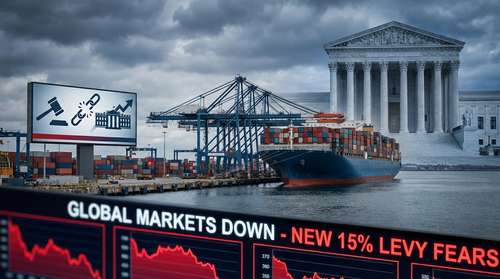
In a historic collision between the executive and judicial branches, the U.S. Supreme Court on Friday struck down the Trump administration's sweeping tariff regime, ruling that the use of emergency powers to bypass Congress was unconstitutional. But the victory for free trade advocates was short-lived. Less than 24 hours later, President Trump escalated the global trade war by announcing a new, universal 15% tariff on all imports, citing alternative legal authorities and plunging the US economy inflation forecast into renewed chaos.
Supreme Court Tariff Ruling: A Check on Executive Power
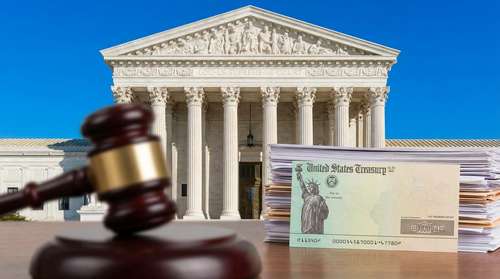
The 6-3 decision in Learning Resources, Inc. v. Trump delivered a stinging rebuke to the White House's interpretation of the International Emergency Economic Powers Act (IEEPA). Writing for the majority, Chief Justice John Roberts argued that while the President has broad latitude in foreign policy, the Constitution explicitly grants Congress the power to levy taxes and regulate commerce. The Court found that the administration's reliance on IEEPA to impose open-ended tariffs on allies and adversaries alike exceeded statutory authority.
"The President asserts the extraordinary power to unilaterally impose tariffs of unlimited amount, duration, and scope," Roberts wrote. "Congress did not delegate such unchecked authority in the IEEPA." The ruling effectively nullified the previous tariff framework, which had levied duties on goods ranging from Chinese electronics to Canadian lumber, validating the arguments of the IEEPA legal challenge brought by a coalition of importers.
Trump Retaliates: The New Universal 15 Percent Import Tax
President Trump's response was swift and furious. Calling the justices a "disgrace to the nation" in a fiery press conference, he immediately pivoted to a new legal strategy. Invoking Section 122 of the Trade Act of 1974—which allows for temporary surcharges to address balance-of-payments deficits—and Section 232 related to national security, the President announced a blanket universal 15 percent import tax on all foreign goods, effective immediately.
"We will not let judicial activists strip away our sovereignty," Trump declared. "If they want to play legal games, we will use every tool in the arsenal to protect American workers." The administration initially floated a 10% rate before hiking the figure to 15% on Saturday, signaling a dramatic global trade war escalation. Unlike the targeted IEEPA measures, this new levy applies indiscriminately, hitting everything from Mexican avocados to German luxury cars.
Billions in Limbo: The Rush for Business Tariff Refunds
The Supreme Court's decision has triggered a frantic scramble among U.S. corporations to recoup roughly $200 billion in duties paid under the now-invalidated regime. However, the path to business tariff refunds remains murky. The Court did not order automatic repayment, leaving the logistics to lower courts and the Court of International Trade.
"It’s a massive win on paper, but a logistical nightmare in practice," said Diane Swonk, a leading trade economist. "Small businesses are particularly vulnerable. They’ve paid these unconstitutional taxes for months, and now they face a bureaucratic wall to get their money back while simultaneously being hit with this new 15% levy."
Corporate Reaction
Major retailers and manufacturers, including those involved in the lawsuit, expressed a mix of relief and trepidation. Rick Woldenberg, CEO of Learning Resources, the lead plaintiff, called the ruling "a win for everyone" who believes in the rule of law. Yet, the immediate imposition of new tariffs has dampened celebrations, with supply chain managers now modeling for a "double-tax" scenario where refunds are delayed while new duties accrue.
Economic Outlook: Inflation Fears Return
The Trump tariffs 2026 saga has rattled financial markets and forced economists to revise the US economy inflation forecast upward. With the new 15% universal tax likely to be passed on to consumers, analysts warn that the cost of living could spike just as inflation had begun to cool. The Federal Reserve may be forced to reconsider its interest rate path if import prices surge.
"Uncertainty is the enemy of investment," noted Josh Stillwagon, an economics professor at Babson College. "Businesses cannot plan when the tax code changes by executive fiat over the weekend. We are looking at a messy operational overhang that could persist for the remainder of the year."