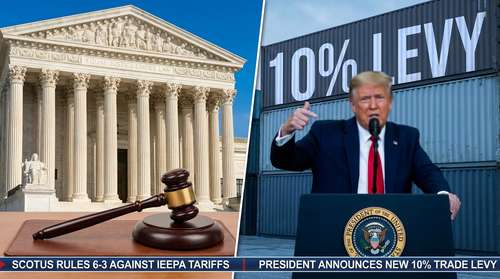
WASHINGTON, D.C. (Feb. 21, 2026) — In a stunning rebuke of executive authority, the U.S. Supreme Court on Friday struck down President Donald Trump’s sweeping global tariffs, ruling 6-3 that the administration lacked the legal power to impose the levies under the International Emergency Economic Powers Act (IEEPA). The landmark decision in Learning Resources, Inc. v. Trump immediately invalidated the 10% to 20% "reciprocal tariffs" that have defined the President's second-term economic agenda.
However, the victory for free-trade advocates may be short-lived. Hours after the ruling, a defiant President Trump appeared in the Rose Garden to announce he would immediately reimpose a new 10% universal tariff using a different statute—Section 122 of the Trade Act of 1974—setting the stage for a continued trade war 2026 news cycle and a potential constitutional showdown.
Supreme Court Rules IEEPA Does Not Grant Taxing Power
The Court’s majority opinion, authored by Chief Justice John Roberts, held that while IEEPA grants the President broad powers to "regulate" economic transactions during a national emergency, it does not implicitly authorize the power to impose taxes or tariffs. Joining Roberts were Justices Neil Gorsuch, Amy Coney Barrett, Elena Kagan, Sonia Sotomayor, and Ketanji Brown Jackson.
"The power to tax belongs to Congress, not the King, and not the President," Roberts wrote in a stinging opinion that leaned heavily on the 'Major Questions Doctrine.' The Chief Justice argued that an economic policy with such vast political and economic significance as a Trump 10 percent global tariff requires clear and explicit authorization from Congress, which IEEPA lacks.
"We hold that the authority to 'regulate importation' found in IEEPA does not include the unbridled power to levy duties on every good entering the United States," the opinion stated. The ruling effectively voids the administration's justification that trade deficits constitute a national emergency sufficient to bypass Congressional revenue powers.
Dissent Argues for Broad Executive Discretion
In a sharp dissent, Justice Brett Kavanaugh, joined by Justices Clarence Thomas and Samuel Alito, argued that the Court was dangerously handcuffing the President's ability to respond to foreign economic threats. Kavanaugh wrote that the broad language of IEEPA was designed precisely for such "flexible and immediate" responses to international adversaries, warning that the decision could weaken the U.S. negotiating position in the ongoing US economy trade policy disputes.
Trump Pivots to Section 122 for "Balance of Payments"
Unwilling to concede defeat, President Trump slammed the SCOTUS trade ruling 2026 as "politically motivated" and "incorrect" during his press conference. "The Supreme Court has made a terrible mistake, but it doesn't matter because we have other tools, better tools," Trump declared.
The President announced he is immediately invoking Section 122 of the Trade Act of 1974. This obscure provision allows the President to impose temporary import surcharges of up to 15% for a maximum of 150 days to address "large and serious" balance-of-payments deficits. Unlike IEEPA, Section 122 explicitly mentions import surcharges, potentially giving the administration stronger statutory footing, albeit for a limited time.
"We are implementing a 10% balance-of-payments surcharge on all foreign goods, effective midnight," Trump vowed. "And if Congress doesn't make it permanent after 150 days, they will have to explain to the American worker why they want to ship our wealth to China."
Economic Chaos and Refund Uncertainty
The legal whiplash has thrown global markets and U.S. importers into disarray. The Supreme Court Trump tariffs ruling theoretically means the government must refund billions of dollars in duties collected over the past year. Trade lawyers estimate the total liability could exceed $200 billion, a figure that would blow a massive hole in the federal budget.
"This is a logistical nightmare," said Sarah E. Miller, a trade attorney in Washington. "Importers are celebrating the IEEPA ruling, but they are terrified of the new Section 122 levies. We are looking at months of litigation just to figure out who gets paid back and who owes what."
Markets reacted with volatility; Dow Jones futures initially surged on news of the Court's decision but pared gains significantly after Trump's Section 122 announcement. The uncertainty suggests that the Trump vs Supreme Court battle is far from over, with the U.S. economy caught in the crossfire of a constitutional power struggle.