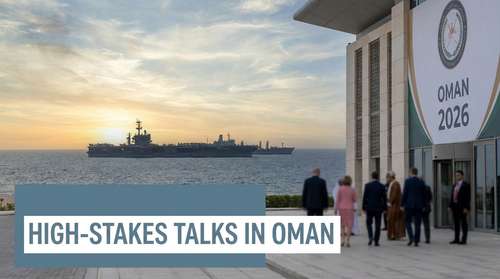
MUSCAT, Oman — Critical nuclear negotiations between the United States and Iran commenced in Oman today, unfolding under the looming shadow of a massive U.S. military buildup in the Persian Gulf. As diplomats gathered at a palace on the outskirts of Muscat, President Donald Trump has reportedly positioned the USS Abraham Lincoln carrier strike group within striking distance, warning that a failure to reach a comprehensive deal—including strict limits on ballistic missiles—could trigger immediate military action. These US Iran nuclear talks in Oman represent a pivotal moment for global security, with the administration seeking to force major concessions from a Tehran government battered by recent domestic unrest and the lingering effects of the June 2025 strikes.
Oman Nuclear Summit 2026: Diplomacy on a Razor's Edge
The indirect talks, mediated by Omani Foreign Minister Badr al-Busaidi, mark the first significant diplomatic engagement since tensions spiraled late last year. According to sources close to the negotiations, the U.S. delegation includes special envoy Steve Witkoff and senior advisor Jared Kushner. In a rare and pointed signal, U.S. Navy Admiral Brad Cooper, head of U.S. Central Command (CENTCOM), is also present in Muscat—a move analysts interpret as a direct reminder of the Trump Iran strike threat hanging over the proceedings.
Iranian Foreign Minister Abbas Araghchi, representing the Islamic Republic, described the initial morning session as a "good start" but cautioned that the "wall of mistrust" remains a formidable obstacle. "We are here to explore a diplomatic path, but negotiation under threat is not our preference," Araghchi told reporters. The talks are expected to focus on reviving a framework for nuclear containment, but the Trump administration has made it clear that the scope must expand to include Iran's ballistic missile program—a red line Tehran has historically refused to cross.
US Navy Middle East Deployment Signals "Maximum Pressure 2.0"
The diplomatic maneuvering in Oman is backed by undeniable hard power. The US Navy Middle East deployment has reached its highest level in years. The USS Abraham Lincoln (CSG-3), accompanied by guided-missile destroyers USS Frank E. Petersen Jr. and USS Spruance, has been conducting flight operations in the Arabian Sea, just south of Iranian waters. This deployment aligns with President Trump's "Maximum Pressure 2.0" strategy, which combines crippling economic sanctions with a credible threat of force.
"We have a big force going towards Iran," President Trump stated from the White House earlier this week. "Maybe we won't have to use it. But we have a lot of ships going that direction. Just in case." This Trump foreign policy 2026 approach aims to leverage Iran's current vulnerability. Following the targeted strikes on Natanz and Fordow in June 2025, and a subsequent wave of nationwide protests that reportedly left over 3,000 dead, the Iranian regime is viewed by Washington as geopolitically weakened and potentially more amenable to a deal to ensure its survival.
Iran Ballistic Missile Negotiations: The Sticking Point
While the nuclear file remains the headline issue, the inclusion of Iran ballistic missile negotiations is likely to determine the summit's success or failure. The U.S. demands a halt to the development of long-range missiles capable of reaching Israel or Europe. Tehran, however, views its missile arsenal as a critical deterrent, especially after its air defenses were degraded during last year's skirmishes. Western intelligence indicates that while Iran's nuclear breakout time was set back by the 2025 strikes, its missile production has continued largely unabated.
Middle East Military Escalation Risks
The stakes for the region could not be higher. Gulf Arab states, while supportive of checking Iran's ambitions, fear that a collapse in talks could lead to a broader Middle East military escalation. A renewed conflict could threaten global oil supplies through the Strait of Hormuz and drag neighboring nations into the crossfire. Omani mediators are working frantically to bridge the gap, hoping to produce at least a temporary "freeze-for-freeze" agreement to lower the temperature before the summit concludes.
As night falls over Muscat, the world watches to see if the combination of diplomacy and dread can produce a breakthrough, or if the warships waiting just offshore will be called into action.