
The trajectory for Federal Reserve interest rates 2026 has taken a hawkish turn. On Wednesday, central bank policymakers voted to hold the benchmark borrowing rate steady at a range of 3.5% to 3.75%, abruptly pausing planned rate cuts. The culprit is a massive geopolitical shock: the escalating U.S.-Israeli conflict with Iran, which has triggered a historic energy crisis and reignited severe inflation fears across the global economy.
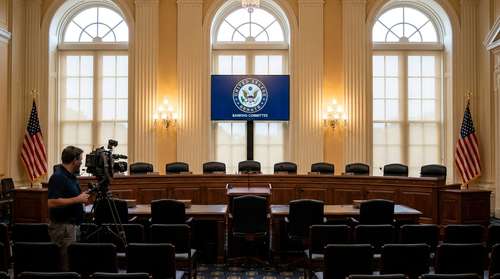
Following a decisive 11-1 vote by the Federal Open Market Committee (FOMC), officials made it clear that taming inflation takes precedence over labor market concerns. Governor Stephen Miran was the lone dissenter, advocating for a quarter-point reduction. However, the majority agreed that the recent Iran war oil price impact has fundamentally altered the economic landscape, threatening to reverse months of progress on consumer prices.
The Strait of Hormuz Blockade Sparks an Energy Crisis
The catalyst for this economic pivot began in late February with direct military strikes on Iranian infrastructure. In retaliation, Tehran effectively shut down the world's most vital energy chokepoint. The resulting Strait of Hormuz blockade has paralyzed maritime traffic, functionally trapping roughly 20% of the globe's daily oil supply. Major marine insurers immediately withdrew war-risk coverage, forcing fleets of supertankers to drop anchor and await safe passage.
This logistical nightmare ignited a violent Brent crude oil price surge. The international benchmark rapidly breached the psychological $100 per barrel threshold, momentarily peaking near $119 before settling into elevated triple-digit territory. Such staggering energy costs are already filtering down to American consumers. The national average for gasoline is climbing daily, and shipping costs are skyrocketing as supply chains face yet another profound disruption.
US Inflation March 2026: A Complicated Path Forward
Even before the missiles flew, domestic price pressures were running hotter than anticipated. The latest US inflation March 2026 data presents a complex challenge for policymakers. Recent economic indicators highlight the mounting pressure on the central bank:
- The baseline Consumer Price Index (CPI) held at 2.4% in February.
- The Fed's preferred metric—the core PCE index—rose to 3.1%.
- Wholesale inflation jumped a punishing 3.4% last month, signaling pipeline pressures.
This dual threat of pre-existing inflation and a fresh oil shock has effectively killed hopes for a springtime rate reduction. As energy costs infiltrate everything from airline tickets to grocery delivery, economists warn that the central bank is walking a tightrope. Lowering rates now could pour gasoline on an inflationary fire, while holding them too high risks fracturing a labor market that showed signs of weakness in February.
Jerome Powell Fed Speech Today Highlights Risks
Addressing reporters in Washington, the central bank chief delivered a sobering assessment of the American economy. During the highly anticipated Jerome Powell Fed speech today, he acknowledged that the implications of the Middle East developments remain highly uncertain. Powell emphasized that while the committee normally looks past temporary energy price spikes, the sheer magnitude of this disruption cannot be ignored.
'The geopolitical risks we are monitoring have clear, tangible impacts on the prices American families pay,' Powell noted, underscoring that the hot wholesale inflation figures have complicated the path toward lower borrowing costs for the remainder of the year. Financial markets, which had fully priced in multiple rate cuts just a month ago, are now adjusting to a reality where monetary relief may be delayed until the fall, or scrapped entirely. The conversation around Federal Reserve interest rates 2026 cuts has rapidly shifted from 'when' to 'if'.
Wall Street Stock Market Slump Deepens
The combination of a hawkish Fed and soaring energy costs has battered equities. A brutal Wall Street stock market slump has wiped out the early-year gains, with technology and consumer discretionary sectors taking the heaviest losses. Investors who previously ignored mounting geopolitical tensions are now panic-selling as profit margins face the dual squeeze of higher-for-longer interest rates and surging fuel expenses.
The housing market is also feeling the immediate burn. Mortgage rates, which had dipped to an encouraging 5.98% in late February, have rapidly reversed course. The average 30-year fixed rate spiked past 6.11% this week, threatening to freeze the crucial spring homebuying season before it even begins.
You can clearly see how fragile the post-inflation recovery truly was. As diplomatic channels struggle to resolve the maritime standoff, the Federal Reserve finds itself in a precarious holding pattern. Until the tankers can safely navigate the Gulf once more, American consumers and businesses will have to weather the storm of expensive credit and volatile energy.