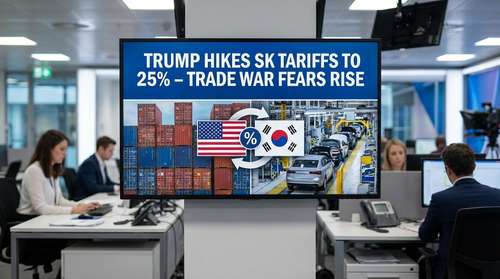
President Donald Trump has escalated trade tensions with a key Asian ally, announcing a sharp increase in tariffs on South Korean imports from 15% to 25%. The surprise move, announced Tuesday on Truth Social, specifically targets the automotive, lumber, and pharmaceutical sectors. The hike serves as a direct retaliation for the South Korean National Assembly's delay in ratifying a bilateral trade framework established last year, reigniting concerns over US South Korea trade war 2026 scenarios and rattling global markets.
Tariff Hike Targets Autos, Lumber, and Pharma
In a characteristic early-morning post, President Trump declared that he is "hereby increasing" duties on a range of South Korean goods. "Because the Korean Legislature hasn't enacted our Historic Trade Agreement, which is their prerogative, I am hereby increasing South Korean TARIFFS on Autos, Lumber, Pharma, and all other Reciprocal TARIFFS, from 15% to 25%," the President wrote.
The announcement sent immediate shockwaves through the Seoul stock market, with shares of automotive giants Hyundai Motor and Kia Corp tumbling between 3.5% and 5% in early trading. The auto import taxes are particularly damaging for South Korea's economy, as the United States remains the top destination for Korean vehicles. In 2025, auto exports to the U.S. were valued at over $30 billion, accounting for a quarter of all shipments to America.
While the inclusion of lumber—a relatively minor export for South Korea—appears symbolic, the pharmaceutical import tariffs pose a significant threat to Korea's burgeoning biotech industry, which has been aggressively expanding its footprint in the American market under the terms of the previous agreement.
The "Historic Trade Deal" in Limbo
At the heart of this dispute is the stalled ratification of the trade pact negotiated between President Trump and South Korean President Lee Jae-myung in July 2025. The deal, which was intended to cement economic ties and foster supply chain resilience, promised to cap U.S. tariffs at 15% in exchange for $350 billion in South Korean investments into U.S. semiconductor and biotech sectors.
However, the South Korea National Assembly trade deal ratification has been bogged down by legislative gridlock in Seoul. South Korea's opposition-controlled legislature has delayed the necessary bills, arguing over specific investment clauses. President Trump's patience appears to have run out, with the White House accusing Seoul of "not living up to its deal."
South Korean officials were reportedly caught off guard. The Presidential Office in Seoul stated they had not been officially notified prior to the social media post. In a scramble to contain the fallout, Trade Minister Kim Jung-kwan, currently in Canada, is rerouting to Washington, D.C., for emergency talks with U.S. Commerce Secretary Howard Lutnick.
Global Supply Chain Disruptions Loom
The renewed friction raises the specter of global supply chain disruptions just as the world economy was finding its footing. Economists warn that a full-blown trade war between the U.S. and South Korea could destabilize the semiconductor and EV battery supply chains, both of which rely heavily on Korean manufacturing prowess. If the tariffs persist, U.S. consumers could see price hikes on popular vehicle models and essential medications.
Trump's Broader Trade Policy Agenda
This latest move fits a pattern of aggressive Trump trade policy news dominating the headlines in early 2026. The President has leveraged tariffs as his primary diplomatic tool, recently threatening Canada with 100% levies if it pursues a separate trade pact with China. By targeting South Korea, an ally that hosts nearly 30,000 U.S. troops, Trump is signaling that no partner is exempt from his "America First" economic enforcement.
"Our Trade Deals are very important to America," Trump added in his statement. "We expect our Trading Partners to act swiftly." With the South Korean National Assembly not scheduled to review pending bills until February 3, the 25% tariff rate could remain in place for weeks, putting immense pressure on President Lee's administration to break the legislative deadlock.