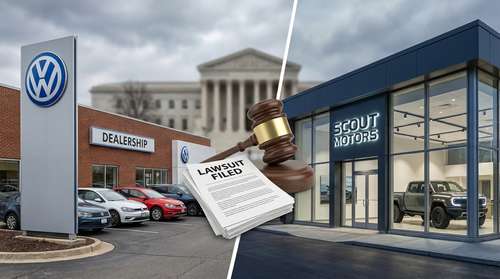
A brewing conflict between Volkswagen and its American retail network has erupted into a full-scale legal battle. Two U.S. Volkswagen dealers have filed a major class-action lawsuit against the German automaker, alleging that its plan to sell the revived Scout Motors brand directly to consumers is a flagrant violation of franchise agreements. Filed in the U.S. District Court for the Eastern District of Virginia, the suit claims VW is playing a "shell game" to bypass the very partners who have built its presence in America for decades. With the primary keyword Scout Motors direct sales at the heart of this dispute, the outcome could reshape how legacy automakers navigate the electric vehicle transition.
The "Shell Game" Accusation: Dealers vs. Volkswagen
The lawsuit, led by Sunrise Imports of New York and Curran Volkswagen of Connecticut, represents a significant escalation in the tension between legacy auto manufacturers and their franchised dealers. The plaintiffs argue that Scout Motors is not a truly independent startup, as Volkswagen claims, but rather an extension of the existing corporate structure designed specifically to circumvent state EV franchise laws.
Represented by Hagens Berman—the same heavyweight law firm that secured a massive settlement for dealers during the "Dieselgate" scandal—the plaintiffs contend that Volkswagen created a "secret plan" to cut them out of the loop. The complaint alleges that by selling the upcoming Scout electric trucks and SUVs directly to buyers, Volkswagen is illegally stripping dealers of their contractual right to sell all current and future VW products.
"In truth, Scout is simply an offshoot of Volkswagen," the lawsuit asserts, arguing that the rebranding effort is a transparent attempt to adopt a Tesla-style direct-sales model while ignoring the binding contracts that have long protected independent dealerships.
Billions at Stake: The Financial Impact on Dealerships
At the core of the Volkswagen dealer lawsuit is the potential for massive financial losses. The suit highlights that Scout Motors has already collected approximately $15 million in reservation fees from over 150,000 potential customers. Under a traditional franchise model, these leads and the subsequent sales would flow through local dealerships, generating profit not just from the vehicle sale, but from financing, trade-ins, and long-term service contracts.
Dealers argue they are being "deprived of their right and ability to sell these cutting-edge vehicles," which effectively strands them with older inventory while the manufacturer funnels the most desirable new Scout electric trucks through a separate, manufacturer-owned channel. The plaintiffs are seeking class-action status, which would automatically include all U.S. Volkswagen dealers unless they opt out, potentially exposing VW to billions in damages.
Cascading Damages Beyond Car Sales
The financial injury described in the complaint goes beyond just the sticker price of the Scout Terra pickup or Traveler SUV. Dealerships rely heavily on "cascading" revenue streams. When a manufacturer bypasses the dealer, that local business loses the opportunity to secure vehicle financing, sell extended warranties, and perform warranty repair work—the lifeblood of the automotive business news sector. The lawsuit seeks an injunction to stop Scout from selling vehicles until these franchise violations are resolved.
The Direct-to-Consumer Trend vs. Legacy Contracts
This legal clash highlights a critical friction point in the modern auto industry: the desire of legacy automakers to mimic the high margins of direct-to-consumer cars popularized by Rivian and Tesla. While startups generally have a clean slate to sell directly, legacy brands like Volkswagen are bound by decades of strict state franchise laws and dealer contracts.
Volkswagen has maintained that Scout is an "independent American company" headquartered in South Carolina, distinct enough to operate outside the VW dealer network. However, the National Automobile Dealers Association (NADA) and state associations have long warned that they would challenge this interpretation. If the court sides with the dealers, it could force Volkswagen to integrate the VW Scout brand into its existing network, fundamentally altering its business strategy for the North American market.
As the case moves forward in Virginia, the entire automotive industry is watching. A ruling in favor of the dealers could fortify the franchise model for years to come, while a victory for Volkswagen might open the floodgates for other legacy manufacturers to launch spin-off brands and bypass their own retail partners.