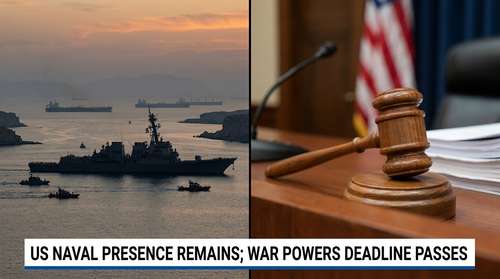
In a breathtaking legal maneuver that has ignited a constitutional firestorm, the White House informed lawmakers this weekend that military hostilities with Tehran are officially "terminated". The declaration arrives just as the 60-day War Powers Resolution deadline expired on Friday, May 1. Yet, for the American sailors enforcing a massive maritime chokehold half a world away, the Trump Iran War 2026 looks far from over.
The latest US Iran conflict news paints a starkly different reality than the administration's peaceful rhetoric on Capitol Hill. While President Donald Trump uses a recently extended, fragile ceasefire to bypass the constitutional requirement for formal Congressional war authorization, the United States continues to enforce a crippling siege on Iranian ports that critics argue is an act of war in everything but name.
The 60-Day Constitutional Clock
The current constitutional crisis traces its origins back to February 28, when surprise U.S. and Israeli airstrikes initiated the conflict. Following the White House's formal notification to Congress on March 2, the 1973 War Powers Resolution started its strict 60-day countdown. Legally, this required the president to withdraw armed forces by May 1 unless lawmakers explicitly authorized the military campaign.
Congressional Democrats made repeated, desperate attempts to force a military withdrawal before the clock ran out. Their sixth attempt, spearheaded by California Senator Adam Schiff, narrowly failed in a 47-50 Senate procedural vote on April 30. While Republicans largely shielded the administration, the vote saw bipartisan fracture—Republican Senators Rand Paul and Susan Collins crossed the aisle to support the measure, while Pennsylvania Democrat John Fetterman stood as the lone Democratic dissenter.
With the legislative threat neutralized, Defense Secretary Pete Hegseth controversially argued to a Senate committee that the 60-day deadline effectively "pauses or stops in a ceasefire". By Saturday, May 2, the administration took that legal theory a step further. The White House explicitly claimed the hostilities launched two months prior were fully terminated, asserting that Congress no longer possesses the authority to intervene.
"Like Pirates": The Strait of Hormuz Naval Blockade
Despite the administration's assurances of peace to Washington lawmakers, military operations remain highly active in the Middle East. Following the collapse of the Islamabad peace talks in mid-April, the U.S. military launched a comprehensive Strait of Hormuz naval blockade on April 13. Far from drawing down, that operation is actively escalating.
Speaking at an event in Florida on Friday evening, President Trump openly boasted about the lucrative nature of the ongoing maritime seizures, framing the aggressive military posture as a massive financial victory.
"We took over the cargo. Took over the oil, a very profitable business," the president told supporters. "Who would have thought, we're sort of like pirates, but we are not playing games".
The Staggering Economic and Global Toll
The administration's dual reality—claiming hostilities are terminated while enforcing a blockade from the Arabian Sea—is inflicting devastating economic damage on Tehran. According to U.S. Central Command (CENTCOM), under the direction of Admiral Brad Cooper, the operation has effectively crippled Iranian maritime trade.
- Over 45 commercial vessels have been intercepted or redirected by U.S. forces since the blockade began.
- At least 41 tankers carrying 69 million barrels of oil are currently trapped, unable to reach global markets.
- The blockade is denying Iranian leadership an estimated $6 billion in revenue, costing the nation roughly $500 million daily.
Iran's President Masoud Pezeshkian condemned the maritime siege as an "intolerable" extension of military operations. Tehran has warned that it views the entry of military vessels near the strait as a direct breach of the ceasefire, promising a severe military response. Meanwhile, Washington is struggling to build an international coalition to manage the fallout, with the administration expressing frustration over fractured support from European allies like Italy and Spain.
Political Fallout Approaching the 2026 Midterm Elections
The administration's high-wire act of maintaining a profitable blockade while dodging legal deadlines carries immense domestic political stakes. The disruption to the Strait of Hormuz—a vital maritime choke point that previously handled roughly 25% of the world's seaborne oil trade and 20% of its liquefied natural gas—has triggered severe affordability issues globally.
American voters are feeling the sharp pinch at the gas pump, adding a volatile economic dimension to the Trump approval rating May 2026 figures. While the president sells the blockade to his base as a strategic masterstroke that punishes adversaries and yields seized assets, opposition lawmakers frame it as a reckless, unauthorized conflict draining American wallets.
As campaigns heat up for the 2026 midterm elections, this constitutional standoff is rapidly becoming a central ballot issue. Lawmakers like Representative John Garamendi have blasted the intervention as an illegal "war of choice" that bypasses the Founders' intent, arguing that the American people are bearing the brunt of a self-inflicted economic disaster.
For now, the White House has successfully navigated the immediate legal hurdle of the War Powers Resolution. But with U.S. Marines actively seizing foreign-flagged vessels, billions of dollars in oil frozen at sea, and Tehran promising retaliation, the declaration of "terminated" hostilities remains a fragile political technicality masking an explosive, ongoing conflict.