
President Donald Trump has issued a blistering ultimatum to Canada, threatening to impose immediate 100% tariffs on all Canadian goods following Ottawa's controversial decision to open its borders to Chinese-made electric vehicles. The threat, delivered via a scathing social media post on Saturday, January 24, 2026, marks a historic low in North American relations and signals a potential death knell for the integrated automotive supply chain that binds the two nations.
The Spark: Canada's Pivot to Beijing
The diplomatic firestorm was ignited by Prime Minister Mark Carney’s announcement earlier this week regarding a new strategic partnership with Beijing. Under the terms of the deal, Canada will slash its tariffs on Chinese EVs from a prohibitive 100% to a mere 6.1% for an annual quota of 49,000 vehicles. In exchange, China has agreed to lower duties on Canadian canola seed from approximately 85% to 15% by March 2026.
For the White House, this move is a betrayal. President Trump, who has championed a fortress-like trade policy against China, blasted the agreement as a backdoor for Beijing to infiltrate the North American market. In his Saturday statement, Trump derided the Canadian Prime Minister as "Governor Carney," warning that "China will eat Canada alive, completely devour it, including the destruction of their businesses, social fabric, and general way of life."
"Governor Carney" and the 100% Tariff Threat
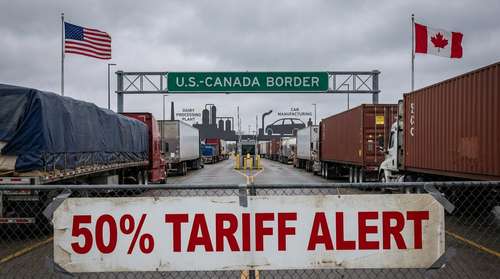
The severity of Trump's threat cannot be overstated. A blanket 100% tariff on Canadian exports would effectively sever the economic artery between the two countries, which trade nearly $2.5 billion in goods daily. The President explicitly stated, "If Canada makes a deal with China, it will immediately be hit with a 100% Tariff against all Canadian goods and products coming into the U.S.A."
This rhetoric escalates the tension significantly beyond the initial tariff skirmishes of 2025. By invoking the "Governor" slur—a jab implying Canada is merely a vassal state—Trump is signaling a complete breakdown in diplomatic respect. Analysts suggest the President views Canada's deviation not just as poor economic policy, but as a violation of the spirit of the USMCA (United States-Mexico-Canada Agreement), specifically the "poison pill" clause designed to deter trade deals with non-market economies.
The Economic Stakes for 2026
Impact on the Auto Industry
The automotive sector faces the most immediate peril. North American manufacturing is deeply integrated; a single vehicle part often crosses the border six or seven times during production. If 100% tariffs are enacted, the cost of manufacturing in Detroit and Ontario would skyrocket overnight, likely leading to mass layoffs and plant closures on both sides of the border. Canadian auto workers, already on edge due to the EV transition, now face an existential threat.
Why Ottawa Risked It
Sources close to the Prime Minister’s Office argue that the pivot to China was a necessary gamble. With EV adoption stalling in Canada due to high prices and the removal of federal incentives in 2025, the influx of affordable Chinese models—half of which must be priced under CA$35,000 according to the deal—is seen as the only way to meet climate targets. Furthermore, Canadian farmers have been desperate to regain access to the Chinese canola market, worth $4 billion annually, after years of trade barriers.
A Deepening North American Divide
This crisis highlights a fundamental divergence in North American trade strategy. While Washington doubles down on protectionism and decoupling from China, Ottawa under Carney is attempting a perilous balancing act—seeking to diversify its trade portfolio while maintaining access to the U.S. market. Critics argue that trying to have it both ways has backfired spectacularly, leaving Canada vulnerable to the wrath of its largest trading partner.
As the 48-hour window for a diplomatic resolution narrows, business leaders on Wall Street and Bay Street are scrambling. The question now is whether Prime Minister Carney will capitulate to Trump's demands and scrap the China deal, or if North America is headed for a trade war that could plunge the continent into a recession.