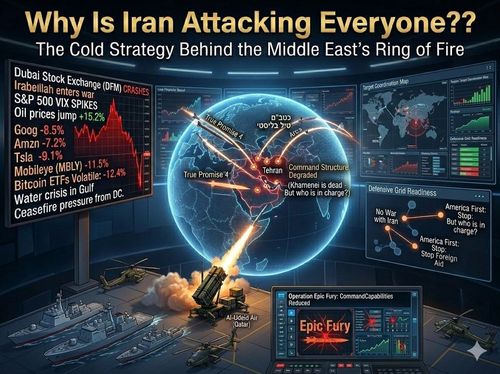
In the Middle East of early March 2026, the joint US-Israeli military campaign against Iran's nuclear and regime infrastructure, designated by Washington as Operation Epic Fury, is exposing the true levers of power driving the region. The campaign opened on February 28 with a massive decapitation strike that eliminated Supreme Leader Ali Khamenei and top military brass.
In response, under the banner of "True Promise 4," the surviving command of the Islamic Revolutionary Guard Corps (IRGC) made a cold, strategic calculation. While they have launched hundreds of ballistic missiles directly at Israel, triggering a nationwide state of emergency and causing deadly impacts in cities like Tel Aviv and Beit Shemesh, Tehran knows it cannot win a symmetrical war against American and Israeli might. Therefore, it is rapidly directing its fire outward. By targeting the United Arab Emirates, Bahrain, Qatar, Saudi Arabia, activating Hezbollah in Lebanon, and even firing ballistic missiles toward Turkey, Iran is setting the entire region ablaze.
The "Hostage" Model: Missiles Over Diplomacy
Striking luxury hotels in Dubai, shutting down airports, or threatening Turkish airspace isn't the random thrashing of a dying regime. It's a calculated execution of a deadly military-economic strategy backed by hard data. The economies of the Gulf states are entirely dependent on their global connectivity. Dubai International Airport (DXB), for instance, routinely handles 85 to 90 million passengers annually, with the aviation and tourism sectors making up over 10% of the UAE's GDP.
Iran is leveraging its asymmetric advantage, an arsenal of thousands of ballistic missiles, cruise missiles, and UAVs, to hold these economies hostage. When a missile lands near Gulf desalination plants (which provide about 90% of the region's drinking water) or major shipping lanes, the logic is clear: the moment these economic assets go up in flames, crashing stock markets and disrupted global trade will create shockwaves massive enough to force Washington to halt Operation Epic Fury.
Glass Economies: When Global Capital Flees
The Iranian gamble on Gulf passivity rests on an understanding of the social contract keeping the royal families in power. The Gulf states have built empires of glass and steel designed to attract Foreign Direct Investment (FDI) measured in tens of billions of dollars annually. But capital is cowardly; a single missile landing near a financial hub instantly spikes the risk premium, wiping out years of market value and sending investors fleeing at the push of a button.
This panic doesn't stop at the borders of the Middle East. Such a security crisis spikes energy prices and disrupts global supply chains. Investors worldwide immediately turn to prediction markets to price in the probability of a descent into total regional war versus a forced ceasefire, injecting massive volatility into the system. This risk environment directly hits broad indexes like the S&P 500 and sends shockwaves through tech and retail giants, from companies like Google (GOOG) and Amazon (AMZN) to advanced automakers like Tesla (TSLA) and auto-tech firms like Mobileye (MBLY), which are highly sensitive to logistical disruptions and energy costs. Simultaneously, the crypto market is stress-tested, with Bitcoin ETFs (like FBTC and IBIT) experiencing violent swings between investors treating them as "digital gold" or an inflation hedge, and those dumping them as standard risk assets.
Gulf leaders understand that a direct conflict would set their economies back a generation. Therefore, they will always prefer to absorb the kinetic blow and activate their lobbying steamroller in the US. Iran is counting on exactly this: that the pressure for a ceasefire won't come from the UN, but from panic on Wall Street.
Horseshoe Theory: The Unholy Alliance of the Extremes
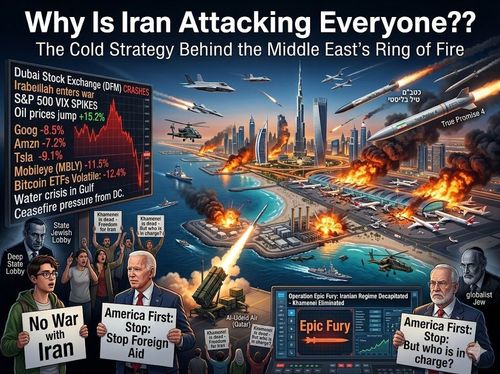
While missiles and economies collide in the Middle East, an ideological war is waging in the West, showcasing one of the most fascinating hypocrisies of our time: the convergence of the radical Left and the populist Right. Both movements oppose Operation Epic Fury, each for their own cynical, opposing reasons, while entirely trampling the reality of the average Iranian citizen.
The progressive Left operates out of structural determinism. Social media algorithms heavily echo an anti-colonial narrative where any American or Israeli action is automatically defined as imperialistic. Under the "bigotry of low expectations," the Left absolves the Ayatollah regime of moral responsibility simply because it opposes the "Western hegemon." Even as human rights organizations report hundreds of executions in Iran annually and the brutal suppression of women and minorities, the rhetoric of liberating Iranian citizens by the West is dismissed as a false pretext. The very human rights the Left champions in other contexts vanish when the oppressor isn't Western.
Conversely, the populist and isolationist Right, sprouting under "America First" ideologies, operates from a clash of civilizations blended with modern antisemitism. Their supposed support for Israel as a "bulwark" against Islam is a tactical illusion. Congressional voting records and alt-right networks reveal a growing opposition to foreign aid, fueled by conspiracy theories about "globalist elites" and a Jewish lobby dragging America into costly wars. This is a Right willing to cheer for bombs as long as it serves a religious war rhetoric, but the moment American resources are directed outward, it turns its back on Israel, utilizing rhetoric that paints Jews as a subversive element working against white national interests.
The Bottom Line
Operation Epic Fury is tearing the masks off the international system. It reveals a region where economic survival in a global market trumps national pride, a terror network that actively weaponizes global stock markets as a deterrent, and a cynical Western political discourse that sacrifices Iranian citizens on the altar of detached isolationist and anti-Western theories.