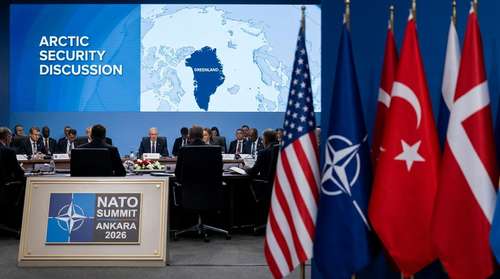
Arriving at the highly anticipated NATO Summit Ankara 2026, President Donald Trump delivered a political shockwave on Tuesday, July 7. Sitting beside Turkish President Recep Tayyip Erdogan, the U.S. leader revived his controversial Trump Greenland demand. Citing mounting strategic concerns over Russian and Chinese activities in the high north, Trump issued an unprecedented ultimatum: if NATO allies continue to push back on American territorial acquisitions, he is prepared to execute a massive withdrawal of U.S. forces from the continent. This latest Trump threat US troops Europe maneuver has immediately plunged the gathering into a transatlantic security crisis.
The Trump Greenland Demand Reignites at NATO Summit Ankara 2026
The opening day of the summit in the Turkish capital was ostensibly designed to focus on defense spending and presenting a unified front following recent global conflicts. Instead, the agenda was entirely overshadowed by the escalating US Denmark Greenland dispute. Addressing reporters from the Bestepe presidential palace, Trump emphatically stated that the massive, resource-rich island "should be controlled by the United States, not by Denmark."
The core of the administration's argument rests heavily on the evolving Arctic military strategy US officials have been developing to counter adversarial encroachment. Trump asserted that Copenhagen does not invest nearly enough financial or military resources to adequately secure the semi-autonomous territory. He pointed to a noticeable uptick in Chinese and Russian naval vessels operating near its icy shores as a primary justification. For the White House, absorbing the island isn't merely a real estate venture; it is viewed as a critical national security imperative designed to lock down the Arctic Circle against rival superpowers and secure vital global shipping lanes.
Escalating the Transatlantic Security Crisis
The most alarming moment for European diplomats came when the president explicitly linked this territorial dispute to the broader American military umbrella. Expressing intense frustration over a perceived lack of allied support—specifically citing nations like Germany, Italy, and France turning down U.S. base access requests during recent military operations involving Iran—the Trump threat US troops Europe pullout materialized on the world stage.
"We could remove all of our soldiers out of Europe," Trump warned, noting the billions of dollars the United States spends to shield the continent from Russian aggression. This rhetoric represents a dramatic escalation in an ongoing transatlantic security crisis that has strained the eight-decade military alliance to its absolute breaking point. NATO Secretary General Mark Rutte and other alliance officials have scrambled to reassure Washington by highlighting tens of billions in new arms contracts, stressing that member states are urgently moving to meet the ambitious 5% GDP defense spending targets recently championed by the administration.
The US Denmark Greenland Dispute Meets Stiff Resistance
Denmark has not taken the renewed Trump Greenland demand lightly. Just hours after the provocative remarks in Ankara, Danish Prime Minister Mette Frederiksen pushed back firmly, making it abundantly clear that Copenhagen will absolutely not surrender its sovereignty. Frederiksen emphasized that while the American desire to own the territory is a matter of public record, European allies must respect the historical boundaries of the Danish kingdom.
"I hope that it is equally well-known everywhere that this is not going to happen," Frederiksen told the press, effectively shutting down any prospect of a direct sale. Despite the very public clash, the issue is actively moving along a quieter diplomatic track. U.S. Secretary of State Marco Rubio confirmed that regular, high-level discussions are indeed occurring between Washington, Copenhagen, and Nuuk. Nevertheless, the aggressive posturing at a gathering designed to project Western unity has left European heads of state deeply unsettled about the alliance's future.
Donald Trump, Recep Tayyip Erdogan, and the F-35 Deal
While the diplomatic mood between the U.S. and Western European allies remains notably frosty, the bilateral dynamic between Donald Trump Recep Tayyip Erdogan could not be warmer. After a grand arrival sequence featuring a ceremonial escort of riders on white horses, Trump showered the Turkish leader with praise. The U.S. president leveraged this strong personal rapport to announce a major policy shift, explicitly offering Turkey a monumental geopolitical concession to the dismay of several members of Congress.
Trump boldly signaled his intent to lift long-standing CAATSA sanctions, opening the door for Ankara to finally purchase advanced American F-35 fighter jets. "We're going to be taking the sanctions off, OK?" Trump told the press pool. By rewarding Erdogan with advanced military hardware while simultaneously threatening the rest of the bloc over the US Denmark Greenland dispute, the administration is drawing sharp, unpredictable new fault lines within NATO.
Looking Ahead for NATO's Arctic Military Strategy US Alignment
As the NATO Summit Ankara 2026 moves into its critical secondary sessions, the atmosphere inside the alliance remains highly volatile. European defense ministers are now forced to navigate a chaotic geopolitical landscape where fundamental transatlantic defense guarantees appear intimately tied to unprecedented territorial demands. Whether this fierce rhetoric serves as a high-stakes negotiating tactic to boost allied defense spending or marks a genuine prelude to an American troop withdrawal remains the defining geopolitical question of the year.