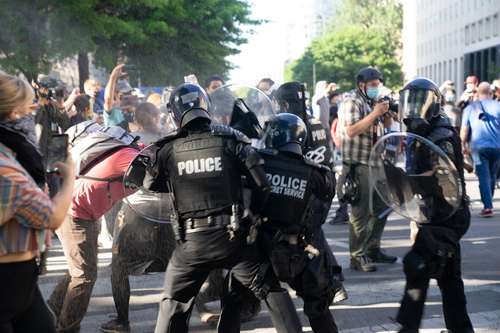
WASHINGTON D.C. — In a high-stakes pivot for his administration's 2026 foreign policy agenda, President Donald Trump officially convened the inaugural meeting of his "Board of Peace" on Thursday, unveiling an ambitious $17 billion reconstruction plan for Gaza backed by a proposed 12,000-person multinational security force. The announcement, intended to mark a new era of stability in the Middle East, was immediately met with chaos on the streets of the capital as police clashed with pro-Palestinian protesters outside the U.S. Institute of Peace.
Inside the 'Board of Peace': A $17 Billion Gamble
The summit, held at the newly renamed Donald J. Trump United States Institute of Peace, brought together leaders and representatives from over two dozen nations. President Trump, flanked by Vice President J.D. Vance and Secretary of State Marco Rubio, pitched the "Board of Peace" as the ultimate alternative to United Nations peacekeeping, which he derided as "obsolete and ineffective."
The centerpiece of the proposal is a massive financial injection for Gaza's reconstruction, contingent on the total disarmament of Hamas. "We are going to straighten out Gaza, make it successful and safe," Trump declared to the assembly. He pledged a staggering $10 billion contribution from the United States alone—a figure that will require a fierce battle for Congressional approval. An additional $7 billion was pledged by a coalition of international partners, including the UAE, Saudi Arabia, Qatar, Kazakhstan, and Morocco.
The administration showcased a polished video presentation depicting a futuristic vision for the strip: a "Mediterranean Riviera" with 200 hotels, artificial islands, and a high-tech "Abrahamic Gateway" connecting Gaza to Egypt and Israel. The plan prioritizes rebuilding Rafah in the south, with an initial goal of constructing 100,000 homes within three years.
The Security Plan: 12,000 Multinational Troops
Beyond the financial pledges, the most controversial aspect of the plan is the creation of an International Stabilization Force (ISF). Major General Jasper Jeffers, appointed to command the ISF, outlined a roadmap to deploy 20,000 soldiers and 12,000 police officers to take over security responsibilities from Israeli forces gradually.
Unlike previous proposals, this force would not include U.S. combat troops on the ground. Instead, the personnel would be drawn from a coalition of Muslim-majority nations. Indonesia, Morocco, Albania, Kosovo, and Kazakhstan have reportedly agreed to contribute troops, while Egypt and Jordan have committed to training the new Palestinian police units. "This is about regional solutions for regional problems," Gen. Jeffers told attendees, emphasizing that the force's deployment is strictly "sector by sector," starting with Rafah.
Skepticism and Strategic Hurdles
Despite the fanfare, the plan faces steep hurdles. European allies were notably absent or sent lower-level observers, signaling deep skepticism about a structure designed to bypass the UN. Furthermore, the core condition—Hamas's voluntary disarmament—remains a significant sticking point. Critics argue that without a clear political horizon for Palestinian statehood, the "security-first" approach replicates failed policies of the past.
Chaos in the Capital: Protests Turn Violent
While diplomats toasted inside, the scene outside was volatile. Thousands of demonstrators descended on Washington to protest what they termed the "imposition of a foreign will" on Gaza. Tensions boiled over as pro-Palestinian groups clashed with police lines near the venue. Officers deployed pepper spray and riot shields to push back crowds chanting "Gaza is not for sale."
The unrest was further fueled by a violent incident involving the security detail of Azerbaijani President Ilham Aliyev, a key attendee of the summit. In scenes reminiscent of 2017, bodyguards for the visiting leader were filmed aggressively confronting protesters outside the Waldorf Astoria hotel, adding a layer of diplomatic embarrassment to the proceedings. "We came to peacefully demand justice, and we were met with brute force—both from foreign guards and our own police," said one organizer from the local chapter of the Palestinian Youth Movement.
Regional Context: The Iran Factor
The timing of the Board of Peace meeting is critical. It comes amidst a massive U.S. military buildup in the region, intended as a deterrent against Iran. With two aircraft carrier strike groups now positioned in the Middle East and tensions with Tehran at a boiling point, the Trump administration is racing to secure a diplomatic win in Gaza to stabilize the seemingly fragile regional alliance against Iran.
As the dust settles on the inaugural meeting, the question remains: Can a "Board of Peace" succeeded where decades of diplomacy have failed, or will it deepen the divide between the U.S. administration and the realities on the ground in Gaza?