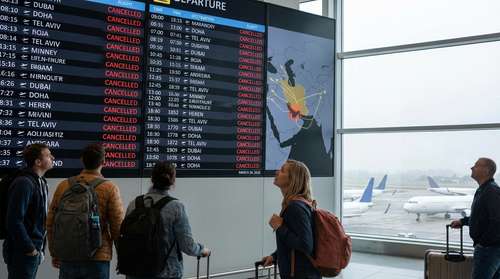
The travel industry is facing its biggest crisis since the pandemic as Middle East flight cancellations 2026 surpass a staggering 46,000 grounded or diverted journeys. Driven by a rapidly expanding conflict involving Iran and massive airspace closures, this unprecedented disruption has plunged the international travel system into chaos. With critical flight corridors suddenly shut down over the past 48 hours, travelers are scrambling, and airlines are passing the spiraling logistical costs onto passengers. For anyone hoping to fly between Europe, Asia, and Africa, this crisis is rewriting the map and the price tag of global mobility.
Global Aviation Shock News: Unprecedented Airspace Closures
The escalating hostilities between Israel, Iran, and allied forces have turned the skies over the Persian Gulf and the Levant into no-fly zones. Aviation authorities have either fully closed or severely restricted civilian access over Iran, Iraq, Syria, Kuwait, and parts of the United Arab Emirates. As a result, major transit lifelines—including the usually bustling hubs of Dubai International Airport, Doha, and Abu Dhabi—have been brought to an alarming near-standstill.
"When those corridors suddenly become unavailable, the entire network has to adapt," noted industry analysts tracking the crisis. Major carriers, including Emirates, British Airways, and Lufthansa, have aggressively paused regional services to Tel Aviv, Beirut, and Amman. In this environment, international travel disruptions have become the norm, completely upending itineraries for millions. Governments are even stepping in to introduce emergency visa measures for thousands of stranded travelers caught mid-journey.
Severe Flight Rerouting Updates: The Logistical Nightmare
The immediate fallout of these closures is a frantic scramble for alternative flight paths. Airlines are being forced to adopt circuitous detours to guarantee the safety of passengers and crew. Current flight rerouting updates indicate that these diversions add anywhere from 300 to 800 nautical miles to long-haul journeys. For a typical flight connecting Europe and Asia, this translates to an extra two to four hours in the air.
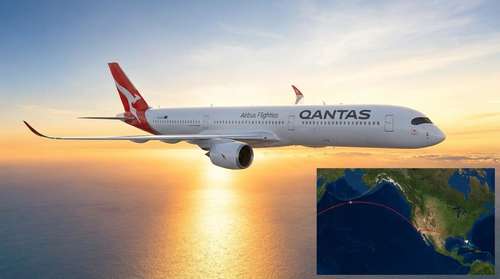
This rerouting creates a severe ripple effect across crew scheduling and aircraft availability. Qantas, for instance, has restructured its ultra-long-haul routes, temporarily adjusting its famous nonstop service from London to Perth to avoid high-risk zones. Air India faces similar hurdles, forced to bypass Iranian and Pakistani airspace, leading to hundreds of schedule adjustments. With aircraft spending significantly more time in the air, overall fleet capacity is shrinking, leaving fewer planes available for regular service.
Skyrocketing Costs and the Airline Fuel Surcharge 2026
Detours do not just consume time; they burn massive amounts of jet fuel. The financial toll on carriers is immense, with estimates showing that extended flying times can raise operating costs by up to $60,000 for a single long-haul sector. Simultaneously, global oil markets are reacting heavily to the geopolitical tension. Jet fuel prices at the U.S. Gulf Coast surged to a four-year high of $4.12 per gallon in early March.
To offset these staggering expenses, carriers are swiftly introducing the dreaded airline fuel surcharge 2026. The combination of restricted capacity and rising overhead means passengers are bearing the brunt of the costs. Those hoping for a bargain are instead being met with high airfares March 2026. On highly competitive routes connecting Europe and Asia, economy ticket prices have surged by up to 80 percent practically overnight. Meanwhile, corporate clients seeking schedule certainty are driving a massive surge in private jet charters across the Gulf, pushing premium travel prices even higher.
The Iran Conflict Travel Impact on the Future of Aviation
While aviation regulators are working closely with intelligence agencies to establish safe emergency corridors, a swift resolution seems highly unlikely. The Iran conflict travel impact has prompted some carriers to make long-term network adjustments. Budget airline Wizz Air has dramatically extended its suspension of flights to multiple destinations in the region until at least late March, and others are signaling month-by-month re-evaluations.
Alternative Hubs Emerge Amid the Chaos
Interestingly, the paralysis of traditional Gulf hubs has sparked a pivot toward alternative connection points. Airports in Central Asia, Eastern Europe, and Africa are experiencing unexpected bursts of transit traffic. Hubs in Istanbul, Athens, and Tbilisi are aggressively marketing themselves as alternative gateways, picking up the spillover demand from travelers no longer comfortable transiting the Gulf.
For the foreseeable future, flexibility is no longer just a recommendation for international travelers—it is an absolute necessity. The ripple effects of this week's airspace shutdowns will continue to test the resilience of an industry still sensitive to global shocks. With tens of thousands of grounded flights and climbing fares, the skies of early 2026 look increasingly turbulent.