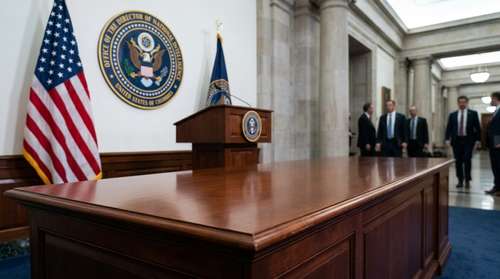
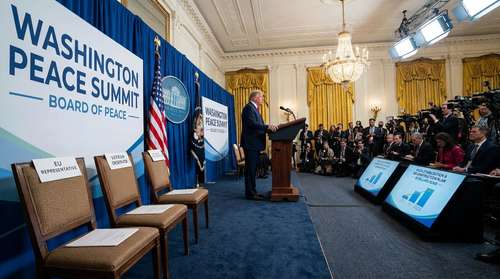
Washington, D.C. — President Donald Trump officially opened the inaugural summit of his controversial “Board of Peace” today at the newly renamed Donald J. Trump United States Institute of Peace, unveiling a massive $5 billion reconstruction package for the Gaza Strip. However, the historic gathering in the nation’s capital was overshadowed by a stark diplomatic rift, as traditional European allies and the Vatican conspicuously declined full membership, signaling deep unease with what critics are calling a challenge to the United Nations’ authority.
The $5 Billion Reconstruction Gambit
In a briefing that set the tone for the summit, the White House announced that the Board’s member states have already pledged over $5 billion toward the immediate reconstruction of Gaza. The funds are earmarked for rebuilding critical infrastructure, housing, and medical facilities devastated during the conflict. “This is not just a promise; this is $5 billion of real investment to restore dignity and stability,” White House Press Secretary Karoline Leavitt told reporters during a pre-summit briefing on Wednesday.
Beyond the financial commitments, the summit produced its first major security breakthrough. Indonesia has become the first nation to formally commit troops to the new International Stabilization Force (ISF), pledging 8,000 personnel to secure the Gaza Strip. The ISF, which will be commanded by U.S. Major General Jasper Jeffers, is a cornerstone of the administration's “Comprehensive Plan to End the Gaza Conflict.” The force is tasked with maintaining the fragile ceasefire and overseeing the disarmament of militant groups, a prerequisite for the reconstruction funds to be released.
Allies Balk at ‘Parallel UN’
Despite the administration’s bullish outlook, the summit’s guest list reveals a fracturing of the traditional Western alliance. While delegations from over 20 nations—including key regional players like Turkey, Egypt, Saudi Arabia, and Pakistan—arrived in Washington, America’s closest European partners have largely stayed away. The European Union and Italy opted to send representatives only as “observers,” a diplomatic downgrade that reflects widespread skepticism about the Board’s mandate.
The most significant rebuke came from the Holy See. In a statement released Tuesday, Vatican Secretary of State Cardinal Pietro Parolin confirmed that the Vatican would not join the Board. “Crisis management should remain under the authority of the United Nations,” Parolin stated, emphasizing that the Holy See had “insisted” on the primacy of established international law. The rejection is particularly stinging given that Pope Leo, the first American pontiff, was personally invited by President Trump to join the body.
Fears of a New Global Order
The core of the controversy lies in the Board’s expanding scope. Originally conceived to oversee the post-war governance of Gaza following the October 2025 ceasefire, President Trump has recently broadened the Board’s mission to address “global conflict resolution.” This pivot has alarmed diplomats in Brussels and New York, who view the body as a potential competitor to the UN Security Council.
Critics argue that the Board represents a shift toward a transactional, pay-to-play model of diplomacy. Reports indicate that a permanent seat on the Board requires a $1 billion contribution, a structure that has drawn sharp criticism from transparency advocates. “The Board is a convenient way for a president interested in quick wins to project movement,” noted one senior analyst at a Washington think tank, questioning whether the pledges would translate into sustainable peace on the ground.
The White House Pushes Back
The Trump administration has aggressively defended the initiative, dismissing concerns about the Board’s legitimacy. During her Wednesday briefing, Leavitt pushed back against the narrative of isolation, calling the Vatican’s decision “deeply unfortunate” and highlighting the participation of "tens of member countries" as proof of the Board's global buy-in. “The President has a bold vision to reconstruct Gaza, and it is well underway because of the Board of Peace,” she asserted.
President Trump himself took to social media to hail the body as “the most consequential International Body in History.” For the administration, the summit is a chance to bypass the gridlock of the United Nations and deliver tangible results—specifically the $5 billion aid package—directly to a conflict zone that has seen little progress under traditional diplomatic frameworks.
A Test for Trump’s Foreign Policy 2026
As the summit continues through the weekend, the world is watching to see if the “Board of Peace” can deliver on its ambitious promises without the full backing of the West. The success of the Gaza reconstruction plan—and specifically the deployment of the International Stabilization Force—will likely determine whether this new body becomes a permanent fixture of the global architecture or a fleeting experiment in unilateral diplomacy.
For now, Washington remains the center of a divided diplomatic world, with billions of dollars on the table and the future of international governance hanging in the balance.