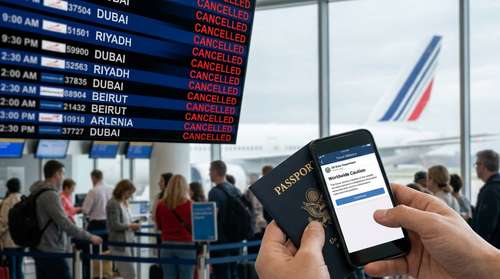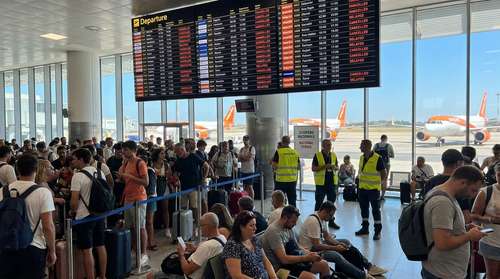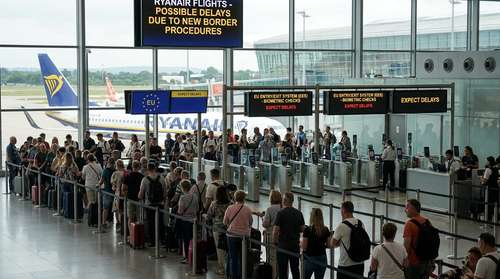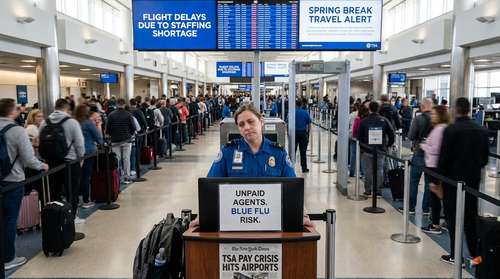
March 5, 2026 – The partial Department of Homeland Security (DHS) shutdown has entered its critical third week, creating a perfect storm for air travelers just days before the busiest Spring Break season in history. As of this morning, over 61,000 Transportation Security Administration (TSA) officers have received reduced or zero-dollar paychecks, triggering warnings of a potential "Blue Flu" that could paralyze checkpoints at major hubs like JFK, O'Hare, and Orlando.
With the DHS shutdown travel impact intensifying, aviation experts are sounding the alarm. The funding lapse, which began on February 14 following a Congressional stalemate over immigration policy, has left essential security personnel working without pay. Now, as 171 million Americans prepare to fly for Spring Break, the collision between a demoralized workforce and record passenger volumes is pushing the nation's aviation infrastructure to the breaking point.
TSA Reduced Pay 2026: A System on the Brink
For the TSA's frontline workforce, the crisis is immediate and financial. On Friday, thousands of officers saw their first impact on their bank accounts, receiving partial payments or nothing at all. Union officials warn that this "financial shock" is the tipping point for many agents who are already suffering from shutdown fatigue—this marks the third federal funding lapse in just four months.
TSA reduced pay 2026 isn't just a payroll issue; it's a security capacity issue. Historically, prolonged shutdowns lead to a spike in unscheduled absences, known as the "Blue Flu," as officers call out sick to work temporary cash jobs or simply because they cannot afford the commute. "You cannot expect people to work a high-stress, national security job for free, indefinitely," said a representative for the American Federation of Government Employees. "The safety of the traveling public relies on a focused, paid workforce."
Spring Break 2026 Flight Delays: The Perfect Storm
The timing could not be worse. The travel industry is bracing for a record-shattering Spring Break, with passenger volumes expected to exceed 2025 levels by 12%. Forecasts indicate that Spring Break 2026 flight delays will likely ripple outward from major hubs as security throughput slows down. Airlines for America, the industry trade group, has already issued a stark warning to Congress, stating that the system "cannot afford to have essential TSA personnel working without pay" during this peak window.
At Tampa International Airport (TPA), officials are expecting 3.1 million passengers over the next 40 days. While TPA has introduced new "Touchless ID" lanes to speed up processing, the sheer volume of travelers combined with potential staffing shortages creates a bottleneck that technology alone cannot solve. Similarly, airport security wait times at Houston's George Bush Intercontinental (IAH) have already begun to creep upward, with travelers reporting 30-minute waits in standard lanes early this week—numbers that could triple if staffing levels drop.
Specific Hubs at Risk: JFK, O'Hare, and Orlando
The TSA staffing shortage JFK is particularly concerning for international travelers. New York's John F. Kennedy International Airport is a critical gateway, and any slowdown in screening capacity there can cause misconnected flights worldwide. Reports from early this morning suggest that some screening lanes in Terminal 4 were operating with reduced staff, a potential precursor to larger disruptions.
In Orlando (MCO), the premier destination for families, the pressure is mounting. The airport is already notorious for long security lines; a reduction in active lanes due to officer absences could leave thousands of families stranded landside as their flights depart. Travelers are being advised to monitor Department of Homeland Security funding crisis updates closely, as the political deadlock in Washington shows little sign of resolving before the mid-March travel surge.
The Political Deadlock
The current Department of Homeland Security funding crisis stems from a deep partisan divide over immigration enforcement tactics. Senate Democrats have blocked the DHS appropriations bill, demanding stricter oversight and reforms for ICE and CBP operations following incidents in Minneapolis earlier this year. With both sides dug in, a "clean" funding bill seems unlikely in the next 48 hours, leaving TSA officers as pawns in a larger political chess match.
Traveler Survival Guide: Navigating the Shutdown
If you are flying this month, standard travel advice no longer applies. Here is how to protect your trip:
- Arrive Earlier than Usual: The standard "two hours before" rule is risky. Aim for three hours for domestic and four for international flights, especially at hubs like JFK or Atlanta.
- Check Your Travel Insurance: Many travelers are rushing to buy travel insurance government shutdown coverage. However, verify your policy terms—some standard policies do not cover delays caused by "known events" once the shutdown has started. Look for "Cancel For Any Reason" (CFAR) upgrades.
- Monitor TSA PreCheck Status: While PreCheck lanes generally move faster, they are not immune to closures if staffing gets critical. Have a backup plan and wear easy-to-remove shoes just in case you are diverted to a standard lane.
- Prepare for REAL ID Fees: Remember that as of February 1, 2026, travelers without compliant REAL ID must pay a $45 fee for alternative identity verification. Have your credit card ready to avoid holding up the line further.
As the clock ticks down to the peak of Spring Break, the resilience of the nation's air travel system is being tested like never before. Without an immediate Congressional resolution to the TSA reduced pay 2026 crisis, millions of Americans may find their holiday plans grounded before they even reach the gate.