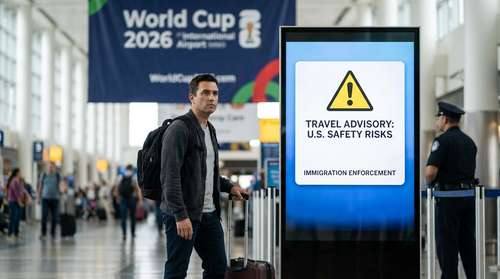
Less than 50 days before kickoff, a coalition of civil rights organizations has issued an unprecedented 2026 World Cup travel advisory for visitors heading to the United States. Spearheaded by the American Civil Liberties Union (ACLU), the NAACP, and an official Amnesty International USA warning, the alert cautions international travelers about the severe risks of racial profiling, arbitrary detention, and aggressive border enforcement.
With an estimated 10 million visitors expected to flood 11 U.S. host cities starting June 11, this human rights travel advisory US serves as a stark reality check. The participating groups are urging soccer fans, journalists, and global delegations to establish strict emergency contingency plans before booking their flights to the tournament.
Behind the Historic 2026 World Cup Travel Advisory
The decision by more than 120 civilian society organizations to issue a formal alert stems from what they describe as a rapidly deteriorating human rights environment. Advocacy groups are directly linking the danger to heightened federal border initiatives and an unprecedented expansion of migrant detention facilities across the nation.
Daniel Noroña, Americas advocacy director with Amnesty International USA, emphasized the gravity of the situation. "Fans, journalists, and others traveling to the United States for the 2026 FIFA World Cup risk encountering a deeply troubling human rights landscape," Noroña stated following the advisory's release. The coalition argues that without concrete guarantees from federal officials and tournament organizers, the event will fail to meet the standard of a safe and inclusive global sporting spectacle.
The NAACP, a key signatory of the advisory, warned that foreign visitors could face unconstitutional law enforcement practices. This is particularly concerning for marginalized groups, as advocates stress that individuals from racial and ethnic minority communities, immigrant backgrounds, and the LGBTQ+ spectrum remain the most vulnerable to serious harm while navigating U.S. jurisdictions.
Travel Risks to United States 2026: What Fans Face
A closer look at the latest U.S. immigration enforcement news 2026 reveals exactly why these organizations are demanding immediate action. Earlier this year, U.S. Immigration and Customs Enforcement (ICE) officials confirmed that their agents would play a "key part" in stadium and event security. The integration of federal immigration officers into local crowd control operations has triggered immense backlash from human rights watchdogs.
Specific Threats Outlined by the Coalition
The advisory outlines a series of acute hazards that visitors must navigate. A valid visa or ESTA authorization does not guarantee admission. Travelers are being warned about:
- Arbitrary Denial of Entry: Customs officials retain broad discretion to turn away ticket holders at ports of entry without standard due process.
- Invasive Digital Searches: Border patrol agents increasingly utilize invasive social media screening and demand passwords to search electronic devices upon arrival.
- Racial Profiling: Elevated risks of discriminatory targeting during routine traffic stops, particularly in states like Texas and Arizona where local police are empowered to question immigration status.
- Custody Hazards: The advisory flags severe concerns over degrading treatment within ICE detention facilities.
Transgender and nonbinary travelers also face heightened scrutiny, as individuals presenting passports that do not align with their sex assigned at birth could be unexpectedly denied entry.
Navigating World Cup 2026 Entry Requirements
Securing a seat at a match requires overcoming complex administrative hurdles. The current World Cup 2026 entry requirements have been complicated by the revival of the Visa Bond Pilot program. Under this directive, consular officers can demand refundable bonds of up to $15,000 from nationals of 50 specific countries deemed overstay risks. Crucially, this list includes several nations whose teams have already qualified for the summer tournament.
Organizations like Advocates for Immigrant Rights and Reconciliation (AIRR) and Decarcerate KC are heavily pushing "Know Your Rights" campaigns in local host cities. Fans are being advised to remove sensitive information, disable facial recognition passcodes on their phones, and download digital emergency tools like the Human Rights First's ReadyNow! app in case they are unlawfully detained.
FIFA World Cup Safety: International Fans Caught in the Middle
The travel risks to United States 2026 have placed tournament organizers under a severe public microscope. With the global image of the sport at stake, advocacy entities like Human Rights Watch are loudly demanding an "ICE Truce". This proposed ceasefire would require federal authorities to temporarily suspend immigration enforcement operations in and around match venues, public transit hubs, and designated fan zones.
Reports suggest that FIFA President Gianni Infantino is considering a direct appeal to the White House to request these temporary enforcement suspensions, arguing that heavy-handed controls will heavily deter international ticket sales. Local organizing committees in major host cities, including Miami, Los Angeles, and Dallas, have initiated urgent outreach to foreign consulates in an attempt to reassure global delegations.
Until a formal truce is established, the overarching priority regarding FIFA World Cup safety international fans remains proactive preparation. Anyone planning to attend the 2026 games must remain hyper-vigilant, continuously monitor policy shifts, and ensure trusted contacts back home are completely aware of their daily itineraries while inside the United States.