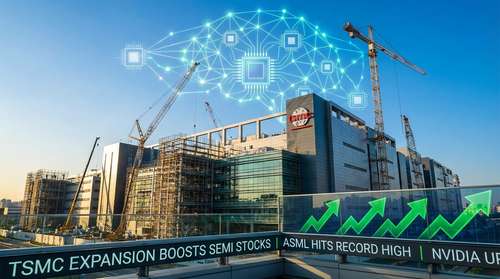
Taiwan Semiconductor Manufacturing Company (TSMC) has officially signaled the start of a new era in artificial intelligence infrastructure, announcing a staggering $56 billion capital expenditure plan for 2026. The decision, driven by what the company describes as "insatiable" demand for AI-specific semiconductors, has sent shockwaves through global markets. While U.S. exchanges remained closed for Presidents' Day on Monday, the announcement triggered an immediate rally in European and Asian markets, propelling key equipment supplier ASML to fresh record highs and setting the stage for a volatile reopening on Wall Street.
The $56 Billion Bet on AI Dominance
In a decisive move to cement its leadership in the semiconductor industry, TSMC confirmed it will ramp up its capital spending by approximately 37% compared to previous cycles, targeting a range of $52 billion to $56 billion for 2026. This aggressive expansion is not merely a capacity upgrade; it represents a fundamental pivot toward next-generation technologies required to train massive AI models.
The company’s board of directors, in a meeting that concluded late last week, approved an initial appropriation of nearly $45 billion to begin immediate construction of advanced fabrication facilities. These new plants are specifically designed to produce 2-nanometer and A16 chips—the ultra-advanced processors that will power the next wave of generative AI tools from Silicon Valley giants like Nvidia, Microsoft, and OpenAI.
ASML Hits All-Time Highs in European Trading
The ripple effects of TSMC's announcement were felt almost instantly across the Atlantic. On Monday, February 16, shares of Dutch lithography giant ASML surged in European trading, hitting a new all-time high of €1,167 in Amsterdam. As the sole provider of the extreme ultraviolet (EUV) lithography machines essential for manufacturing TSMC's most advanced chips, ASML is viewed by investors as a direct beneficiary of this spending spree.
"The correlation is direct and undeniable," said a semiconductor analyst in a note released Monday morning. "TSMC's commitment to $56 billion in spending is effectively a guaranteed order book for ASML's High-NA EUV systems for the next three years." This sentiment helped lift the broader European tech sector, providing a bullish backdrop for U.S. investors preparing for the post-holiday market reopen.
Insatiable Demand Drives the "AI Super-Cycle"
The terminology used by TSMC executives has notably shifted from cautious optimism to urgent confidence. During the announcement, leadership cited "insatiable" demand from hyperscalers—the massive cloud computing companies building the physical infrastructure of the internet. This demand is no longer cyclical but structural, driven by the race to achieve artificial general intelligence (AGI).
Industry insiders point to Nvidia’s upcoming "Rubin" architecture as a primary catalyst. These next-generation GPUs require significantly more complex manufacturing processes than the current Blackwell chips, necessitating the expanded capacity TSMC is rushing to build. Consequently, the "AI Super-Cycle" appears to be accelerating rather than plateauing, debunking fears of an imminent market bubble.
Wall Street Eyes Dow 50,000 Upon Reopening
As American traders return to their desks on Tuesday, all eyes will be on whether this global momentum can sustain the U.S. market's record-breaking run. The Dow Jones Industrial Average recently breached the psychological 50,000 barrier, a milestone fueled largely by the semiconductor rally. Early futures data suggests that TSMC's American Depositary Receipts (ADRs) and Nvidia stock are poised for significant movement.
However, analysts caution that the market is entering a "show me" phase. With Nvidia scheduled to report earnings on February 25, investors are looking for concrete evidence that this massive capital expenditure will translate into immediate revenue growth. TSMC’s bold move has effectively raised the stakes, signaling that the hardware underpinning the AI revolution is still in the early innings of its growth trajectory.