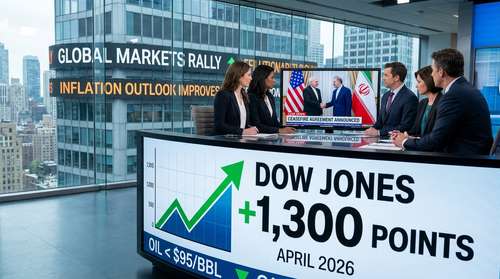
Financial markets experienced a historic rally heading into the weekend as the United States and Iran agreed to a crucial two-week ceasefire. The sudden diplomatic breakthrough has effectively cooled months of intense geopolitical and energy tensions that have battered the global economy since the onset of military operations in February. The momentous news prompted a stunning 1,300-point surge in the Dow Jones Industrial Average and sent crude oil prices tumbling below $95 per barrel. For consumers and inflation-weary businesses, this US-Iran ceasefire 2026 provides immediate, tangible relief and has already triggered the first significant drop in mortgage rates in months.
Global Stock Market Rally Brings Wall Street Roaring Back
The sudden pause in "Operation Epic Fury" has injected a massive dose of optimism into a previously anxious market environment. The Dow Jones 1300 point surge earlier this week marked the blue-chip index's strongest single-day performance since April 2025. The S&P 500 and the tech-heavy Nasdaq Composite rapidly followed suit, advancing broadly as investors welcomed the de-escalation rhetoric.
President Donald Trump announced the "double-sided ceasefire" on his Truth Social platform, creating a two-week window for international diplomats to finalize a comprehensive peace agreement. The immediate reaction on Wall Street was a sharp reversal of the defensive posturing that had dominated trading for weeks. While the geopolitical situation remains undeniably delicate, the sheer scale of the global stock market rally highlights how desperately investors had been waiting for positive developments. Risk appetite has returned across nearly all asset classes—including equities and cryptocurrencies—as the threat of a wider regional war temporarily subsides.
Energy Market Recovery as Oil Prices Plunge Below $95
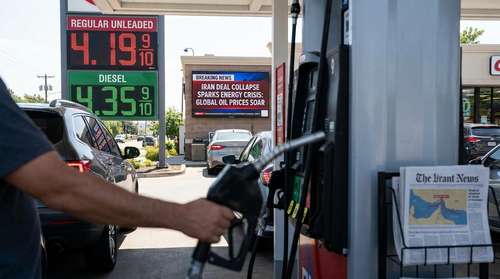
At the center of the recent global economic turmoil has been the critical Strait of Hormuz. Because roughly a fifth of the world's maritime oil tankers pass through this narrow waterway, it quickly became a major strategic flashpoint. Prior to the ceasefire, the blockade and ongoing military operations had sent energy markets into a volatile tailspin, threatening to reignite the worst inflationary pressures of the post-pandemic era.
Now, with the first non-Iranian tankers beginning to transit the strait again under the terms of the temporary agreement, we are witnessing a rapid energy market recovery. The immediate result has been oil prices below 95 dollars per barrel. Easing crude costs provide massive downstream benefits across the entire global supply chain. Although Tehran continues to exercise strict control over maritime traffic and the prospect of unprecedented toll charges looms, the mutual agreement to reopen this crucial shipping lane has removed the immediate fear of a catastrophic global energy shortage.
Tangible Inflation Relief News and the Mortgage Rate Drop
The ripple effects of lower energy costs and normalized maritime trade are already reaching the American housing sector, providing a much-needed lifeline to prospective buyers. Following the ceasefire announcement, data released by Freddie Mac confirmed a notable mortgage rate drop April 2026. The average rate on a 30-year fixed mortgage fell to 6.37%, down significantly from 6.46% just a week prior.
This decline marks the first time in weeks that prospective homebuyers have seen borrowing costs decrease. Recently, the Federal Reserve's preferred inflation gauge—the Personal Consumption Expenditures (PCE) price index—showed an uncomfortable spike driven heavily by surging war-time energy costs. This had fueled fears that the central bank would be forced to keep interest rates higher for longer. Because inflation expectations are intimately tied to energy markets, the sudden plunge in oil prices gave bond markets the breathing room they desperately needed. Falling Treasury yields translated directly into lower home loan rates, offering inflation relief news that average Americans can feel in their wallets.
The Path Forward for the Ceasefire
While the immediate economic indicators are overwhelmingly positive, the long-term durability of this financial boom depends entirely on the success of ongoing diplomatic negotiations. Vice President JD Vance is currently leading a high-level U.S. delegation in Islamabad, Pakistan, working alongside special envoy Steve Witkoff and international mediators to translate this temporary 14-day truce into a permanent resolution. The 10-point proposal on the table covers complex issues ranging from sanctions relief to maritime security.
The stakes for the global economy couldn't be higher. If the peace talks succeed in maintaining the open flow of trade and preventing further military escalation, the current economic recovery could solidify into a sustained, multi-year bull market. For now, investors and consumers alike are closely watching the headlines out of Islamabad, grateful for the immediate economic stabilization that this landmark ceasefire has secured.