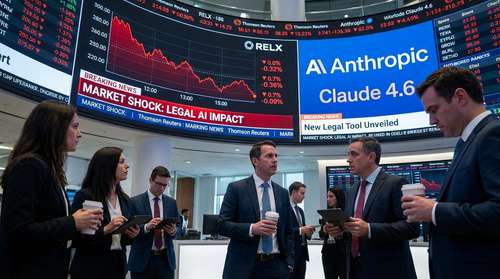
Global professional information markets are reeling this weekend after a historic sell-off wiped billions of dollars in value from industry titans RELX and Thomson Reuters. The market rout, which began Tuesday and accelerated through Friday’s close, follows the release of Anthropic’s new Claude 4.6 ecosystem and its groundbreaking "Claude Cowork" legal automation suite. The stock plunge—reaching declines of nearly 18% for Thomson Reuters and 14% for RELX—marks the sector's most significant volatility since the dot-com crash, signaling a potential paradigm shift in how professional services are delivered.
The "Claude Cowork" Shock: Why the Market Panicked
The catalyst for the crash was Anthropic’s unveiling of Claude Cowork, a desktop application powered by the new Claude 4.6 model. Unlike previous chatbots, Cowork is an "agentic" tool capable of accessing a user's local file system to autonomously execute complex multi-step workflows. Crucially, Anthropic released a suite of open-source plugins specifically designed for legal tasks—including contract review, NDA triage, and regulatory compliance checks—effectively democratizing high-margin services that were previously the domain of expensive specialized software.
"The middlemen just became optional," wrote one tech analyst in a note that circulated widely on Wednesday. By allowing in-house legal teams to run sophisticated document analysis locally and securely without a third-party vendor, Anthropic has struck directly at the "seat-based" revenue models of traditional legal tech firms. The open-source nature of these plugins means corporate legal departments can now build custom, proprietary tools on top of Claude 4.6 without paying licensing fees to intermediaries like LexisNexis or Westlaw for workflow automation.
RELX and Thomson Reuters Stock Crash: By the Numbers
The financial impact was immediate and severe. Thomson Reuters (TRI), the parent company of Westlaw, saw its shares plummet roughly 18% by mid-week, erasing months of gains. RELX, which owns LexisNexis, suffered a similar fate with a 14% decline in London trading. The sell-off dragged down the broader professional services sector, with analysts at major banks downgrading price targets across the board.
Investors fear that the "moat" these companies have built—vast proprietary databases of case law and statutes—may not be enough to protect their lucrative workflow and analytics businesses. "The market is pricing in a future where AI handles the drudgery of legal work for free," said Giuseppe Sersale, a fund manager tracking the sector. "If an AI agent can review a 50-page merger agreement in seconds on your desktop, the value of a $5,000-per-seat software license evaporates overnight."
"SaaSpocalypse" or Overreaction?
The severity of the drop has led some commentators to dub the event the "SaaSpocalypse," fearing that AI agents will cannibalize the entire Software-as-a-Service (SaaS) industry. However, some experts argue the sell-off is an overreaction. They point out that while workflow tools are vulnerable, the core value of Thomson Reuters and RELX lies in their authoritative, verified legal content—something an open-source AI model cannot legally replicate without licensing.
Incumbents Fight Back: The Trust in AI Alliance
Facing an existential threat, the data giants are not standing still. Thomson Reuters has already reaffirmed its commitment to AI, highlighting its recent $200 million annual investment in generative AI upgrades. In a bid to reassure investors, the company pointed to its participation in the newly formed "Trust in AI Alliance," a partnership with tech leaders aimed at establishing standards for accuracy in professional AI.
Furthermore, executives argue that "hallucination" risks still make standalone AI tools dangerous for high-stakes legal work. "Accuracy is our currency," a Thomson Reuters spokesperson stated on Thursday. "Our tools are grounded in the world's most trusted legal database. An open-source plugin cannot offer that guarantee." Despite these assurances, the market remains skittish, waiting to see if corporate clients will defect to the cheaper, faster, and increasingly capable Anthropic ecosystem.
What This Means for the Future of Legal Tech
The events of the last few days suggest that 2026 will be a defining year for professional services. The Claude 4.6 market impact demonstrates that AI is moving beyond simple chat interfaces to becoming a true "co-worker" capable of independent labor. For law firms and corporate counsel, this promises massive efficiency gains and cost reductions. For the legacy providers who have dominated the industry for decades, it represents a clear ultimatum: adapt your business model to an agentic AI world, or risk obsolescence.
As markets reopen on Monday, all eyes will be on whether RELX and Thomson Reuters can stem the bleeding or if this AI stock market crash is just the beginning of a broader sector rotation away from traditional SaaS and toward AI-native platforms.