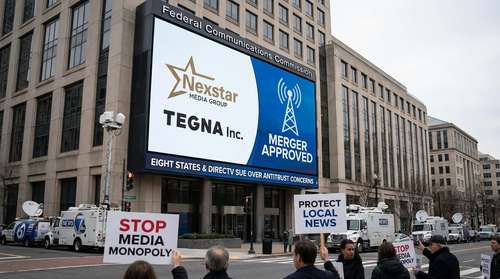
The landscape of American television underwent a seismic shift late Thursday as federal regulators handed down the highly controversial Nexstar Tegna merger approval. Valued at a staggering $6.2 billion, the historic consolidation creates an unparalleled broadcast behemoth that will effectively control local stations reaching roughly 80 percent of all U.S. households. Yet, the ink on the Federal Communications Commission's green light was barely dry before a fierce legal backlash erupted. Hours after the official announcement on March 19, 2026, a coalition of eight state attorneys general joined forces with satellite television giant DirecTV to file sweeping antitrust lawsuits. They argue the massive buyout will devastate local journalism, eliminate competitive viewpoints, and guarantee steep financial burdens for everyday viewers.
The Brendan Carr FCC Decision and Regulatory Fallout
At the center of this rapidly escalating FCC media antitrust debate is the regulatory agency's controversial waiver of historic ownership rules. Historically, federal guidelines have prevented a single corporate entity from owning stations that reach more than 39 percent of American television households. However, the sweeping Brendan Carr FCC decision bypassed these traditional guardrails to permit the monumental expansion.
According to the agency's Thursday evening order, Nexstar Media Group is required to divest only six stations across markets including Denver, Indianapolis, New Haven, Portsmouth, Slidell, and Rogers. Chairman Carr robustly defended the regulatory clearance, taking to social media to state that the agreement contains concrete conditions to increase localism and promote affordability. Nexstar CEO Perry Sook echoed these sentiments, celebrating the acquisition as a vital step to empower local broadcasters against unchecked Silicon Valley tech giants and legacy national networks.
However, the rapid approval process drew immediate fire from within the commission itself. Anna M. Gomez, the sole Democratic commissioner on the FCC panel, condemned the lack of public transparency. She noted the clearance was pushed through without a formal, open commission vote, leaving consumers to suffer the consequences of a looming local television broadcast monopoly. The political stakes of the deal were further amplified earlier this year when former President Donald Trump openly championed the corporate marriage as a necessary counterweight to national media networks, calling it a way to fight back against the fake news establishment.
DirecTV Lawsuit Nexstar: The Fight Against Monopolistic Control
The regulatory victory lap was immediately cut short by aggressive litigation filed in the U.S. District Court in Sacramento. The legal offensive—spearheaded by California Attorney General Rob Bonta and joined by top lawyers from New York, Colorado, Connecticut, Illinois, North Carolina, Oregon, and Virginia—aims to slam the brakes on the transaction.
Running parallel to the states' actions is the high-stakes DirecTV lawsuit Nexstar. The satellite provider's legal team argues that allowing a single corporate parent to manage 259 full-power television stations in 44 states grants Nexstar dangerous leverage in retransmission consent negotiations. When broadcasters hold too much market dominance, they can effectively hold distributor networks hostage during contract renewals. DirecTV claims this aggressive bargaining tactic forces distributors to either accept exorbitant carriage fee demands or face crippling channel blackouts that block audiences from accessing critical local news, emergency weather updates, and live programming.
The Threat to Local Newsrooms
Beyond distribution battles, state officials are raising alarms over the direct impact on regional journalism. Colorado Attorney General Phil Weiser explicitly warned that combining multiple stations in a single city—such as the merging of Denver's Fox31 and 9News operations—will lead to immediate newsroom closures and job losses for seasoned journalists. Consolidating resources often means syndicating national content rather than investing in boots-on-the-ground community reporting.
Media Industry Consolidation 2026: Preparing for Consumer Cable Price Hikes
For the average television viewer, the immediate fallout of this historic corporate marriage is likely to hit their monthly budget. Legal filings from the multistate coalition warn that the creation of this broadcast titan will inevitably trigger significant consumer cable price hikes. As Nexstar consolidates its grip on the local news market, the inflated operational and acquisition costs are routinely passed down to subscribers through elevated regional sports and broadcast TV surcharges. New York Attorney General Letitia James stated emphatically that if the merger stands, cable bills will instantly spike for families nationwide.
The sweeping Nexstar Tegna merger approval represents the undeniable apex of media industry consolidation 2026. Watchdogs argue that as independent newsrooms merge and duplicate roles are eliminated, local communities stand to lose diverse editorial voices. While Nexstar promises enhanced news programming and stronger capabilities to compete in a fractured digital landscape, critics maintain that centralizing editorial control over local affiliates of ABC, CBS, Fox, and NBC diminishes the hyper-local focus that residents rely on.
As the litigation advances in federal court over the coming weeks, the industry remains on edge. Whether this massive $6.2 billion transaction successfully modernizes local journalism to compete with big tech, or permanently fractures the competitive broadcast landscape, remains the defining regulatory question of the decade.