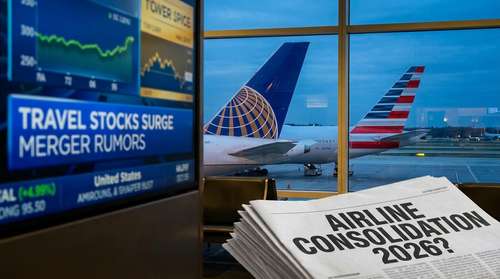
The aviation industry is experiencing severe turbulence this week after shocking United American merger rumors surfaced, sending Wall Street into a frenzy. In the latest American Airlines United merger news, travel industry giants face immense public and political scrutiny following reports that United Airlines CEO Scott Kirby pitched a blockbuster consolidation directly to the White House. For investors actively following travel stock market updates, the whispers of a mega-merger triggered an immediate 8% surge in American Airlines shares, highlighting the massive financial implications of combining two legacy carriers.
If realized, this historic deal would dramatically reshape airline consolidation 2026, combining the two largest global carriers by capacity. The proposed entity would command roughly 40% of the United States domestic market. However, robust opposition from corporate boardrooms and federal regulators suggests that creating an aviation monopoly will be anything but a smooth flight.
Inside the Proposed Aviation Behemoth
The initial proposal reportedly took place in late February when Kirby met with President Donald Trump to discuss infrastructure renovations at Washington Dulles International Airport. The United executive argued that merging with American Airlines would create a U.S. carrier highly competitive against foreign airlines, which currently operate roughly two-thirds of long-haul seats flying in and out of the country. By shifting the industry focus from domestic market share to global network capabilities, United hoped to build an unmatched international juggernaut.
A Fleet Without Equal
A combined United-American entity would wield staggering global power. Industry data reveals the new airline would operate an unparalleled fleet of over 2,800 aircraft—more than double the size of Delta Air Lines. This level of dominance would fundamentally alter the competitive landscape, effectively crowding out smaller competitors at highly contested hubs. At Chicago's O'Hare International Airport, for instance, the two carriers have already been engaged in a fierce battle over gates, prompting the Federal Aviation Administration to order significant flight cuts this summer to reduce gridlock.
Federal Pushback and Alternative Visions
Any combination of this magnitude inevitably faces strict regulatory hurdles, particularly regarding a Department of Transportation airline merger review. While Transportation Secretary Sean Duffy initially indicated a willingness to entertain large-scale deals, noting the administration's appetite for major business moves, the executive branch decisively pumped the brakes on this specific pairing.
During an April 21 appearance on CNBC's Squawk Box, President Trump publicly opposed the transaction. "With American it's doing fine, and United is doing very well," he stated. "I don't like having them merge." The President compared the potential tie-up to previous aerospace and defense industry contractions, warning that a lack of competition makes massive corporations sluggish and complacent.
Interestingly, the administration highlighted a different path for the distressed aviation sector. The conversation pivoted toward smaller, struggling carriers, with suggestions that Trump airline federal aid could be directed toward facilitating a buyout of bankrupt Spirit Airlines. The intent would be to preserve 14,000 industry jobs rather than enrich top-tier legacy airlines.
American Airlines' Blunt Rejection
The financial markets experienced sharp whiplash following the initial travel stock market updates. American Airlines abruptly ended the United American merger rumors on Friday by issuing a firm statement refusing the acquisition. The Fort Worth-based carrier declared it is "not engaged with or interested in any discussions regarding a merger with United Airlines."
American further argued that combining forces would be decidedly negative for consumers and contrary to the principles of antitrust law. Following this stark rejection, American Airlines stock reversed its earlier gains, plunging more than 4% as the reality of a standalone future set in for traders heavily invested in the speculation.
What This Means for US Airfare Trends 2026
Beyond Wall Street, the most pressing concern for everyday travelers is how these corporate maneuvers affect their wallets. Current US airfare trends 2026 are already under pressure from soaring jet fuel prices linked to the ongoing conflict in Iran. Adding a monopolistic legacy merger to the equation has politicians from both sides of the aisle sounding the alarm.
A bipartisan coalition, led by Senators Elizabeth Warren and Mike Lee, recently wrote to both airlines cautioning that such aggressive airline consolidation 2026 would destroy competitive pricing. Consumer advocacy groups argue that reduced domestic competition historically leads to aggressive fee hikes and a severe reduction in direct flight availability. If the "Big Four" carriers are reduced to three, experts project that fliers would face unprecedented cost burdens across domestic routes.
As the dust settles on this week's extraordinary corporate drama, the message from both regulators and the airlines themselves appears clear. While the U.S. aviation industry remains ripe for strategic shifts, these specific United American merger rumors have hit a solid wall of resistance. Travelers can breathe a temporary sigh of relief, though volatile global fuel markets will continue dictating ticket costs heading into the busy summer travel season.