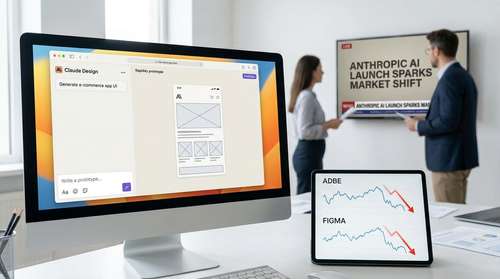
Anthropic has sent shockwaves through the creative software industry with the surprise Claude Design launch. Revealed as a standalone generative design workspace, the platform fundamentally disrupts how digital products are built by allowing anyone to turn plain-text prompts into polished, production-ready visuals. The announcement triggered immediate panic on Wall Street, contributing to a notable Adobe stock drop 2026 and sending private and public shares of major design software competitors into a tailspin.
The Anthropic AI Design Tool Disrupts the Status Quo
For years, the professional design workflow has been securely locked behind specialized software and steep learning curves. The new Anthropic AI design tool tears down those barriers, acting as a hyper-intuitive middleman between conceptual ideas and finished products. Developed by Anthropic Labs, Claude Design allows users to generate interactive prototypes, marketing collateral, one-pagers, and professional pitch decks simply by chatting with the system.
Unlike previous AI copilots that merely assisted within existing software ecosystems, this platform operates as a completely independent environment. Users can start with a text description, an uploaded image, or even an existing codebase. From there, the system generates a high-fidelity first draft. What sets it apart is the refinement process: users can drop inline comments on specific elements, edit text directly, or utilize custom adjustment sliders that the AI generates on the fly to tweak spacing, layout, and color palettes.
Figma vs Anthropic: The Catalyst Behind the Market Sell-Off
The financial fallout from the announcement was immediate. Following the launch, Figma shares plunged 7.5% in secondary markets, while Adobe dipped over 1%. Wix and other visual software providers also saw their market values melt away as investors digested the news.
The core issue driving the Figma vs Anthropic narrative isn't just about AI capabilities—it is about the target user. Historically, companies like Adobe and Figma assumed that a trained professional designer would always remain in the loop. Claude Design is deliberately engineered for founders, product managers, and marketers who may have never opened a professional design application. By empowering non-designers to go from a rough idea to a working prototype in a single conversation, Anthropic has fundamentally expanded the market while threatening incumbent monopolies.
Interestingly, not all design giants are fighting the tide. Canva has explicitly partnered with Anthropic. Outputs from Claude Design can be exported cleanly as standalone HTML, PDF, or PPTX, but they can also be pushed directly into Canva. Melanie Perkins, Canva’s CEO, confirmed the collaboration, noting that drafts seamlessly import into their ecosystem where they become fully editable and collaborative.
Under the Hood: The Opus 4.7 Vision Model
None of this rapid prototyping would be possible without significant underlying hardware and algorithmic advancements. The platform is driven by the Opus 4.7 vision model, Anthropic’s newest and most capable generally available model, which was released to paid subscribers across Pro, Max, Team, and Enterprise tiers just one day prior on April 16, 2026.
This model represents a massive leap in visual intelligence and coding proficiency. Opus 4.7 can process images at up to 3.75 megapixels, offering more than three times the resolution capacity of previous generations. When it comes to AI-generated UI prototypes, this high-resolution processing ensures that typography, subtle gradients, and complex UI layouts are rendered flawlessly rather than outputting the blurred approximations common in older image generators.
Furthermore, benchmark data reveals why Opus 4.7 excels at this specific application. The model scored a staggering 87.6% on SWE-bench Verified for software engineering and jumped to 78.0% on OSWorld-Verified for computer use. Because Claude Design isn't just generating static pixels—it is writing the underlying frontend code to make these prototypes functional—this coding prowess is exactly what allows the platform to generate working digital assets in minutes.
Reliability and Enterprise Integration
A major hurdle for AI in professional environments has been poor model alignment—where a system invents incorrect information or deviates from strict brand guidelines. Anthropic has addressed this head-on. The Opus 4.7 system architecture is built with a heavy focus on alignment and reliability. In the context of design, this means the platform automatically extracts and strictly adheres to brand design specifications.
When a corporate marketing team requests a slide deck, the AI rigorously applies the company's established visual identity. This enterprise-grade reliability is why major education platforms like Brilliant are already reporting that tasks requiring 20-plus prompts in competing tools now take merely two interactions in Claude Design.
Redefining the Generative Design Workspace
The timing of this aggressive push into the application layer signals Anthropic's transformation from a foundation model provider to a full-stack product powerhouse. The company's financials reflect this aggressive trajectory, reportedly surging past $30 billion in annualized revenue by early April 2026. With Wall Street whispering about a potential blockbuster IPO as early as October 2026, capturing the enterprise design market adds a massive revenue stream to their portfolio.
Early enterprise adopters are already reporting radical workflow shifts. Datadog noted that design cycles that previously required a full week of briefs, wireframing, and review rounds can now be finalized during a single meeting. As the generative design workspace matures, the traditional boundary between having an idea and shipping a product is vanishing. The software landscape is being rewritten, and the incumbents must now prove they can adapt to an era where plain English is the only design tool required.