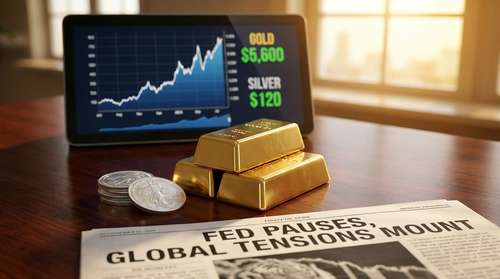
Precious metals markets entered a historic "melt-up" phase on Thursday, with gold spot prices shattering the $5,600 ceiling and silver surging past $120 an ounce. The dizzying rally comes in the immediate wake of the Federal Reserve's decision to hold interest rates steady at 3.50%-3.75%, defying pressure from the White House for further cuts. However, traders point to escalating geopolitical dread—specifically the deployment of a U.S. naval armada toward Iran—as the primary fuel for the panicked flight into safe-haven assets.
Precious Metals 'Melt-Up' Breaks All Records
The scale of the move has left veteran commodities traders stunned. Gold spot prices (XAU/USD) touched an intraday high of $5,595.44 early Thursday before consolidating near $5,550, marking a fresh all-time high. The yellow metal has now logged a staggering 102% gain over the past 12 months, driven by a perfect storm of central bank buying, currency debasement fears, and now, acute war risk.
Even more dramatic is the silver surge. The "poor man's gold" has finally eclipsed its legendary 1980 and 2011 peaks, rocketing nearly 29% since the start of 2026 to trade at $120.43 per ounce. Market analysts describe the price action as a classic "short squeeze" compounded by physical shortages, as industrial demand for silver in solar and EV manufacturing collides with desperate investment hoarding.
The 'Safe Haven' Stampede
"This isn't just a rally; it's a vote of no confidence in global stability," said a senior commodities strategist at J.P. Morgan. "When you see silver move $10 in a single session and gold ignore overbought technical signals, you know the market is pricing in a catastrophic geopolitical event. Investors are dumping fiat currency for hard assets at any price."
Fed Holds Steady at 3.5%, Breaking Cut Streak
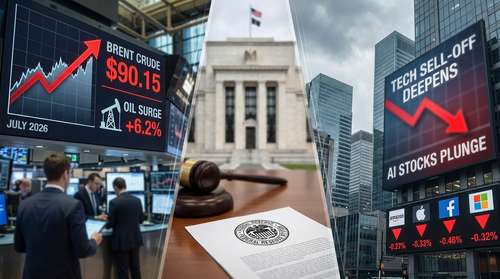
While the charts scream panic, the Federal Reserve attempted to project calm on Wednesday. The Federal Open Market Committee (FOMC) voted to maintain the federal funds rate at 3.50%-3.75%, pausing its easing cycle after three consecutive rate cuts in late 2025. The decision to hold was not unanimous; Governors Stephen Miran and Christopher Waller dissented, voting for another 25-basis-point reduction, highlighting the deep divisions within the central bank.
Fed Chair Jerome Powell, in a tense press conference, cited "solid" economic expansion and inflation that remains "somewhat elevated" above the 2% target as the rationale for the pause. "The economy is coming into 2026 on a firm footing," Powell stated, attempting to push back against market expectations of an immediate return to near-zero rates. However, his comments did little to soothe investors who fear the central bank is falling behind the curve as geopolitical risks explode.
The pause also drew immediate ire from the Oval Office. President Trump, who has frequently criticized the central bank's independence, took to social media to blast Powell, calling the decision to hold rates a "disaster" for American manufacturing and demanding lower borrowing costs to offset his aggressive tariff policies.
Geopolitical Powder Keg Ignites Market Volatility
The true driver of this week's gold price record 2026 isn't monetary policy, but war. Tensions in the Middle East reached a boiling point Wednesday night after President Trump confirmed that a "massive armada," led by the USS Abraham Lincoln, was moving into striking distance of Iran. The deployment follows a series of heated exchanges and the dramatic U.S. military operation in Venezuela earlier this month, which has left global nerves frayed.
Tehran's response has been bellicose, with Iran's Revolutionary Guard stating they have their "finger on the trigger." Reports that Supreme Leader Ayatollah Ali Khamenei has been moved to a fortified underground bunker have only deepened the sense of impending conflict. The geopolitical market volatility has sent oil prices higher, but gold and silver have been the primary beneficiaries, decoupling from traditional drivers like the U.S. dollar strength or real yields.
Gold vs US Dollar Forecast: What's Next?
Typically, a Fed pause and a relatively stable dollar would act as a headwind for non-yielding assets. However, the current dynamic has broken all historical correlations. The gold vs US dollar forecast has shifted into a new paradigm where gold rises alongside the dollar, as both are bid up as ultimate safe havens against localized currencies in Europe and Asia.
Technically, the metals are in uncharted territory. With the Relative Strength Index (RSI) for gold hovering near 85—extremely overbought levels—a correction would be normal. Yet, in a "melt-up" scenario driven by existential fear, technical resistance levels like $5,600 often become mere speed bumps. Analysts caution that while the volatility is dangerous for leveraged traders, the long-term trend remains firmly upward as long as the geopolitical picture remains fractured.
"We are watching a re-rating of tangible assets in real-time," noted a lead analyst at FXStreet. "Until the fleets turn around or the rhetoric cools, $6,000 gold isn't just possible—it's probable."