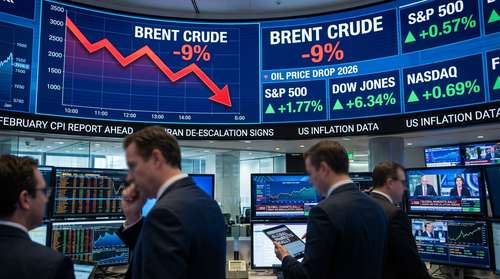
Global equities are witnessing a massive resurgence this Wednesday morning, driven by a dramatic overnight shift in energy markets and easing geopolitical tensions. The stock market rally today is being supercharged by a historic oil price drop 2026, which saw crude benchmarks plummet more than 9% to hover near the $90 per barrel mark. This sudden wave of investor optimism arrives just hours before the critical February CPI report release, creating a perfect storm for bullish market action. Following a surprisingly weak labor report last week, trading desks are rapidly recalibrating their expectations for the broader U.S. economy.
Iran Conflict De-escalation Triggers Brent Crude Price Crash
Only a few days ago, energy traders were aggressively pricing in a worst-case scenario. Crude oil was teasing the dreaded $100 threshold amid rising hostilities in the Middle East, threatening to unleash a secondary wave of global inflation. However, late-night diplomatic breakthroughs have signaled a material cooling of regional tensions. This sudden Iran conflict de-escalation immediately deflated the geopolitical risk premium that had artificially propped up energy markets throughout late February and early March.
The resulting Brent crude price crash wiped out nearly a tenth of the commodity's value in a single trading session. Plunging past key technical support levels, international benchmark Brent crude settled back near $90 a barrel, alleviating widespread fears of a protracted energy shock. Bank of America analysts recently warned that sustained high oil prices could severely damage final consumer demand and complicate central bank policy. For consumer-facing businesses and global supply chains, this sharp reduction in fuel costs provides immediate operational relief, sparking aggressive equity buying across European and Asian sessions that has now spilled over into North American markets.
All Eyes on the February CPI Report Release
While the plunge in energy costs is commanding the early morning narrative, Wall Street remains laser-focused on upcoming macroeconomic data. The Bureau of Labor Statistics is set to publish the February Consumer Price Index at 8:30 AM Eastern Time today, March 11. This specific release serves as the definitive scorecard for whether the U.S. economy is successfully navigating a soft landing after years of restrictive monetary policy.
Consensus estimates from FactSet suggest headline inflation will tick up slightly by 0.3% month-over-month, bringing the year-over-year rate to 2.4%—matching January's heavily scrutinized print. Meanwhile, core CPI, which strips out volatile food and energy sectors, is forecast to rise 0.3% on a monthly basis and hold steady at 2.5% annually. Market participants monitoring US inflation data news know that while shelter costs remain a sticky upward pressure point, continued declines in used vehicle pricing and goods inflation could provide the necessary offset.
Labor Market Cooling Adds Crucial Context
Today's inflation data arrives on the heels of a surprisingly soft employment picture that has already rattled fixed-income markets. Last Friday's February jobs report revealed an unexpected contraction, with payrolls shrinking by 92,000 and the national unemployment rate ticking up to 4.4%. This measurable labor market cooling implies that wage-driven inflation is no longer the primary threat to price stability. When combined with crashing energy inputs, the macroeconomic landscape looks vastly different today than it did just one week ago.
Federal Reserve Interest Rates in the Crosshairs
The intersection of falling oil prices, rising unemployment, and fresh inflation data carries profound implications for central bank policy. Sustained high energy prices are notoriously difficult for policymakers to manage because they act as a regressive tax on consumers while simultaneously driving up headline inflation. With crude retreating rapidly, Federal Open Market Committee members may finally find the breathing room they desperately need.
If today's inflation print comes in at or below expectations, the sudden drop in energy costs and a softening labor market could solidify a decisively dovish shift regarding Federal Reserve interest rates. Traders in the Fed Funds futures market are already pricing in a higher probability of imminent rate cuts. Lower borrowing costs directly reduce household debt burdens, inherently supporting the consumer discretionary sector without requiring aggressive monetary tightening to artificially destroy demand.
Sectors Leading the Stock Market Rally Today
The overnight recalibration of the energy complex has created clear winners in today's pre-market trading session. Transportation and logistics equities—particularly major airlines, cruise operators, and shipping conglomerates—are surging, as jet fuel and diesel constitute their largest variable operating costs. Consumer discretionary stocks are closely following suit, with investors betting that cheaper gas at the pump will translate directly into higher retail spending power heading into the spring season.
Even technology and growth stocks, which are highly sensitive to long-duration borrowing costs, are catching a robust bid. The underlying market logic is relatively straightforward: cheaper oil helps anchor long-term inflation expectations, which in turn keeps a firm lid on long-term Treasury yields. As the opening bell approaches on Wall Street, institutional trading desks are perfectly positioned to capitalize on the momentum. Whether this sweeping rally holds through the afternoon will ultimately depend on the exact decimal points hidden inside this morning's inflation report, but for now, the bulls are firmly back in control.