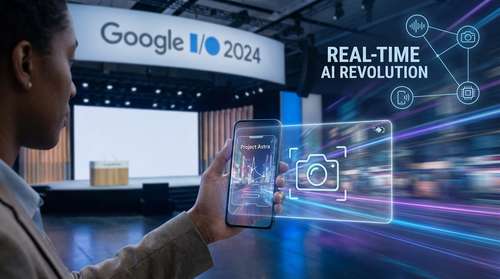
The tech landscape experienced a seismic shift during the developer conference in Mountain View, where the most crucial Google I/O 2024 highlights centered entirely on the transition from passive chatbots to proactive, intelligent systems. The unveiling of the Project Astra AI agent represents Google's ambitious vision to integrate artificial intelligence directly into the physical environment. By leveraging complex neural networks capable of seeing, hearing, and remembering context, the company is fundamentally rewriting the rules of human-computer interaction.
For years, users have interacted with digital assistants through rigid text prompts and stilted voice commands. The recent showcase demonstrated a leap toward fluid, uninterrupted dialogue. These advancements indicate that the future of AI assistants lies in systems that can process complex environmental cues instantly, making autonomous decisions to assist users with everyday tasks.
Project Astra: A Universal Agent for the Physical World
At the core of Google's strategy is Project Astra, a prototype designed to function as an omniscient digital teammate. During live demonstrations, the system utilized a smartphone camera to identify objects in a room and interact with the physical environment seamlessly. In one notable example, the AI was used to assist with coding problem-solving while also tracking down physical objects in the immediate area. It even recalled where a user had left their glasses moments earlier. This spatial awareness and memory retention marks a distinct evolution in consumer technology.
Mastering Real-Time Multimodal AI
The magic behind Astra is its foundation in real-time multimodal AI. Unlike older models that handled text, images, and audio in separate silos, Astra natively processes multiple data streams simultaneously. By ingesting video, spoken dialogue, and environmental sounds without noticeable lag, the assistant can hold natural, conversational back-and-forths. This uninterrupted flow allows users to interject, change subjects, and receive immediate, contextually accurate responses—mirroring a natural human dialogue. The system adapts to the user's pacing, eliminating the awkward pauses that have historically plagued voice assistants.
Gemini 1.5 Flash: Prioritizing Speed and Efficiency
To power these resource-intensive applications without overwhelming server capacities, developers were introduced to Google Gemini 1.5 Flash. Positioned between the mobile-focused Nano and the robust Pro models, Flash is specifically optimized for high-frequency tasks where low latency is critical. Despite its smaller footprint, it retains a massive one-million-token context window. This allows developers to feed it hours of video, extensive audio transcripts, or thousands of lines of code in a single prompt, receiving immediate synthesized outputs.
The timing of this release inevitably sparked discussions surrounding Google vs OpenAI GPT-4o. Just 24 hours prior to Google's keynote, OpenAI showcased its own rapid, natively multimodal model. While OpenAI focused heavily on emotive voice synthesis and hyper-fast conversational cadence, Google's counter-strategy emphasizes deep ecosystem integration and the unmatched context window of the Gemini family. Flash offers enterprise developers a highly cost-effective way to build responsive applications that require heavy data processing at lightning speeds, positioning Google as the pragmatic choice for complex workflows.
Transforming Mobile with Android 15 AI Features
Beyond cloud-based models, the conference illuminated how these advancements will directly impact billions of smartphone users. The upcoming rollout of Android 15 AI features focuses heavily on on-device processing via Gemini Nano, ensuring that powerful tools remain private and secure without requiring a constant internet connection.
One of the most practical applications announced is real-time scam detection. The operating system will listen to phone calls locally and flag conversational patterns typically associated with fraud—such as urgent requests for bank transfers or gift cards. It alerts the user immediately with an on-screen warning, all without sending audio data to the cloud. Additionally, Android 15 introduces a sophisticated Theft Detection Lock. By utilizing the phone's gyroscope and accelerometer, the AI can detect the specific physical motions of a snatch-and-run theft, instantly locking the screen to protect personal data before the thief can access it.
Enhancing Everyday Utilities
Google is also revamping its core applications to be more proactive. The "Ask Photos" feature allows users to query their image libraries using complex natural language—such as requesting the best photos from a specific national park trip—rather than relying on simple keyword matches. Workspace tools like Gmail and Docs are receiving tighter Gemini integration, enabling the AI to summarize long email threads, organize digital receipts into spreadsheets, and draft nuanced replies based on the user's specific context.
The Infrastructure Behind Proactive Computing
Underpinning all of these consumer-facing features is a massive upgrade to Google's physical infrastructure. To handle the staggering computational requirements of agentic AI, the company announced its sixth-generation Trillium processors, which promise nearly five times the peak compute performance of their predecessors. This hardware leap is what makes the instant processing of video and audio streams feasible at a global scale.
The overarching theme of these announcements is clear: the technology industry is moving past the novelty phase of generative text. By embedding multimodal processing into our pockets and workspaces, software is transforming into an active participant in our daily lives. As these intelligent agents continue to learn and adapt, the barrier between the digital ecosystem and the physical world will only continue to dissolve.