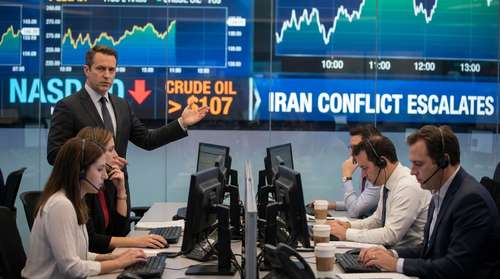
The financial markets have reached a critical inflection point as geopolitical shockwaves reverberate through the global economy. The escalating war in the Middle East has triggered a fierce stock market correction 2026, wiping out months of equity gains and pushing energy markets into a frenzy. With the Strait of Hormuz facing unprecedented disruptions, oil prices today have surged, threatening to undo the progress made on inflation over the past two years.
Following the rejection of a 15-point U.S. peace proposal by Iranian officials this week, Wall Street sentiment shifted from cautious optimism to outright panic. This diplomatic impasse has forced investors to confront the reality of a prolonged conflict, accelerating a massive flight from equities to safe-haven assets. Analysts are openly warning that the fallout could spark a severe global energy crisis 2026, leaving both consumers and corporations vulnerable to soaring input costs.
Nasdaq Correction Territory: Tech Stock Selloff Deepens
The technology sector, which served as the market's primary growth engine over the last year, has suddenly become its heaviest anchor. The tech-heavy Nasdaq 100 officially entered Nasdaq correction territory on Friday, plunging more than 11% from its October record high of 26,119 to settle around 23,138. This represents the index's lowest level in roughly seven months.
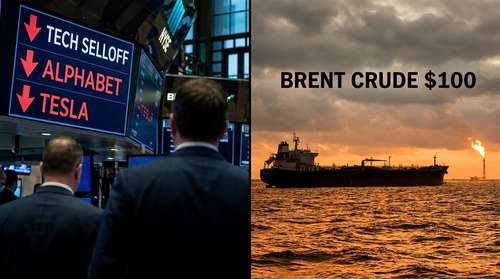
The broader market is feeling the acute pain as well. The Dow Jones Industrial Average has similarly shed 10% from its early-year peak, erasing over 800 points in a single Friday session alone. What began as a targeted repositioning has quickly evolved into a widespread tech stock selloff. Growth-oriented technology companies are notoriously sensitive to borrowing costs, and the prospect of sustained high energy prices has revived fears that the Federal Reserve will be forced to abandon its rate-cutting trajectory.
The Federal Reserve's Ultimate Dilemma
Central bankers now face an impossible balancing act. The U.S. economy was already showing signs of cooling before the conflict erupted. Now, surging crude threatens to unleash a new wave of inflation just as growth decelerates—a textbook recipe for stagflation. Investors who previously bought every market dip are adopting a highly defensive posture, recognizing that the Fed cannot simply lower rates to stimulate the market if energy-driven inflation remains untamed.
Safe-Haven Assets and Sector Winners
Amid the sweeping market carnage, a few distinct sectors are thriving. As tech valuations crumble, institutional capital is rapidly rotating into traditional energy entities and commodities. The Energy Select Sector SPDR Fund has emerged as a standout winner, climbing 1.6% late this week as refining margins widen alongside the massive Brent move. Gold and precious metals have seen erratic trading, occasionally tumbling as rising energy costs solidify a higher-for-longer interest rate narrative, but ultimately maintaining a floor due to systemic geopolitical fears.
Iran Conflict Economic Impact and the Supply Squeeze
The Iran conflict economic impact extends far beyond the trading floors of New York and London. The war, sparked by U.S.-Israeli strikes on Iran in late February, has severely compromised the Strait of Hormuz. This vital maritime chokepoint handles approximately a fifth of the world's daily oil and liquefied natural gas flow. The disruption of key global output has laid the groundwork for an immediate and dangerous energy deficit.
Diplomatic efforts currently offer very little relief. On Thursday, Iran's foreign minister firmly rejected direct negotiations with Washington, stating that indirect exchanges through mediators do not constitute a pathway to peace. U.S. President Donald Trump recently announced a 10-day pause on strikes against Iranian energy infrastructure—a fragile window slated to expire in early April—to allow negotiators room to maneuver. However, the massive gap in messaging between the two nations leaves the market bracing for renewed hostilities. If energy facilities sustain direct damage, repairs could take years, permanently altering the global supply chain.
Brent Crude Price Forecast: Navigating Triple-Digit Oil
Energy traders are systematically pricing in maximum geopolitical risk. On Thursday, global benchmarks spiked aggressively, with Brent crude blasting past $107 per barrel, up more than 5% on the day. U.S. West Texas Intermediate (WTI) crude closely followed suit, climbing toward the $95 mark. To put the sheer velocity of this move in perspective, U.S. crude oil costs have rocketed over 40% since the conflict began.
Looking at the near-term Brent crude price forecast, the outlook remains aggressively bullish so long as diplomatic channels stall. Market strategists warn that if the Strait of Hormuz faces a complete blockade, crude could realistically test the $110 to $120 range. Such an environment guarantees a cascading effect across all sectors. Heating oil and jet fuel prices have already spiked by 6%, ensuring that transportation, manufacturing, and logistics costs will aggressively filter down to everyday retail consumers.
Historical parallels are already being drawn to the market shock of February 2022 following Russia's invasion of Ukraine. However, the current crisis involves direct threats to Middle Eastern production facilities, amplifying the systemic risk. Until a concrete diplomatic resolution emerges, Wall Street remains entirely dependent on military headlines, navigating a treacherous financial landscape defined by triple-digit oil and deteriorating risk appetite.