Investors are bracing for a highly volatile start to the second quarter as the 2026 oil price spike sends shockwaves through the global economy. A widening conflict in the Middle East has severely disrupted international energy routes, pushing Brent crude past $112 per barrel and sending the tech-heavy Nasdaq into official correction territory. With the national average for gas surging an unprecedented $1 per gallon in just thirty days, persistent inflation fears are forcing Wall Street to completely reassess the Federal Reserve's monetary policy for the remainder of the year.
Strait of Hormuz Energy Crisis Drives Up Prices
The catalyst for this sudden financial turmoil is rooted in escalating geopolitical tensions. Following the outbreak of the US-Israel war on Iran in late February, the near-complete closure of the Strait of Hormuz has created an unprecedented supply bottleneck. Because roughly one-fifth of global oil and liquefied natural gas usually passes through this narrow maritime chokepoint, the disruption has severely restricted flows vital to the international economy.
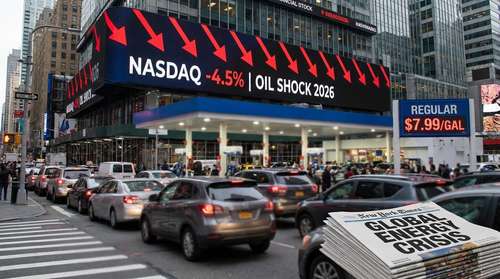
The immediate consumer impact has been brutal. When looking at gas prices March 2026, everyday drivers are experiencing one of the steepest one-month surges in recent history. The national average leaped from $2.98 in late February to $3.98 by the end of March. Regional disparities are even more stark, with California motorists now paying well over $5.30 per gallon. As President Trump extends negotiation deadlines into April to find a diplomatic off-ramp, energy analysts warn that the geopolitical premium on crude oil is unlikely to fade quickly. The longer these maritime supply routes remain compromised, the harder it will be for the global economy to avoid a pronounced deceleration.
The Nasdaq Correction 2026: Tech Sector Takes a Hit
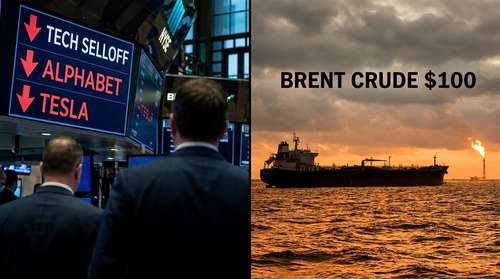
The escalating Middle East war economic impact has spilled aggressively into equity markets, triggering a broad and punishing sell-off. The Nasdaq Composite has officially entered correction territory, having fallen more than 10% from its bull market peak of nearly 24,000 in October. Investors are rapidly rotating out of risk-heavy growth sectors, particularly software-as-a-service (SaaS) and artificial intelligence stocks, seeking shelter in defensive and cyclical areas like energy and consumer staples.
Market Volatility Deepens
This Nasdaq correction 2026 reflects a fundamental shift in market psychology. Both the Dow Jones Industrial Average and the Russell 2000 have joined the tech-heavy Nasdaq in shedding roughly 10% from their recent all-time highs. Surging operational costs, driven by the energy sector, have triggered widespread profit-taking as portfolio managers adjust to a new normal of triple-digit crude prices. Historically, market corrections of this magnitude are not uncommon and average out to happen once a year, but the underlying geopolitical catalysts make this specific downturn uniquely unpredictable.
Shifting Inflation Trends 2026
The sudden energy crunch is radically altering inflation trends 2026. Entering the year, economists were generally optimistic that consumer prices were finally stabilizing around the central bank's target rate. However, the current oil shock acts as a universal tax on the economy, driving up costs across manufacturing, transportation, and retail sectors simultaneously. This swift transmission mechanism means that higher crude costs will inevitably bleed into core goods and services over the coming months.
This dynamic has created a complex dilemma for the Federal Reserve. At their March 18 meeting, the Fed opted to hold the benchmark interest rate steady at 3.50% to 3.75%, explicitly citing the unexpected energy market shocks and sticky inflation metrics. While earlier dot plot projections from December suggested multiple rate cuts this year, the central bank's path forward is now shrouded in uncertainty. If the Strait of Hormuz energy crisis persists, the Fed may be forced to abandon hopes of near-term rate reductions entirely to prevent a secondary wave of runaway inflation.
Rising US Recession Risk Forecast
With borrowing costs remaining restrictive and energy prices steadily sapping consumer purchasing power, the US recession risk forecast is inevitably climbing. Household budgets are being squeezed from multiple directions. When families spend significantly more to fill up their gas tanks and heat their homes, discretionary spending—the traditional engine of the American consumer economy—rapidly grinds to a halt. Retailers are already bracing for a subdued second quarter as shopper confidence wanes.
Furthermore, businesses are feeling the immediate pinch of elevated shipping and production expenses. If companies pass these surging overhead costs onto consumers, overall demand will likely falter. Conversely, if they choose to absorb the blow to maintain market share, corporate earnings will suffer. Dwindling profit margins often serve as a precursor to hiring freezes and eventual labor market contractions. Market participants now recognize that current financial volatility stems not from natural economic cycles, but from rigid supply-side infrastructure disruptions.
As we move deeper into the spring of 2026, Wall Street's gaze remains fixed on the Middle East. A swift diplomatic resolution could rapidly normalize oil prices, relieve inflationary pressures, and revive equity markets. However, an extended conflict threatens to cement high energy costs, keeping inflation elevated and pushing the fragile global economy closer to the brink of a pronounced downturn.