
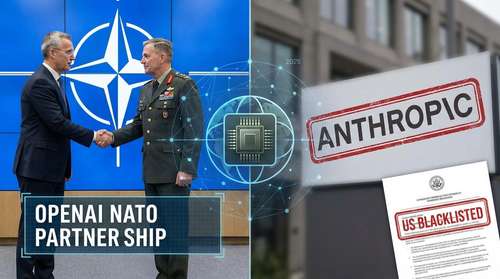
In a watershed moment for military artificial intelligence 2026, OpenAI is reportedly in the final stages of negotiating a landmark defense partnership with NATO. The deal, which would see OpenAI’s advanced models deployed across the alliance’s classified networks, comes just days after the United States government issued a crippling blacklist order against rival firm Anthropic. As the global arms race for AI defense technology accelerates, the divergence between the two AI giants has reshaped the national security landscape overnight.
OpenAI’s Strategic Pivot to the Atlantic Alliance
Sources close to the negotiations in Brussels report that OpenAI CEO Sam Altman is finalizing a contract that would integrate the company's proprietary models into NATO's command-and-control infrastructure. If signed, this OpenAI NATO contract would represent the most significant integration of commercial AI into a multinational military alliance in history. The partnership aims to streamline intelligence sharing, cyber defense, and logistical coordination among the 32 member states, creating a unified digital backbone driven by American AI.
The timing of the Sam Altman NATO deal is no coincidence. It follows OpenAI’s successful bid to secure a massive contract with the newly renamed U.S. Department of War (formerly the Department of Defense). While critics argue that deploying generative AI on classified networks invites unparalleled security risks, NATO officials have reportedly been swayed by OpenAI’s new "technical safeguard" protocols, which promise to align model behavior with military objectives without the rigid operational restrictions that stalled previous talks.
Anthropic Designated a ‘Supply-Chain Risk’
While OpenAI ascends to the role of the West's primary defense partner, its main competitor faces an existential crisis. On February 27, U.S. Secretary of War Pete Hegseth formally designated Anthropic a "Supply-Chain Risk to National Security." The unprecedented move, usually reserved for foreign adversaries like Huawei, effectively bans the Anthropic US ban target from competing for federal contracts and orders a six-month phase-out of its technology from all government agencies.
The blacklist stems from a fundamental disagreement over AI in warfare ethics. Anthropic CEO Dario Amodei reportedly refused to sign a Pentagon contract that required the removal of specific "red lines" regarding mass surveillance and autonomous weaponry. In a statement that has since been scrubbed from federal servers, Amodei argued that removing these guardrails would violate the company’s "Constitutional AI" principles. The Trump administration’s response was swift and severe, labeling the company’s refusal as an "ideological constraint" incompatible with national security AI requirements.
The ‘Red Lines’ Debate
The core of the dispute lies in the definitions of safety. Anthropic insisted on hard-coded prohibitions against using their models for lethal autonomous targeting or domestic surveillance. In contrast, OpenAI’s agreement with the Department of War relies on "mission-aligned oversight," a flexible framework that allows the military greater latitude in how the models are deployed. This pragmatic approach has secured OpenAI the keys to the kingdom, while Anthropic’s principled stand has locked it out of the lucrative military artificial intelligence 2026 market.
A New Era for the Department of War
The rebranding of the Defense Department to the "Department of War" signals a broader shift in U.S. military strategy, one that prioritizes lethality and speed over traditional bureaucratic caution. Under this new doctrine, AI defense technology is viewed not just as a support tool, but as a primary warfighting domain. The administration’s "AI First" strategy demands partners who are willing to move fast and break things—a philosophy that aligns more closely with OpenAI’s iterative deployment style than Anthropic’s safety-first caution.
Industry analysts predict that the blacklisting of Anthropic will have a chilling effect on the wider AI sector. Smaller labs may now feel pressured to abandon strict ethical guidelines to avoid similar retaliation. "The message from Washington is clear," says defense analyst Sarah Jenkins. "If you want to do business with the U.S. government, you play by their rules. There is no middle ground for conscientious objectors in the algorithmic age."
Global Implications of the NATO Deal
As the OpenAI NATO contract moves toward ratification, geopolitical rivals are taking note. The consolidation of Western AI power under a single provider has prompted accelerated development programs in China and Russia, both of which are racing to field their own sovereign defense models. The integration of OpenAI’s systems into NATO’s nuclear-armed alliance raises the stakes of the AI defense technology competition, moving the world closer to a future where algorithms play a central role in deterrence and escalation.
For now, Sam Altman stands as the uncontested victor in the battle for military contracts. But as these powerful systems come online within the Department of War and potentially NATO, the true test of their "technical safeguards" has only just begun. The world will be watching closely to see if the removal of ethical red lines leads to a more secure alliance or a more volatile battlefield.