
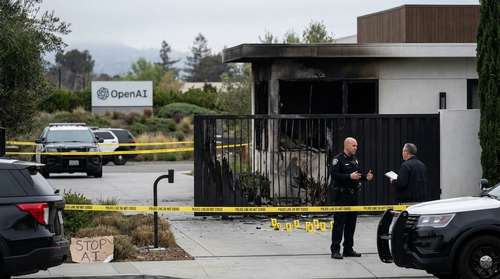
An alarming OpenAI security breach early Friday morning has exposed a radical shift in the debate over the future of artificial intelligence. A 20-year-old man from Texas is now in federal custody after allegedly throwing a Molotov cocktail at the San Francisco home of OpenAI CEO Sam Altman. Investigators revealed that the attempted firebombing was driven by a deep-seated belief that the company’s progress toward artificial general intelligence (AGI) would inevitably trigger the extinction of humanity.
The OpenAI CEO Attack: Timeline of the Assault
The escalation from online discourse to physical violence began in the pre-dawn hours of April 10, 2026. Authorities allege that the suspect, identified as Daniel Alejandro Moreno-Gama of Spring, Texas, traveled to California specifically to carry out the OpenAI CEO attack. At approximately 3:45 a.m., Moreno-Gama approached Altman’s $27 million residence in the Russian Hill neighborhood and hurled an improvised incendiary device at the property.
Fortunately, the Molotov cocktail bounced off the house, igniting a fire on an exterior gate without causing injuries to Altman, his husband Oliver Mulherin, or their young child. San Francisco Police responded shortly after 4:10 a.m., but the assailant had already fled the scene on foot.
From Residence to Headquarters
The threat did not end at the executive's doorstep. Roughly an hour later, officers were dispatched to the 1400 block of Third Street in Mission Bay, the site of OpenAI’s corporate headquarters. There, Moreno-Gama reportedly used a chair to strike the glass doors of the facility while threatening to burn the building down and "kill anyone inside". Responding officers immediately recognized him from the earlier incident profile and took him into custody. They recovered a blue lighter, a jug of kerosene, and a physical document outlining his motives at the scene.
Inside the 'AI Extinction Manifesto'
Central to the investigation is a disturbing document recovered by federal agents, titled "Your Last Warning". This AI extinction manifesto paints a grim picture of a suspect radicalized by artificial intelligence doomsday narratives. In the text, Moreno-Gama explicitly advocated for violence against AI company executives and their financial backers, viewing their assassination as a necessary measure to prevent human annihilation.
The manifesto included a targeted list of names and addresses belonging to prominent tech industry leaders. Online footprints show the suspect was steeped in extreme communities obsessed with the existential risks of technology, describing himself as a "consequentialist" and a "Butlerian Jihadist"—a direct reference to the science fiction trope of a holy war against thinking machines. Although he previously participated in the PauseAI Discord server, the organization swiftly banned him and disavowed his actions, stating that violence runs entirely counter to their mission of peaceful advocacy.
The Rising Tide of Anti-AI Extremism
This incident represents a stark escalation in anti-AI extremism, transforming theoretical doomsday arguments into real-world San Francisco tech crime. Industry watchers have long monitored the intense rhetoric surrounding generative AI, but few anticipated the rapid jump from digital boycotts to attempted murder. The ideological friction stems from what critics call the "alignment problem"—the challenge of ensuring an artificial superintelligence acts in the best interest of humanity. However, a radical fringe has distorted this concept, propagating the idea that preventing a hypothetical future apocalypse justifies immediate, violent intervention today.
In the aftermath of the attack, Sam Altman took to his personal blog to address the jarring reality of tech executive safety in the current climate. Sharing a photograph of his family, Altman wrote that he hoped humanizing himself might "dissuade the next person from throwing a Molotov cocktail at our house, no matter what they think about me". He acknowledged that anxiety surrounding AI is understandable but stressed that critics need to "de-escalate the rhetoric and tactics and try to have fewer explosions in fewer homes, figuratively and literally". Altman admitted he was previously too dismissive of the risk, noting that "words have power" and he had underestimated how dangerous certain narratives could become.
Legal Fallout and the Future of Tech Security
The swift law enforcement response underscores the severity of the threat. San Francisco District Attorney Brooke Jenkins announced multiple state charges against Moreno-Gama, including attempted murder, attempted arson, and possession of a destructive device. If convicted on the state charges alone, he faces a sentence ranging from 19 years to life in prison.
Meanwhile, the federal government has also mobilized. FBI Director Kash Patel confirmed that agents executed a coordinated operation at the suspect’s Texas residence on Monday to gather additional evidence. Federal prosecutors are weighing further legal action, including potential domestic terrorism enhancements, given the suspect's stated intent to influence corporate development and public policy through physical violence.
As Silicon Valley grapples with this unprecedented security breach, companies across the tech sector are actively reviewing their executive protection protocols. The transition from abstract philosophical debates about the alignment problem to tangible threats against human lives has forever altered the landscape of technological innovation. It serves as a chilling reminder that as artificial intelligence grows more powerful, so too does the ideological fervor of those who fear its ascendancy.