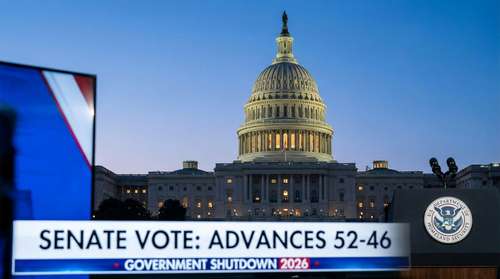
In a decisive move to break a 66-day partisan gridlock, the U.S. Senate has initiated a complex legislative maneuver designed to finally end the government shutdown 2026. Tuesday's pivotal 52-46 vote marks the beginning of a relentless push by Republican leadership to restore full operations at the Department of Homeland Security (DHS) without conceding to Democratic demands for immigration enforcement reform.
The partial closure, which began in mid-February, has officially become the longest US government shutdown on record. At the center of the dispute are fierce disagreements over federal policing tactics, stemming from the fatal shootings of two protesters, Renee Good and Alex Pretti, by federal agents in Minneapolis earlier this year. With airport security lines growing exponentially and temporary funding mechanisms running completely dry, lawmakers are facing immense public pressure to restore critical federal operations before May.
Bypassing Gridlock: The Senate DHS Funding Vote
The recent Senate DHS funding vote advanced strictly along party lines, underscoring the deep, persistent divisions within the current Congress. With Democrats holding firm on their demands for sweeping policy changes—including stricter rules on judicial warrants and mandatory identification for federal officers—GOP leadership realized a traditional bipartisan compromise was entirely out of reach.
To overcome the 60-vote filibuster threshold in the 53-47 chamber, John Thune Senate Majority Leader announced that Republicans would pursue funding "the hard way". The leadership is deploying a rarely used two-track legislative approach to ensure the Department of Homeland Security reopening can proceed rapidly. While a bipartisan bill is expected to fund standard operations like the Transportation Security Administration and FEMA, controversial immigration agencies will be stripped out and funded entirely through a separate, GOP-only mechanism.
Securing the ICE and Border Patrol Budget
The newly unveiled 58-page budget resolution directs congressional committees to draft a massive $70 billion ICE and Border Patrol budget. This sweeping funding package is explicitly designed to secure immigration enforcement operations through the remainder of the presidential term, preventing another lapse in appropriations. By isolating this highly controversial budget from the broader DHS appropriations, Republicans hope to force the reopening of non-disputed security agencies while thoroughly insulating their immigration enforcement priorities from Democratic policy riders.
The Tragic Catalyst Behind the Political Impasse
To fully grasp the magnitude of the current legislative crisis, you have to look back to the tragic events in January. Federal agents operating in Minneapolis fatally shot two protesters, sparking widespread public outrage and nationwide demonstrations. Senate Democrats immediately leveraged the looming spending deadlines to demand severe accountability measures. They insisted they would not authorize a single taxpayer dollar for ICE or Customs and Border Protection without actionable, legally binding restraints on federal officers.
Senate Minority Leader Chuck Schumer condemned the GOP's legislative workaround this week as a "partisan sideshow." Schumer forcefully argued that the Republican resolution funnels billions into immigration enforcement without putting any restraints on what he characterized as rogue agency violence. Despite these loud objections, the administration has refused to budge on its hardline immigration tactics, leading directly to this historic lapse in agency funding.
A High-Stakes Gamble: Speaker Mike Johnson Budget Reconciliation
Successfully executing this legislative bypass relies heavily on the Speaker Mike Johnson budget reconciliation strategy. Reconciliation allows the Senate to pass tax and spending measures with a simple majority, but the procedural path is notoriously difficult to navigate. It involves grueling marathon voting sessions, intense scrutiny from the Senate parliamentarian to ensure compliance with the Byrd Rule, and strict limitations regarding what types of structural policies can actually be included in the bill.
The high-risk strategy has also exposed significant fractures within the Republican party itself. House conservatives initially balked at the idea of separating DHS funding, fearing that passing the bipartisan portion first would leave the enforcement agencies orphaned and politically vulnerable. Speaker Johnson and Senator Thune have spent weeks holding delicate, closed-door negotiations to keep their respective chambers aligned. The eventual breakthrough required GOP leadership to promise their right-wing flank a dedicated megabill specifically tailored for immigration enforcement.
Looking Ahead: The Final Push for Resolution
With Homeland Security officials issuing stark warnings that the agency will soon be unable to cover basic employee salaries, the clock is ticking rapidly. The newly passed budget blueprint sets a strict May 15 deadline for both House and Senate committees to deliver the finalized reconciliation legislation. From there, the White House has imposed a hard June 1 mandate for the final bill to reach the Resolute Desk.
Whether this intricate dual-track strategy can survive the chaotic reconciliation process without further alienating moderate voters remains to be seen. However, Tuesday's 52-46 vote signals that lawmakers are finally moving aggressively to end the unprecedented stalemate. For the thousands of furloughed federal workers struggling to pay rent, and the millions of Americans affected by disrupted government services, the prospect of a fully funded and operational DHS cannot materialize soon enough.