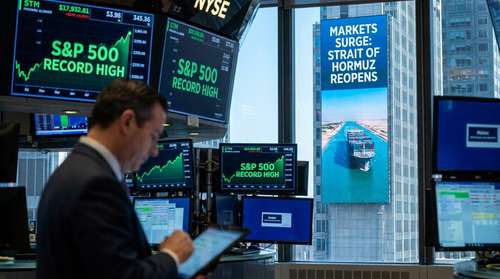
The global financial landscape witnessed a historic shift this week as the strategic Strait of Hormuz reopening sparked a massive relief rally across Wall Street. Following a tense period of geopolitical gridlock and naval blockades, Iran’s declaration that commercial tankers can once again traverse the Persian Gulf has ignited the markets. Investors breathed a collective sigh of relief, driving S&P 500 record highs 2026 as the threat of an extended energy crisis and global trade disruption recedes.
The benchmark S&P 500 leaped 1.2% to close at an unprecedented 7,126.07, capping off a remarkable winning streak that represents its strongest performance in years. This dramatic turnaround marks a sharp pivot from the steep losses endured in late February, with U.S. indices surging more than 11% since bottoming out in late March. The easing of Middle East tensions has fundamentally shifted investor sentiment, pulling capital out of safe-haven assets and back into growth-focused equities.
Global Stock Market Rally Erases Spring Volatility
The sudden de-escalation, tied to a newly announced 10-day ceasefire between Israel and Lebanon, sent a wave of optimism through international trading desks. President Donald Trump added momentum to the trading day by noting in a recent speech that the wider regional conflict "should be ending pretty soon". This combination of diplomatic progress and executive assurance catalyzed a global stock market rally that wasn't limited to the S&P 500. The tech-heavy Nasdaq all-time high today hit a staggering 24,468.48 after climbing 1.5%. Meanwhile, the blue-chip Dow Jones Industrial Average surged 1.8%, finishing at 49,447.43.
Market analysts note that the rally reflects a broader alleviation of fears regarding consumer stability and corporate profit margins. When the strait was effectively closed to commercial traffic, fears mounted that an inflationary shock would hammer the economy and prompt central banks to keep interest rates restrictive. The recent diplomatic breakthrough provides a vital pressure release valve for the entire financial ecosystem.
European and Asian Markets Respond
International indexes mirrored the enthusiasm seen in North America. France's CAC 40 jumped 2%, while Germany's DAX climbed 2.3% on the news. In Asia, where trading hours preceded the official announcement regarding the waterway, markets remained slightly depressed but are expected to aggressively catch up as the global recovery narrative takes root in the upcoming sessions.
Oil Price Market Impact and Supply Chain Stabilization
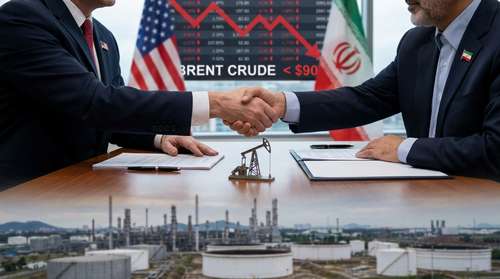
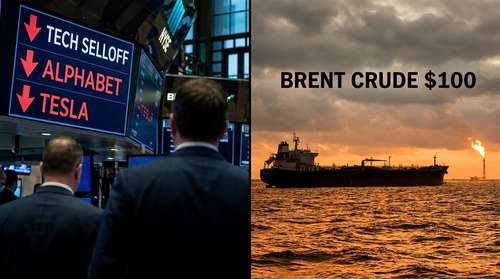
The most immediate oil price market impact was felt on the commodities exchange, where crude futures plummeted as traders rapidly priced out war-risk premiums. Brent crude, the international standard, dropped over 10% to settle at $89.13 per barrel—a steep decline from the $119 peaks seen just weeks ago. Benchmark U.S. crude tumbled 10.8% to $81.28, directly reflecting the newly restored flow of global energy supplies.
For the logistics sector and consumers alike, the latest supply chain news 2026 offers substantial relief. Millions of barrels of oil and gas, alongside essential commercial shipments, had been stalled by the naval conflict. Reopening this vital maritime chokepoint significantly lowers fuel costs for cargo operators, airlines, and ground transport networks. Shares in major travel companies saw immediate benefits, with United Airlines soaring 7.1% and cruise operators like Royal Caribbean gaining over 7% as fuel shortage fears dissipated.
Earnings Optimism Fuels the U.S. Equities Forecast
Beyond the geopolitical catalyst, a robust start to the first-quarter earnings season is underpinning the optimistic U.S. equities forecast. Institutional investors have been pleasantly surprised by the resilience of American corporations throughout the recent disruptions.
Major financial institutions, including Bank of America, State Street, and Morgan Stanley, posted trading revenues that soundly beat Wall Street estimates. Bank of America CEO Brian Moynihan highlighted that consumer credit quality remains robust and corporate clients are actively utilizing their capital lines. Furthermore, the technology sector continues to demonstrate relentless growth. Semiconductor giant TSMC reported a 58% jump in first-quarter profits, propelled by unabated artificial intelligence demand.
Navigating Future Volatility
These fundamental strengths, combined with retreating 10-year Treasury yields—which fell to 4.24% as inflation fears cooled—provide a solid foundation for continued market expansion. Prior to the ceasefire, banking executives like JPMorgan's Jamie Dimon had warned that energy shocks could reignite inflation. The current drop in crude oil prices directly neutralizes that specific threat.
While some caution remains embedded in the trading data—given that oil prices are still elevated compared to the $70 levels seen before the conflict—the mood on the trading floor is decidedly bullish. If the diplomatic agreements hold and commercial vessels continue navigating the Persian Gulf unhindered, the convergence of stabilizing energy costs and robust corporate earnings indicates this historic market momentum possesses the structural support needed to endure.