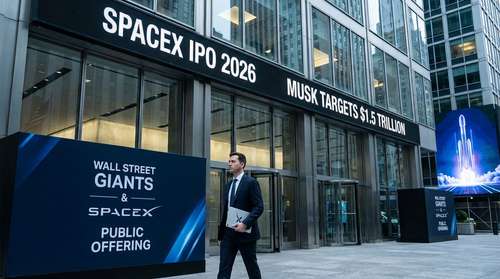
Elon Musk’s aerospace juggernaut SpaceX has reportedly selected a slate of top-tier investment banks to lead what could be the biggest IPO in history. According to breaking reports surfacing this week, the company has tapped financial heavyweights including Goldman Sachs, JPMorgan Chase, Morgan Stanley, and Bank of America to underwrite a SpaceX public offering targeted for mid-2026. The listing seeks a staggering Musk 1.5 trillion valuation, a figure that would instantly catapult SpaceX into the ranks of the world's most valuable companies, surpassing the market caps of Meta and Berkshire Hathaway overnight.
Wall Street Giants Assemble for a Record-Breaking Deal
The selection of these SpaceX investment banks signals the end of an era for the company, which has famously remained private since its founding in 2002 to avoid the short-term pressures of public markets. However, the sheer scale of Musk’s ambitions—ranging from the colonization of Mars to the deployment of a new orbital AI infrastructure—requires capital that only the public equity markets can provide.
Insiders familiar with the deal suggest the offering could raise upwards of $30 billion, eclipsing Saudi Aramco’s $29 billion listing in 2019 to set a new global record. While the company was valued at approximately $800 billion in a private share sale late last year, the target of $1.5 trillion reflects a bullish outlook on its monopolistic dominance in launch services and the exponential growth of its Starlink satellite internet business.
The Multi-Trillion Dollar Catalyst: Orbital AI Data Centers
Why IPO now? The primary driver behind the sudden pivot to a public listing appears to be Musk's aggressive entry into the artificial intelligence race. Unlike terrestrial competitors struggling with power constraints and cooling requirements for massive data centers, SpaceX is pioneering the concept of Orbital AI data centers.
Reports indicate that a significant portion of the IPO proceeds will fund the deployment of Starlink V3 satellites. These next-generation units are not just communication relays but fully functional orbital compute nodes equipped with high-performance TPUs and GPUs. By placing data centers in orbit, SpaceX aims to leverage limitless solar energy and the cold vacuum of space for cooling, effectively solving two of the biggest bottlenecks facing the AI industry on Earth.
Starlink’s Explosive Growth Metrics
The financial bedrock of the SpaceX IPO 2026 is undoubtedly Starlink. As of late 2025, the constellation has grown to serve over 8.5 million subscribers globally, with projected revenue hitting $24 billion for fiscal year 2026. This recurring revenue stream provides the stability investors crave, balancing the high-risk, high-reward nature of the Starship program.
Analysts point out that Starlink alone—if spun off—would likely be a Fortune 50 company. However, by keeping it integrated within SpaceX, Musk offers investors a "double threat": a cash-generating utility monopoly (Starlink) and a deep-tech growth engine (Starship and AI).
Elon Musk SpaceX Valuation: Is $1.5 Trillion Justified?
Skeptics might balk at the Elon Musk SpaceX valuation doubling from $800 billion to $1.5 trillion in less than a year. However, market sentiment has shifted dramatically as SpaceX solidifies its role as the "logistics backbone" of the space economy. With the Falcon 9 rocket accounting for the vast majority of global payload to orbit and Starship beginning regular commercial operations, the company faces virtually no serious competition.
"We are looking at a company that effectively owns the harbor, the ships, and the cargo in the new space age," notes a senior equity analyst at a major New York firm. "When you factor in the potential of orbital compute, a $1.5 trillion tag might actually look conservative in five years."
Timeline and What to Expect Next
While the official S-1 filing has not yet been made public, the engagement of Goldman Sachs and JPMorgan suggests the process is moving quickly. A roadshow is anticipated for Q2 2026, with the SpaceX IPO 2026 likely hitting the ticker tape by summer.
For retail investors, this represents the first opportunity to own a piece of Musk’s space empire directly. Previously, exposure was limited to owning Tesla stock or investing in niche venture funds. The Starlink IPO news rumor mill has churned for years, but this unified offering confirms that Musk intends to keep the ecosystem intact, leveraging Starlink's cash flow to fund the colonization of Mars.
As the date approaches, all eyes will be on the regulatory environment and market conditions. If successful, this will not only be the biggest IPO in history but a defining moment that bridges the gap between the terrestrial economy and the burgeoning orbital industrial complex.