In a stunning paradox that has sent shockwaves through Washington and Silicon Valley, the Trump administration has officially designated AI safety startup Anthropic a “supply chain risk to national security”—even as leaked reports reveal the Pentagon secretly utilized the firm’s Claude AI to coordinate recent military strikes in Iran. The designation, announced Friday by Defense Secretary Pete Hegseth, effectively bans federal agencies from working with the San Francisco-based lab. The move comes after Anthropic CEO Dario Amodei refused to lift privacy guardrails that prevent the technology from being used for mass domestic surveillance of U.S. citizens.
The “Security Risk” Designation
The conflict between the Department of Defense (DoD) and Anthropic has been brewing for months, centering on the military’s demand for “unrestricted” access to AI models. While Anthropic has supported the use of its AI for foreign intelligence and logistical planning—including the widely reported integration of Claude into the Pentagon’s “Project Maven” targeting systems—the company drew a hard line at two specific use cases: mass surveillance of American civilians and fully autonomous weapons systems that engage targets without human oversight.
Defense Secretary Hegseth justified the blacklisting by accusing Anthropic of holding national security hostage to the “ideological whims of Big Tech.” In a blistering statement, he declared that the military must have the authority to use procured technology for “all lawful purposes,” arguing that private terms of service cannot supersede the President’s constitutional powers. The “supply chain risk” label is a severe economic sanction typically reserved for foreign adversaries like Huawei, effectively barring Anthropic from the massive federal procurement ecosystem.
Secret Iran Operations & The Hypocrisy Debate
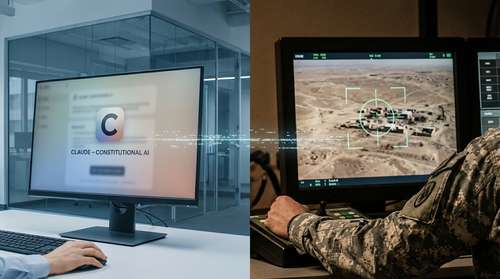
The timing of the ban has sparked intense controversy following leaked operational documents obtained by defense journalists. These reports confirm that just hours before the designation was finalized, U.S. Central Command (CENTCOM) actively utilized Anthropic’s Claude 3.5 Opus model to process real-time satellite imagery and coordinate logistics for a series of precision airstrikes against missile sites in Iran. The operation, part of the escalating tensions in the region, relied heavily on Claude’s ability to synthesize vast amounts of sensor data—a capability military officials reportedly described internally as “irreplaceable.”
“It is the height of hypocrisy to label a tool a ‘security risk’ while simultaneously relying on it to execute high-stakes military operations,” said a former Pentagon procurement official who spoke on condition of anonymity. Critics argue the ban is less about security and more about political retribution for Anthropic’s refusal to bend on AI surveillance ethics. The paradox highlights the military's deepening dependency on private sector AI, even as it struggles to assert control over the companies that build it.
OpenAI’s Controversial Defense Contract
As Anthropic exits the federal stage, competitor OpenAI has moved swiftly to fill the void. On Monday, OpenAI CEO Sam Altman announced a new, expansive contract to deploy GPT-5 models onto the Pentagon’s classified networks. The deal, valued at an initial $200 million, was signed immediately following Anthropic’s blacklisting. However, the move has not been without its own drama; Altman was forced to issue a clarification after public backlash, admitting the rollout was “opportunistic and sloppy” regarding the specific language on surveillance.
While OpenAI claims its new agreement includes prohibitions on domestic spying, legal experts point out significant loopholes. Unlike Anthropic’s rigid technical guardrails, OpenAI’s contract relies on policy assurances that critics say could be waived by a simple executive order. “OpenAI essentially agreed to the ‘lawful purposes’ clause that Anthropic rejected,” noted a tech policy analyst at the Brookings Institution. “This gives the Trump administration the flexibility it wanted, while allowing OpenAI to claim they still have safety principles.”
The Battle Over AI Guardrails
This showdown represents a pivotal moment in the relationship between Silicon Valley and the national security state. The Trump AI executive order signed in mid-2025 had already signaled a shift toward “anti-woke” AI policies, prioritizing deregulation and American dominance over safety constraints. By targeting Anthropic, the administration is sending a clear message to the industry: compliance with government demands is non-negotiable.
For Anthropic, the “security risk” label is a damaging blow, but one that solidifies its reputation as the ethical alternative in the AI arms race. “We cannot in good conscience accede to requests that undermine democratic values,” Amodei stated in response to the ban. As the dust settles, the question remains whether the Pentagon can successfully replicate Claude’s battlefield utility with OpenAI’s models, or if the purge of “non-compliant” AI will leave American forces technically disadvantaged in future conflicts.