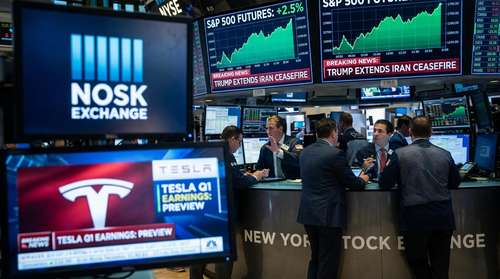
U.S. equity markets are staging a robust pre-market rebound this Wednesday morning as a stock market rally 2026 takes shape. The catalyst is twofold: a critical geopolitical pressure release valve and the kickoff of a massive earnings week. Investors breathed a collective sigh of relief following the overnight announcement of a Trump Iran ceasefire extension. With macro fears slightly tempered, Wall Street's attention is rapidly pivoting to corporate fundamentals, where a highly anticipated Tesla Q1 earnings preview is setting the stage for what traders are calling "Monster Week."
The sudden de-escalation of immediate Middle East tensions has injected fresh optimism into trading desks, lifting S&P 500 futures news headlines and propelling tech-heavy indices upward. However, beneath the broad market lift, the financial sector is bracing for critical disclosures that will test the resilience of AI technology stocks and the broader narrative of global economic stability.
Geopolitical Relief: The Iran Ceasefire Extension
The geopolitical landscape shifted dramatically late Tuesday when President Donald Trump announced an indefinite extension of the impending ceasefire with Iran. Citing a "seriously fractured" leadership structure in Tehran, the administration signaled a willingness to hold off on fresh military strikes, though strict enforcement of the Strait of Hormuz blockade remains firmly in effect.
The diplomatic breakthrough—albeit fragile—comes after plans for a second round of peace talks collapsed. Vice President JD Vance was scheduled to travel to Islamabad for negotiations, but the trip was abruptly canceled when Iranian representatives backed out, reportedly citing unreasonable U.S. demands. Despite the stalled diplomacy, the mere avoidance of immediate escalation sent shockwaves of relief through financial markets.
By early Wednesday, S&P 500 futures advanced 0.58% to 7,104.66, while Nasdaq 100 futures led the charge, climbing 0.71%. Dow futures also gained 0.50%. The broader bond and commodities markets reacted swiftly to the de-escalation as well. The benchmark 10-year U.S. Treasury yield edged down slightly to 4.29%, while safe-haven assets like gold advanced to $4,760 an ounce.
Energy markets, however, remain highly sensitive to the geopolitical impact on business. With the Strait of Hormuz still closed to Iranian shipping, global crude benchmarks are elevated. Brent crude is currently hovering near $98.95 a barrel, and U.S. West Texas Intermediate (WTI) pushed past $90, extending recent two-day gains.
All Eyes on the Tesla Q1 Earnings Preview
While the ceasefire extension provides macro breathing room, micro-level scrutiny is intensifying around Tesla. Set to report first-quarter results after the closing bell on April 22, the automaker is facing what Wall Street analysts describe as a critical credibility test. Consensus estimates peg revenue between $21.4 billion and $22.7 billion, representing a sequential decline from Q4 2025 and reflecting significant seasonal headwinds. Adjusted earnings per share are expected to land around $0.33 to $0.37.
Tesla has already reported a disappointing Q1 delivery figure of 358,023 vehicles, falling nearly 7,600 units shy of consensus expectations. This has created a production-to-delivery gap of roughly 50,000 units, raising concerns about an inventory overhang that could force future price cuts. For investors, automotive gross margins—specifically the 17% to 18% threshold—will be the essential metric indicating whether the company maintains its pricing power amid cooling EV demand.
Pivoting from Automaker to AI Powerhouse
The core narrative driving Tesla's valuation has aggressively shifted from electric vehicle dominance to a broader bet on robotics and automation. The market is increasingly viewing the company as a physical AI platform rather than a traditional car manufacturer. Investors will be listening closely for concrete timelines regarding the Cybercab robotaxi rollout, the Optimus humanoid robot, and the deployment of Dojo supercomputers.
This pivot comes with a massive price tag. Tesla's capital expenditures for 2026 are projected to soar past $20 billion—a steep climb from $8.5 billion the previous year. This unprecedented spend on AI technology stocks infrastructure poses real cash-flow tension in the near term. Shareholders are demanding clarity on when these capital-intensive, futuristic bets will begin generating tangible revenue.
The Convergence of Macro and Micro Forces
The intersection of easing global tensions and pivotal corporate earnings is setting up a highly volatile trading environment. The current stock market rally 2026 relies heavily on this delicate balance. If energy prices stabilize due to the extended ceasefire, inflationary pressures could ease, giving the Federal Reserve more leeway in its monetary policy.
Market analysts note that the rapid, V-shaped rebound equities experienced as Middle Eastern hostilities subsided might face resistance if mega-cap earnings fail to impress. The upcoming days are critical for maintaining global economic stability, as traders weigh the cost of energy against consumer spending data and corporate profitability.
Simultaneously, "Monster Week" will set the tone for the tech sector. Beyond Tesla, major players like AT&T, Boeing, and GE Vernova are also slated to release their quarterly financials. Should Tesla provide an upbeat, concrete roadmap for its AI monetization alongside resilient auto margins, it could supercharge the current market momentum. Conversely, any major operational stumbles could ripple through the tech-heavy Nasdaq, testing the bounds of the newly restored market confidence.