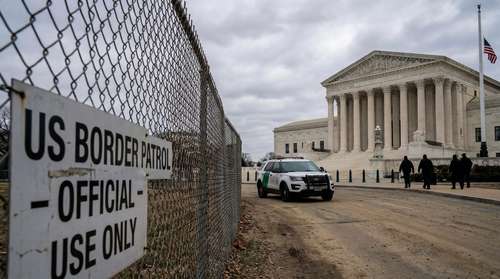
On June 25, 2026, the nation’s highest court fundamentally transformed the landscape of American asylum and immigration law. In a pair of sweeping 6-3 decisions, the conservative majority handed the executive branch unprecedented authority to block migrants at land crossings and strip humanitarian protections from hundreds of thousands of people residing legally in the United States. The Supreme Court immigration ruling 2026 marks a watershed moment, dismantling decades-old refugee frameworks and setting the stage for a massive enforcement campaign.
The Mullin v Al Otro Lado Decision: Redefining Asylum at the Border
At the heart of the controversy is the Mullin v Al Otro Lado decision, which centered on the legality of turning away asylum seekers before they set foot on American soil. For years, the US border metering policy allowed U.S. Customs and Border Protection (CBP) officers to physically block migrants on the Mexican side of the border, forcing them onto perilous, unofficial waitlists. Lower courts had previously struck down the practice, ruling that it violated the government's statutory obligation to process asylum claims for anyone presenting themselves at a port of entry.
Writing for the conservative majority, Justice Samuel Alito argued that the Immigration and Nationality Act’s guarantee of asylum processing only applies once a person actually crosses the boundary line. “In ordinary speech, no one would say that a person ‘arrives in’ a place... before the person enters that place,” Alito stated. This literal, geographical interpretation means CBP agents have no legal duty to inspect or process individuals stopped even inches outside U.S. territory.
The ruling triggered a visceral rebuke from the court's liberal wing. Justice Sonia Sotomayor, delivering a rare, impassioned dissent from the bench, warned of devastating human costs. “The consequences of today’s decision are predictable. More people will die,” Sotomayor read, underscoring the lethal risks migrants face while stranded in northern Mexico. In an unusual break from courtroom decorum, Justice Alito responded to her directly from the bench, noting he would have expanded his written remarks had he known she planned a verbal dissent—a stark illustration of the deep ideological fractures dividing the court.
White House Reaction: The Stephen Miller Asylum Statement
The White House and the Department of Homeland Security (DHS), now led by Secretary Markwayne Mullin, wasted no time celebrating the judicial victories. Following the release of the opinions, administration officials made their operational intentions unambiguously clear.
In a highly publicized Stephen Miller asylum statement, the architect of the administration's hardline immigration agenda declared that America's doors are fully "closed" to asylum seekers. Miller announced that the government is preparing rapid enforcement operations to capitalize on their newfound judicial backing, signaling an immediate end to systemic leniency at the southern border.
DHS General Counsel James Percival echoed the triumphant sentiment, calling the rulings “victories for the rule of law and common sense”. Percival emphasized that the agency now possesses critical legal leverage to aggressively secure the border, confirming that physical turnbacks will become standard operating procedure moving forward.
The Trump Administration TPS Ruling: Reversing Humanitarian Protections
While the border decision reshapes future arrivals, a companion case, Mullin v. Doe, threatens immigrants who have built lives in the United States for over a decade. The Trump administration TPS ruling affirmed the executive branch's power to revoke Temporary Protected Status (TPS) for foreign nationals fleeing disasters and armed conflicts.
Congress created TPS in 1990 to offer a safe haven for foreign nationals stranded in the U.S. when extraordinary events make returning home potentially fatal. However, the conservative majority determined that federal courts largely lack the jurisdiction to review a DHS Secretary's subjective decision to terminate a country's TPS designation.
Justice Alito emphasized that TPS functions almost entirely at the discretion of the executive branch. He noted that while the program was designed to afford temporary relief, designations have practically lasted for decades. The ruling effectively shields the administration from judicial interference, removing the legal roadblocks that had stalled the termination of protections for approximately 350,000 Haitians and roughly 4,000 Syrians.
Looming Threats of Haitian TPS Deportation
Advocates and lawmakers are sounding the alarm over the immediate threat of widespread Haitian TPS deportation. Haiti remains engulfed in a severe security and humanitarian crisis, leading the U.S. State Department to maintain strict "Do Not Travel" advisories. Despite these documented dangers, the court’s decision clears the runway for DHS to strip these individuals of their legal work authorization and force them into removal proceedings.
"We are watching the forced expansion of the deportation pipeline in real time," warned Adina Appelbaum, Program Director at the Amica Center. Representative Delia Ramirez characterized the combined rulings as an assault on human rights, pointing out that hundreds of thousands of people who have lived and worked legally in American communities are now thrust into immediate legal jeopardy.
What These Historic Rulings Mean for U.S. Immigration
As the nation grapples with these sweeping changes, the rulings provide the White House with significant operational momentum. By validating the physical obstruction of asylum seekers and shielding executive TPS terminations from the courts, the Supreme Court has removed the primary guardrails that historically restrained mass deportation frameworks.
Immigration lawyers and civil rights organizations are now scrambling to find alternative legal avenues for the millions of people caught in the crosshairs. Ultimately, the dual decisions consolidate immense, unchecked power within the executive branch to dictate who gets to seek refuge at the border and who gets to stay safely within the country.