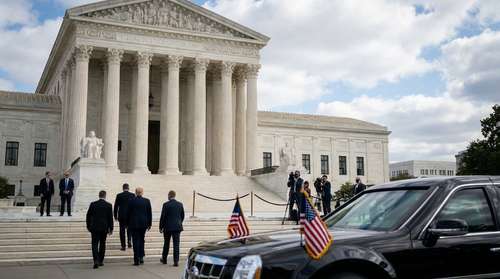
In a historic legal showdown, the U.S. Supreme Court signaled deep skepticism on Wednesday toward President Donald Trump’s sweeping effort to dismantle automatic citizenship for children born in the United States to undocumented immigrants. The high-stakes birthright citizenship Supreme Court clash took an unprecedented turn as Trump himself sat in the public gallery, marking the first time a sitting president has attended oral arguments at the nation's highest court.
An Unprecedented Courtroom Appearance and a US Citizenship Legal Battle
On April 1, 2026, the long-anticipated Trump 14th Amendment case, formally known as Trump v. Barbara, finally reached the justices. Trump, who issued the controversial end of birthright citizenship executive order on the first day of his second term in January 2025, arrived at the courthouse just before 10:00 a.m.. Surrounded by heightened security, he took a seat alongside Attorney General Pam Bondi and Commerce Secretary Howard Lutnick.
While his presence underscored the sheer political weight of this US citizenship legal battle, the president remained uncharacteristically quiet. As a silent observer, Trump watched Solicitor General D. John Sauer defend the administration's policy for just over an hour before departing the chamber during the rebuttal from American Civil Liberties Union (ACLU) national legal director Cecillia Wang.
Shortly after exiting, however, Trump took to his Truth Social platform to voice his frustration, writing: "We are the only Country in the World STUPID enough to allow 'Birthright' Citizenship!".
Inside the Chamber: SCOTUS Birthright Citizenship Skepticism
Despite the glare of the commander-in-chief seated just feet away, the justices did not hold back. Throughout the two-hour session, there was widespread SCOTUS birthright citizenship skepticism coming from both the liberal and conservative wings of the bench.
The administration's central argument hinges on redefining the 14th Amendment’s phrase "subject to the jurisdiction thereof." Sauer argued that children of undocumented immigrants do not qualify because their parents owe allegiance to a foreign power. However, several conservative justices, including those appointed by Trump, appeared unconvinced.
The 14th Amendment Case and Precedent
Justice Neil Gorsuch explicitly questioned the government's interpretation of the landmark 1898 case United States v. Wong Kim Ark, which affirmed that nearly everyone born on U.S. soil is a citizen. "I'm not sure how much you want to rely on Wong Kim Ark," Gorsuch told Sauer during the proceedings.
Justice Brett Kavanaugh also pushed back on the administration's legal theories. He noted that if the Court chooses to uphold the traditional legal understanding of birthright citizenship established over a century ago, "this is a short opinion".
Meanwhile, the liberal justices aggressively challenged the logic of the administration. Justice Ketanji Brown Jackson offered a compelling hypothetical to illustrate how physical presence establishes local jurisdiction. She noted that if she, as an American, were to visit Japan and steal a wallet, Japanese authorities would have the full power to arrest and prosecute her—proving she was subject to their jurisdiction while physically on their soil.
Defending the Controversial Executive Order
For the Trump administration, the executive order remains a cornerstone of his second-term immigration agenda. Trump’s legal team contends that for over 150 years, the United States has misinterpreted the Civil War-era amendment, which was originally drafted to grant citizenship to formerly enslaved Black Americans following the overturning of the infamous Dred Scott decision.
Conversely, the ACLU and a coalition of civil rights groups argue that the administration is unlawfully trying to rewrite the Constitution. Cecillia Wang emphasized that the 14th Amendment and centuries of subsequent legal rulings categorically protect the citizenship of anyone born in the country, barring a few narrow exceptions like the children of foreign diplomats. Wang asserted that the executive order flouts fundamental American values and threatens to create a permanent, multigenerational underclass of residents.
Legal scholars have long warned that dismantling this right would throw the immigration system into chaos. Prominent experts, including Yale Law School faculty and former Republican officials, filed amicus briefs arguing that the executive branch cannot unilaterally bypass Congress. They noted the amendment’s original authors focused solely on the child being "born" in the U.S., without conditioning citizenship on parental legal status.
Anticipating the Supreme Court Immigration Ruling 2026
Since its signing in early 2025, the executive order has been universally blocked by every lower federal court that has reviewed it. Based on the pointed questions and the evident fact that Trump attends oral arguments without swaying the bench, the Supreme Court appears highly likely to deal a final blow to the policy.
The impending Supreme Court immigration ruling 2026, expected by late June or early July, will have profound ramifications for millions of families. If the Court were to surprisingly uphold the order, it would instantly strip the guarantee of citizenship from countless future children and create massive disruptions in public education and social services across the country. However, Wednesday's proceedings strongly suggest the justices are prepared to maintain the long-standing constitutional consensus, leaving American birthright citizenship intact for the foreseeable future.