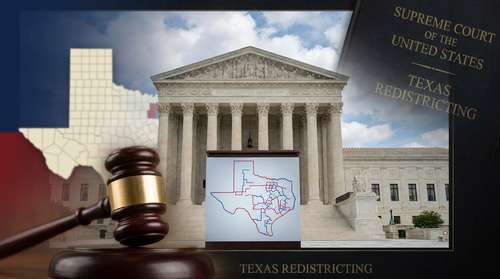
The U.S. Supreme Court formally reinstated a redrawn Texas congressional map on Monday, putting an end to a fierce legal battle and securing a significant advantage for Republicans ahead of the upcoming elections. In a pivotal 6-3 decision, the conservative majority struck down a lower court's ruling that had blocked the map over allegations of racial discrimination. By cementing the district boundaries indefinitely, this consequential Supreme Court Texas ruling promises to be a dominant force in 2026 midterm election news, potentially handing the GOP up to five additional seats in the U.S. House of Representatives.
The Legal Battle Over Texas Redistricting at SCOTUS
Monday's summary order by the high court officially finalizes a temporary stay the justices issued last December. The dispute over this specific Texas redistricting SCOTUS case began in the summer of 2025, breaking from the traditional once-a-decade timeline for drawing legislative maps. Responding to public pressure from President Donald Trump to maximize partisan advantages before the midterms, the Republican-led Texas legislature embarked on a highly unusual mid-decade redistricting effort. Governor Greg Abbott signed the new map in August 2025, prompting immediate litigation from civil rights groups and pro-voting organizations who argued the map disenfranchised voters of color.
In November 2025, a panel of federal judges halted the implementation of the new boundaries. Judge Jeffrey Brown, a Trump appointee, authored a scathing 160-page opinion, concluding there was "substantial evidence" the map was designed to dilute minority voting power. Brown's ruling asserted the redrawn lines violated constitutional protections and the Voting Rights Act 2026 enforcement standards by intentionally sidelining Black and Latino communities. The lower court injunction was celebrated by civil rights advocates but aggressively appealed by the state's legal team.
Partisan Advantage vs. Racial Gerrymandering 2026
The Supreme Court's summary reversal effectively bypasses the lower court's extensive findings on racial discrimination. Instead, the conservative majority characterized the Republican-led effort as an exercise in partisan gerrymandering. Under existing Supreme Court precedent, federal courts cannot block election maps drawn purely for partisan advantage, drawing a distinct, albeit controversial, line between acceptable political maneuvering and illegal racial gerrymandering 2026 claims.
The court's three liberal justices—Elena Kagan, Sonia Sotomayor, and Ketanji Brown Jackson—sharply dissented from Monday's decision. Echoing arguments she made during the emergency stay phase, Justice Kagan criticized the conservative majority for casually discarding a comprehensive district court review based on a hasty perusal of a "cold paper record". The dissenters argued that the summary ruling severely disrespects the meticulous fact-finding conducted by the lower court judges. On the other side of the aisle, 5th U.S. Circuit Court of Appeals Judge Jerry Smith, the lone dissenter in the initial lower court panel, previously blasted Judge Brown's injunction as the "most blatant exercise of judicial activism" he had ever witnessed.
Securing GOP House Seats in Texas
With the legal cloud now lifted, Texas election officials have the green light to proceed without further disruption. The finalized lines will fundamentally shape the landscape of the fast-approaching 2026 Congressional primaries, forcing several incumbents to navigate unfamiliar constituencies while creating prime pickup opportunities for conservative challengers.
The stakes for control of the U.S. House could not be higher. Republicans currently hold a razor-thin majority in Congress, and maintaining or expanding that margin is a top priority for the party's legislative agenda. If the GOP loses control of the House, it would open the door to Democratic-led congressional investigations and stall conservative legislative efforts. By altering the state's electoral geography to maximize GOP House seats Texas stands as the cornerstone of the party's nationwide midterm strategy.
A Nationwide Redistricting Arms Race
The Texas controversy is not unfolding in a vacuum. The unprecedented mid-decade push by Republicans sparked a direct counter-offensive from Democrats elsewhere. In February, the Supreme Court allowed California to implement a new electoral map explicitly designed to give Democrats five additional congressional seats, a move initiated by the Democratic-led state in direct retaliation to the actions of Texas Republicans. This tit-for-tat escalation underscores how state legislatures are increasingly weaponizing map-drawing to dictate national power dynamics.
For everyday Texans, the ruling means their district boundaries are locked in indefinitely, likely until the next mandatory redistricting cycle following the 2030 Census. Legal experts note that while this specific injunction has been overturned, separate challenges to the map that do not seek immediate injunctive relief remain active. Those underlying lawsuits will continue to be litigated in the background, though they will not affect the upcoming November elections.
In response to the Supreme Court's decision, civil rights leaders and voting advocates are shifting their strategies from the courtroom to the campaign trail. Organizations that initially sued the state are now launching massive voter registration and mobilization drives aimed at overcoming the new district hurdles. "For now, Black voters and other voters of color in Texas will have to cast their ballots based upon a rigged map," the Lawyers' Committee for Civil Rights Under Law stated following the litigation, urging residents to participate in overwhelming numbers. Meanwhile, political strategists are already pouring resources into the newly minted districts. As the midterm campaign season shifts into high gear, the reverberations of Monday's decision will set the tone for the nationwide battle over Congress.