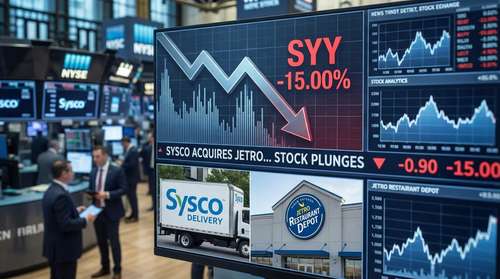
On Monday, March 30, 2026, global food distribution giant Sysco shocked the financial markets with a massive strategic pivot. The newly announced Sysco Jetro acquisition carries a staggering $29.1 billion price tag, marking one of the largest deals in the sector's history. But rather than cheering the expansion, Wall Street reacted with immediate skepticism. The announcement triggered a severe SYY stock price crash, sending shares plummeting by up to 15% as investors digested the massive debt load and sudden halt to share buybacks.
While the deal promises to transform how independent restaurants source their daily ingredients, the market's violent reaction highlights the delicate balance between aggressive growth and shareholder returns. For anyone following food service industry news, this mega-deal represents a seismic shift in how the nation's food supply network operates.
The $29 Billion Jetro Restaurant Depot Merger Details
To understand the market's panic, you have to look at the sheer scale of the Jetro Restaurant Depot merger. Under the terms of the definitive agreement, Sysco is paying top dollar to bring the family-owned cash-and-carry operator under its corporate umbrella. Jetro shareholders will walk away with $21.6 billion in cash and 91.5 million shares of Sysco stock, which will ultimately give them a 16% ownership stake in the combined entity.
Jetro Restaurant Depot is no small fish in the wholesale space. The company generated $16 billion in revenue and $2.1 billion in EBITDA in 2025 across its footprint. By acquiring them, Sysco is paying roughly 14.6 times Jetro's operating income. Sysco CEO Kevin Hourican defended the hefty premium during a Monday morning investor call, calling Jetro a "gem of an asset" that will create a powerful multichannel foodservice distribution platform.
The core financial components of the acquisition include:
- Total Deal Value: $29.1 billion
- Cash Consideration: $21.6 billion, funded primarily through new debt
- Stock Consideration: 91.5 million Sysco shares
- Cost Synergies: An estimated $250 million annually within three years of closing
Why the SYY Stock Price Crash Happened
If the acquisition brings so much revenue, why did the stock crater? The answer lies in how Sysco plans to foot the bill. To finance the heavy cash portion of the deal, the company is taking on $21 billion in new and hybrid debt, utilizing only about $1 billion in cash on hand and equity.
This mountain of new leverage spooked investors and credit agencies alike. Following the announcement, S&P Global Ratings immediately revised Sysco's outlook from stable to negative. The agency warned that the distributor's adjusted leverage will jump to roughly 5.0x at the close of the deal, a sharp increase from its current 3.5x ratio. Adding to the pressure, Sysco announced an immediate pause on its share repurchase program to help manage the new debt burden.
The Cost of Growth in 2026
For years, Sysco shareholders have relied on consistent stock buybacks to drive portfolio value. By suspending the program and issuing 91.5 million new shares to Jetro's owners, existing investors are facing sudden, immediate dilution. The market sold off the financing strategy, ignoring the long-term revenue potential to focus on near-term balance sheet degradation. This reaction perfectly encapsulates the cautious sentiment surrounding large-scale business mergers and acquisitions 2026, where debt-heavy deals are increasingly penalized by a risk-averse Wall Street.
Strategic Push Into Cash-and-Carry Wholesale
Despite the financial backlash, the strategic rationale behind the purchase is robust. Sysco currently dominates the traditional delivery model, loading trucks and dropping off supplies to large hospital networks, hotels, and established restaurant chains. However, they have historically lacked a strong presence in the high-margin "cash-and-carry" sector.
Jetro Restaurant Depot essentially operates as a warehouse club for independent food operators. Operating 166 warehouse locations across 35 states, the company allows customers to walk in, pay upfront for 50-pound sacks of rice and sugar or cases of takeout containers, and transport the goods themselves. This model eliminates the expensive last-mile delivery costs that eat into Sysco's traditional profit margins. By bringing Jetro into the fold, Sysco is capturing a massive slice of the price-conscious, independent restaurant market that it previously struggled to reach efficiently.
This move is the latest aggressive step in ongoing wholesale food market consolidation. Just last year, US Foods abandoned merger talks with Performance Food Group—a tie-up that would have combined the second and third-largest distributors to challenge Sysco's dominance. Now, Sysco has effectively lapped its competitors by buying up the premier asset in the cash-and-carry space.
What This Means for Restaurant Supply Chain Trends
What does this mean for the average local diner or independent chef? The acquisition signals a major shift in restaurant supply chain trends. Sysco has explicitly stated its intention to aggressively expand Jetro's footprint, leveraging its own massive global logistics network to open more than 125 new warehouse locations in unserved communities.
If the integration is successful, independent operators might see more consistent inventory availability and potentially better pricing on bulk goods due to streamlined procurement. However, some industry advocates quietly worry that removing a major independent supplier from the ecosystem could eventually lead to less competitive pricing down the road.
For now, the integration timeline stretches into the third quarter of Sysco's fiscal 2027. Both companies will continue operating normally as the customary regulatory reviews begin. Whether Kevin Hourican's massive bet pays off remains to be seen, but the immediate future will require Sysco to prove to Wall Street that this $29 billion gamble was worth sacrificing its near-term financial flexibility.