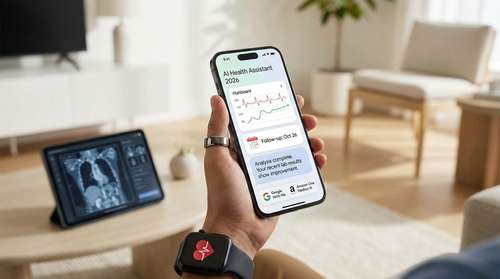
On May 5, 2026, the era of frantically searching medical symptoms online officially ended. A comprehensive new report published today by JMIR Publications confirms that the transition from enterprise-focused medical software to direct-to-consumer care is complete. The rapid rollout of AI health assistants 2026 by global technology titans has fundamentally replaced basic web searches with sophisticated care orchestration platforms. These intelligent agents no longer just answer generic questions; they actively manage patient well-being, securely access medical records, and synthesize real-time biometric data to offer actionable guidance.
Moving Beyond Search to Care Orchestration
For years, the future of healthcare AI seemed restricted to hospital back offices, clinical trials, and provider workflow automation. That paradigm has permanently flipped. Instead of passive information retrieval systems, today's platforms feature autonomous, agentic capabilities designed to streamline the patient experience.
When a user wakes up with a recurring issue, they no longer have to guess whether they need an urgent care visit. Their digital agent can cross-reference personal health history, check past prescriptions, and suggest the appropriate clinical pathway. By directly connecting conversational interfaces with medical records and provider networks, these tools alleviate the confusion and delays that often cause patients to postpone necessary treatment.
Breaking Down Big Tech's Consumer Ecosystems
The race to dominate personalized medicine accelerated dramatically this spring, with major tech platforms carving out distinct approaches to patient interaction.
Amazon One Medical AI
Amazon aggressively scaled its healthcare footprint by deploying Amazon One Medical AI to all U.S. consumers directly through its primary retail website and mobile app. Operating as a fully integrated assistant, the tool accesses state health information exchanges to review diagnoses, manage prescription renewals, and book physical or virtual appointments. For eligible Prime members, the service includes free direct-message consultations for over 30 common conditions, effectively blurring the line between e-commerce software and primary care delivery.
OpenAI ChatGPT Health
Taking a different trajectory, OpenAI ChatGPT Health focuses on creating a secure, isolated workspace for the hundreds of millions of users who already ask the platform medical questions every week. Patients can directly sync their wellness applications and patient portals to the system. This capability allows the chatbot to break down complex medical AI lab results and prepare users for upcoming physician appointments with tailored, evidence-based context. Crucially, OpenAI explicitly sandboxes this sensitive data in an encrypted environment, ensuring it is never utilized to train the company's foundational models.
Google Verily Me App
Alphabet's life sciences division, Verily, recently rolled out the Google Verily Me app to U.S. consumers following its formal showcase at SXSW 2026. Verily distinguishes itself through a rigorous hybrid model. Rather than relying entirely on autonomous algorithmic outputs, the platform provides personalized recommendations that are actively reviewed by licensed clinicians. This positions the application as a comprehensive, accountable care delivery ecosystem rather than a standalone informational chatbot.
The Intersection of Wearables and Longitudinal Tracking
A primary catalyst behind this transformation is the seamless integration of continuous physiological monitoring. Recent wearable health tech trends highlight a sharp departure from simple step counting, moving toward clinical-grade biomarker tracking.
Devices now feed high-fidelity data into specialized models, such as Google's Personal Health LLM (PH-LLM), which is fine-tuned specifically to decode signals like resting heart rate variability and respiratory patterns. When a smartwatch detects an irregular sleep cycle, your agent contextualizes that specific anomaly against your longitudinal medical history. This eliminates the paralyzing guesswork that previously plagued self-monitoring, transforming raw metrics into immediately actionable insights.
Balancing Decentralized Access with Patient Safety
While decentralizing medicine brings undeniable benefits, particularly for rural populations facing severe primary care provider shortages, it also introduces profound new responsibilities. The integration of direct-to-consumer digital agents forces regulators and healthcare professionals to confront complex questions regarding clinical liability and user psychology.
Today's JMIR report warns that while these platforms expand access, they also carry the risk of triggering hypochondria spirals, where AI-driven health anxiety could paradoxically increase the follow-up burden on human physicians. Tech leaders maintain that these systems are engineered to support, not replace, traditional doctor-patient relationships, instituting hard guardrails to refer users to human professionals for actual diagnoses.
The deployment of these consumer platforms marks a watershed moment. By placing sophisticated care orchestration directly in the hands of patients, the technology sector has permanently altered the medical landscape. The doctor is no longer solely a destination; it is an intelligent, highly personalized agent residing quietly in your pocket.