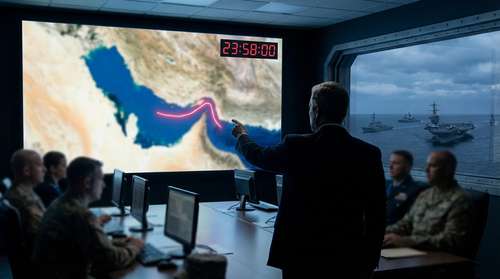
The stakes in the two-month-old US Middle East conflict have reached a boiling point. President Donald Trump has issued a final, unyielding warning to Tehran: reopen the critical Strait of Hormuz by Monday midnight, or endure devastating attacks on civilian and energy infrastructure. The Trump Iran war deadline arrives as the world grapples with a massive global fuel price surge, and closely follows a miraculous U.S. military operation that successfully rescued a downed American airman deep behind enemy lines. With global markets shaken and thousands already dead, the Strait of Hormuz crisis 2026 is teetering on the edge of unprecedented escalation.
The Ultimatum: Midnight Deadline for Strait of Hormuz Crisis 2026
President Trump has drawn a definitive line in the sand. Over the weekend, the president used his Truth Social platform to deliver an expletive-laden warning, declaring that Tuesday will become 'Power Plant Day, and Bridge Day, all wrapped up in one' if Iranian blockades are not lifted immediately. The strategic waterway, which normally handles about 20 percent of the world's oil and natural gas supplies, has been effectively choked off since the joint U.S.-Israeli offensive began on February 28.
Trump's rigid deadline leaves diplomatic channels rapidly closing. Despite ongoing mediation efforts by Pakistan, Turkey, and Egypt to broker a compromise, Washington's core demand remains simple: unblock the vital shipping lane or prepare to lose essential national infrastructure. Legal scholars and international observers have cautioned that targeting civilian bridges and power grids carries immense risk and could cross the line into war crimes if civilian harm outweighs military advantage. Yet, the White House appears resolute in its commitment to crippling Tehran's operational capabilities.
Daring Rescue: U.S. Airman Extracted from Iranian Mountains
Fueling the administration's emboldened posture is the successful extraction of a U.S. weapons systems officer whose F-15E Strike Eagle was shot down on Friday. In what President Trump described as a 'miraculous' nighttime raid, American forces recovered the severely wounded, highly respected colonel from the treacherous mountains of central Iran. The pilot of the two-person aircraft had been rescued earlier in broad daylight.
The CIA Deception Campaign
The rescue mission involved a highly sophisticated Central Intelligence Agency deception campaign. Intelligence operatives reportedly spread false information within Iran, suggesting the airman was already moving toward an exfiltration point. This clever tactical maneuver drew Iranian military patrols away from his actual location in a mountain crevice. While Iran claimed its air defense systems destroyed multiple U.S. transport planes and Black Hawk helicopters during the maneuver, U.S. officials confirmed that American forces intentionally blew up two of their own immobilized transport aircraft to prevent sensitive technology from falling into enemy hands.
The safe return of the crew gives a substantial boost to President Trump military strategy and frees the administration from the looming threat of a high-profile hostage situation that could have complicated further air strikes. A total of 365 American service members have been injured since operations against Iran began, making this successful recovery a crucial morale victory.
Retaliation Threats and President Trump's Military Strategy
Tehran has shown no signs of capitulation as the countdown ticks closer to zero. General Ali Abdollahi Aliabadi of Iran's Khatam al-Anbiya Central Headquarters dismissed the American ultimatum entirely. In a fierce public statement, the general characterized the threat of Iran infrastructure strikes as a 'helpless, nervous, unbalanced and stupid action.' Echoing the religious rhetoric used by the U.S. president, Aliabadi warned that if Washington strikes civilian targets, 'the gates of hell will open for you.'
The threat of reciprocal damage is severely complicating the ongoing war. Iranian leadership has promised that any assault on its power grids or bridges will trigger irreversible retaliatory strikes against essential infrastructure in neighboring Gulf Arab countries and Israeli petrochemical facilities. They have also threatened to expand their blockade to the Bab el-Mandeb Strait, effectively cutting off the Red Sea to global maritime trade.
Global Fuel Price Surge Amid Escalating US Middle East Conflict
The economic tremors of the conflict are already being felt in every corner of the globe. The prolonged closure of the strait has sparked a dramatic global fuel price surge, leaving nations scrambling to secure energy reserves. Over the weekend, multiple oil tankers bound for Australia were canceled, and nations like Sri Lanka were forced to hike domestic fuel prices by a staggering 25 percent in just two weeks.
European leaders are holding emergency sessions to address supply chain resilience, terrified that Tuesday could mark the beginning of a long-term energy drought. Spanish Prime Minister Pedro Sánchez publicly demanded the preservation of all Middle Eastern energy sites, warning that the world cannot afford to pay the consequences of this escalating war. If the Monday night deadline passes without a diplomatic breakthrough, global markets are bracing for a catastrophic economic shock.
The Iran War Political Impact and What Comes Next
As the midnight threshold approaches, the Iran war political impact is reverberating through Washington and allied capitals. While some Republican lawmakers, including Senator Lindsey Graham, have praised the ultimatum as a necessary show of force against an adversarial regime, critics argue that bombing civilian bridges will do little to open shipping lanes and could destabilize the region beyond repair.
For now, the world watches a high-stakes standoff where neither side is willing to blink. The president's prior willingness to temporarily postpone deadlines suggests a sliver of hope for backchannel diplomacy. However, the rapid mobilization of U.S. naval forces and the aggressive defensive posture from Tehran indicate that both militaries are fully prepared for the worst. Whether the Strait of Hormuz reopens peacefully or Tuesday truly becomes the promised 'Power Plant Day', the next 24 hours will irrevocably alter the geopolitical landscape.